Subscribe to
Opera Today

Receive articles and news via RSS feeds or email subscription.


twitter_logo[1].gif


UCP_9780226043425.gif

Recently in Reviews

Domingo Conducts Holdridge’s New Opera Dulce Rosa

Dulce Rosa, a brand new opera, had its world premiere Friday night, May 17, 2013 at the Broad Stage in Santa Monica, California. It was produced by Los Angeles Opera, but staged in the smaller theater.

Verdi’s Falstaff at Glyndebourne

Richard Jones’ 2009 production of Verdi’s Falstaff translates the action from the first Elizabethan age to the start of the second.

Gareth John, Wigmore Hall

Baritone Gareth John is rapidly accumulating a war-chest of honours. Winner of the 2013 Kathleen Ferrier Award, he recently won the Royal Academy of Music Patrons’ Award and was presented the Silver Medal by the Worshipful Company of Musicians.

La bohème at ENO

This second revival of Jonathan Miller’s La bohème was the first time I had caught the production.

Rolando Villazón: Verdi (International Opera Stars Series 2013)

It’s Verdi’s bicentenary year and Rolando Villazón has two new CDs to plug — titled somewhat confusingly, ‘Villazón: Verdi’ and ‘Villazón’s Verdi’, the latter a ‘personal selection’ of favourite numbers performed by stars of the past and present.

Brahms Third in San Francisco

Nicola Luisotti and the San Francisco Opera Orchestra climbed out of the War Memorial pit, braved the wind whipped bay and held spellbound an audience at Cal Performances’ Zellerbach Auditorium at UC Berkeley.

Ariane et Barbe-Bleue on Blu-Ray

Paul Dukas’ Ariane et Barbe-Bleue, first heard in 1907, once seemed important. Arturo Toscanini conducted the Met premiere in 1911 with Farrar and later arranged some of its music for a 1947 recording with his NBC Symphony.

Glyndebourne: Ariadne auf Naxos

Utterly mad but absolutely right — Richard Strauss’s Ariadne auf Naxos started the Glyndebourne 2013 season with an explosion. Strauss could hardly have made his intentions more clear. Ariadne auf Naxos is not “about” Greek myth so much as a satire on art and the way art is made.

Wozzeck at ENO

“Man is an abyss. It makes one dizzy to look into it.” So utters Georg Büchner’s Woyzeck, repeating what was also a recurring motif in the playwright’s own letters.

Mulhouse: Rare Britten Well Done

National Opera Company of the Rhine has marked this year’s Benjamin Britten celebration with a remarkably compelling, often gripping new production of the seldom-seen Owen Wingrave.

Frankfurt's Intriguing Idomeneo

Once upon a time, Frankfurt Opera had the baddest ass reputation in Germany as “the” cutting edge producer of must-see opera.

Rigoletto at Lyric Opera of Chicago

Productions of Giuseppe Verdi’s Rigoletto can serve as a vehicle for individual singers to make a strong impression and become afterward associated with specific roles in the opera.

Britten Sinfonia with Ian Bostridge

Just in case we were not aware that the evening’s programme was ‘themed’, the Britten Sinfonia designed a visual accompaniment to their musical exploration of night, sleep and dreams.

Aida, Manitoba Opera

Poor Aida! She never seems to have anything go her way.

Superlative singing: Don Carlo, Royal Opera House

Is it possible to upstage Jonas Kaufmann? Kaufmann was brilliant in this Verdi Don Carlo at the Royal Opera House, London, but the rest of the cast was so good that he was but first among equals. Don Carlo is a vehicle for stars, but this time the stars were everyone on stage and in the pit. Even the solo arias, glorious as they are, grow organically out of perfect ensemble. This was a performance that brought out the true beauty of Verdi's music.

Sarah Connolly: French Song at Wigmore Hall

The big names were absent: Duparc, D’Indy, Debussy, Ravel … and while Fauré, Chausson, Roussel and several members of Les Six put in an appearance, in less than familiar guises, this survey of French song of the early 20th century and interwar years deliberately took us on a journey through infrequently travelled terrain.

Rare restoration: Handel’s Esther 1720

Composed between 1718 and 1720, Handel’s Esther is sometimes described as the ‘first English Oratorio’, but is in fact a hybrid form, mixing elements of oratorio, masque, pastoral and opera.

The Damnation of Faust, London

Hector Berlioz's légende dramatique, La Damnation de Faust, exists somewhere between cantata and opera. Berlioz's flexible attitude to dramatic form made the piece unworkable on the stages of early 19th century Paris and his music is so vivid that you wonder whether the piece needs staging at all.

Elizabeth Connell Memorial Concert, St John's Smith Square

St. John’s Smith Square was the site of Elizabeth Connell’s final London concert, intended as a farewell to London on her moving to Australia. It was rendered ultimately final by her unexpected death.

Aida with all the Trimmings, Even a Blue Silk Elephant!

With the building of the Suez Canal, Egypt became more interesting to Western Europeans. Khedive Ismail Pasha wanted a hymn by Verdi for the opening of a new opera house in Cairo, but the composer said he did not write occasional pieces.

OPERA TODAY ARCHIVES »

Reviews

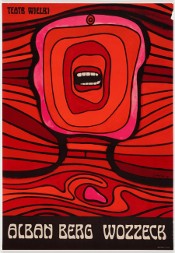
Wozzeck by Jan Lenica, 1928- 2001
11 Oct 2009

Wozzeck in designer khaki : Salonen and Keenlyside in London

In the opera house, stagings can impress by gorgeous sets and costumes. But in semi-staged performances, there's no where to hide behind. Semi-staging tests whether a director understands the music and what its dramatic soul might be. In dramaturgy, less is more.

Alban Berg : Wozzeck

Wozzeck: Simon Keenlyside, Marie : Katarina Dalayman, The Captain : Peter Hoare, Andres : Robert Murray, The Doctor : Hans-Peter Scheidegger, Drum Major: Hubert Francis, Margret : Anna Burford, Apprentices : David Soar and Leigh Melrose, Idiot: Ben Johnson, Soldier: Peter Wilman, Marie's child : Louis Watkins,Philharmnia Voices, Aidan Oliver, chorusmaster, Philharmonia Orchestra, Esa-Pekka Salonen, conductor. Jean-Baptiste Barrière, director. Royal Festival Hall, South Bank, London, 8th October 2009.


Alban Berg’s music is so visual that Wozzeck could lend itself extremely well to semi-staging, so this performance, at the Royal Festival Hall on London’s South Bank might have been a chance to see something truly innovative. Most of the action in this opera happens in the minds of the protagonists. So much is said in musical imagery that a concert performance can be inherently dramatic even without props. Berg builds patterns and mazes into his music, and the solo parts in the orchestra act as roles within a symphony of sound.

Unfortunately this performance turned out to be a lost opportunity. It was the final concert in an ambitious series titled “Vienna: City of Dreams 1900-1930”. Ostensibly, the concerts were part of a wider panorama presenting the music in the context of Vienna at a time of unprecedented developments, in music, literature, philosophy,art and psychology. Perhaps the message had to be blunted because the music of the Second Viennese School doesn’t promise box office success. So perhaps it was too much to expect a production that referenced the innovations in theater design that were part of Vienna’s significance. Musically, though, performances have been extremely strong. Esa-Pekka Salonen has proved his worth as head of the Philharmonia. He and this orchestra, arguably London’s finest, are an excellent match. Their performance of Schoenberg’s Gurrelieder in February was exceptionally good and fortunately was recorded. The CD is now available.

Wozzeck demands great orchestral forces, so visual impact is already built into a semi-staged performance. A sensitive production could even have made capital of the situation, focusing on what happens in the orchestra,. Even the fact that there’s barely a yard between music and and singers is no disadvantage: Wozzeck is about tight corners and entrapment.

In this performance, there was a huge screen behind the orchestra on which were projected many visual images - oil on water transparencies, montages, close-ups of the singers. This could have worked very well in theory, because Berg was interested in cinema, and his music lends itself to expression in film. In practice however, what happened on screen was busy rather than focused, distracting from rather than reinforcing the inherent drama in the music.

In opera, singers are singing “about” something. Context matters. Just as orchestral musicians need a conductor, singers need direction. Katarina Dalayman has sung Marie so often that we know what she’s capable of when truly inspired. Here she sang well, but wasn’t challenged to show her acting skills, which are usually considerable.

This was Simon Keenlyside’s debut as Wozzeck, eagerly awaited by his many admirers. Although he’s a light rather than dark baritone, at the higher registers he can catch the tension in the part, which subtly connects to the shrill tenor parts around him, and contrasts well with the bass Doctor, sung by Hans-Peter Scheidegger. Keenlyside’s forte, though, is his naturally elegant bearing. He looks aristocratic, whatever he does, even his stubble looked expensively manicured. This was a Wozzeck in designer khaki. This could well have worked, because the opera isn’t about outward appearances. With suitable direction, Keenlyside could have created character wearing a tuxedo. Wozzeck’s world is surreal, after all. Perhaps Keenlyside’s talents will be put to better use in future, more complete productions.

With semi-staging, detail counts even more than in full production. So why did Marie’s child appear in the final scene dressed in beautifully pressed, emerald green silk pajamas? We don’t know what the child’s future might be, but the indications aren’t hopeful. “Ringel, ringel Rosenkranz” sing the taunting children, and the words “Hopp, Hopp” indicate a repetitive child’s game . Berg’s fascination with circular forms and patterns would also imply the child might well end up like Wozzeck. If emerald green silk means anything, it should have been supported by other images and from the music. I also didn’t understand why the children walk on dressed in funereal black, like a cortege, Marie’s son following behind. It isn’t necessarily wrong but without substantiation it doesn’t add to the drama or to the meaning of the opera.

This is the dilemma of all stage direction faces. Visual images are open to all kinds of interpretation. They operate on many levels at the same time, and can be seen in different ways. That’s why stage direction is controversial, there’s never only one way of seeing things. Visual literacy is a skill, too, but perhaps we’ve been conditioned to TV and movies for so long, it’s a lost art. That’s why semi-staged performances are important because they concentrate the mind on the essentials of dramatic meaning. This production, directed by Jean-Baptiste Barrière seemed like grand opera manqué rather than focused concentration on the fundamentals in the drama. But getting the basics right is the key to all good direction.

Anne Ozorio
Send to a friend

Send a link to this article to a friend with an optional message.

Friend's Email Address: (required)

Your Email Address: (required)

Message (optional):