Subscribe to
Opera Today

Receive articles and news via RSS feeds or email subscription.


Recently in Reviews

MENDELSSOHN: Athalia

In addition, to his popular score to A Midsummer Night’s Dream Felix Mendelssohn wrote incidental music to several other plays. Commissioned by the Prussian King Friedrich Wilhelm IV, the incidental music to Athalia was intended for a private performance of the play by Jean Racine. While the story is a complicated Old Testament plot, Mendelssohn’s music captures the tone of the tragedy with delight, whimsy, and severity.

MORRIS: Reading Opera Between the Lines: Orchestral Interludes and Cultural Meaning from Wagner to Berg

Interludes in opera articulate moments when the lush voices of singers and vivid spectacle of scenery and action are removed and often the curtain is drawn, and thus they span a functional gap between textless instrumental music and explicit theatrical vehicle. Although composers and analysts suggest rich and multivalent meanings for the music, those implications often escape decoding by audiences. Even the interlude titles — Zwischenspiel, entr'acte, intermezzo — suggest their intermission-like nature. As functional placeholders for scene changes and the like, the interludes are for many a cue to relax attentive listening, read synopses, and whisper with companions. Undaunted by such complexities, Morris takes up the problematic nature of operatic interludes, engaging their ambiguities with eyes wide open in an effort to enrich our understanding of these challenging bits of music.

GOEHRING: Three modes of perception in Mozart — the philosophical, pastoral, and comic in Così fan tutte

According to the book jacket, this is the first major scholarly study of Così fan tutte, considered to be one of Mozart's least-understood operas and librettist Lorenzo Da Ponte's most interesting text. Così fan tutte has been studied extensively, despite the broad assertion stated in the book. What the author of this study brings to the reader, which others have not, is a detailed examination of the philosophical, pastoral, and comic background of the libretto, characters, and music of the opera. New perspectives on text and tone in the opera, the subtle use of the pastoral mode, and the tension and balance between philosophy and comedy are what the author brings to the study of this work. In addition, the author does an intensely close reading of the primary sources of the opera, in order to support his theories and statements.

TRIBO: Annals 1847-1897 del Gran Teatre del Liceu

The importance of the Teatre del Liceu, can not be overstated. The house ranks with all the leading theatres of the world, being right up there with Paris, London, New York, Vienna, Madrid, Rome, Milan, Lisbon, St. Petersburg, Moscow, Turin, Naples, Buenos Aires, and other cities of comparable importance. During its long history (158 years at the time of writing) it featured many of the great singers. These include Caruso, Battistini, Tamagno, Ruffo, Caballe, Tebaldi, Mario, Pavarotti, Vignas, Lazaro, O'Sullivan, Stracciari, Pagliughi, Gayarre, Masini, Stagno, Lauri-Volpi, Bellincioni, and countless others. Quite a few of these who sang there before 1897 are represented on the accompanying disc.

MAY: Decoding Wagner — An Invitation to His World of Music Drama

Thomas May's stated goal in Decoding Wagner is indeed summarized in his subtitle, An Invitation to His Music Dramas. Mr. May offers an introduction to those who may seek a reliable yet succinct guide in their first Wagnerian experience; a further potential readership is seen among those who have attended performances of Wagner but who wish to expand their appreciation of the music dramas. In his chronological overview of Wagner's oeuvre from the mid-1830s until the close of his career May presents an approachable guide to appreciating the composer's operatic genius. As an illustration of May's commentary on the works, a generous selection of Wagner's music is included on two Discs that accompany the volume in a protective sleeve.

The Cambridge Companion to the Lied

Books described as a "Companion" to this or that and published by university presses should be required to come with a Reader Beware label. As is the case with many books put out by university and many for-profit publishers, the main reason for publishing these is to advance the tenure and promotion prospects of the authors. This is not a bad thing, except that all too often the books aren't very good.

DUNSBY: Making Words Sing: Nineteenth- and Twentieth-Century Song

In Making Words Sing, Jonathan Dunsby investigates what he calls the "vocality" of song, that is, the "quality of having voice," as the author states in the introduction to his study. By using this perspective, Dunsby focuses on the intensification of the text that occurs when words are set to music, which stands in opposition to the kind of "songfulness" that Lawrence Kramer discussed in Musical Meaning: Toward a Critical History (Berkeley, CA: University of California Press, 2002).

RANDALL & DAVIS: Puccini & the Girl

"Puccini & the Girl" is a rare and engrossing work of scholarship that can be enjoyed on several levels. For the Puccini-lover, to say nothing of one who has a special interest in La Fanciulla del West, it will provide a wealth of information not previously available, particularly all in one place. Any one interested in the creative process will find it exposed and examined clearly. The scholar will recognize the fascinating chance discovery, the thrill of the chase and the deep rewards of work undertaken lovingly and with rigorous care by the dedicated and passionate co-authors.

HANSEN: The Sibyl Sanderson Story — Requiem for a Diva

Jack Winsor Hansen's 520-page biography of Sibyl Sanderson (1865 - 1903) is packed with romanticism and gossip that will delight and titillate true worshipers of operatic divas and inquisitive opera fans. It also fills a gap in the music-historical writings about opera at the end of the 19th century.

The Cambridge Companion to John Cage

Cage's music is like Einstein's theorem: most people know it exists, know it's important, but beyond these facts know nothing about it (count me in this category when it comes to Einstein).

WEAVER & PUCCINI: The Puccini Companion

If any opera lover feels daunted by the many biographies and analytical tomes dedicated to the life and art of Giacomo Puccini, Norton has done that reader a tremendous favor with the publication of The Puccini Companion. Tightly organized, this series of essays details the life, discusses the operas, and provides a wealth of supplementary information about the composer.

STRAUSS: Der Ziguenerbaron

When Rudolf Bing came to the Metropolitan Opera in 1950, he scored a tremendous hit with a new staging of the perennial operetta favorite Die Fledermaus. Both at the opera house on 39th Street and on national tour, the slickly Broadwayized Fledermaus packed in big audiences season after season. A decade later, Bing assembled a fine cast and proven production team for the company's first performances of Strauss's Der Zigeunerbaron in fifty years. 18 performances were scheduled. It sank like a stone and has never appeared at the MET again.

EVERETT: The Musical — A Research and Information Guide

Much current popular culture assumes that its audience is knowledgeable of the American musical. References to, and parodies of, specific musicals are frequently a part of episodes of The Simpsons and South Park, and ads for companies as diverse as The Gap and the World Wrestling Entertainment promotion recently have restaged numbers from West Side Story to plug their products or events. Rarely, if ever, are the sources acknowledged; it is simply taken for granted that a general audience will understand the quotations and parodies.

TOMMASINI: The New York Times Essential Library: Opera — A Critic’s Guide to the 100 Most Important Works and the Best Recordings

"I particularly want to reach newcomers" writes Anthony Tommasini, Times chief classical music critic, in his preface. I do not think they will be helped very much by this book. A rookie who picks it up and reads the subtitle may expect something more than two operas by Bellini, two by Donizetti, one Gounod (not Faust), one Massenet (not Manon) and no Lohengrin.

KRAMER: Opera and Modern Culture — Wagner and Strauss

"New musicology" is the cultural study, analysis and criticism of music, which proffers the belief that music has societal, religious, political, personal, and sexual agendas. Consequently, new musicology, much like the discussion of such topics at social gatherings, can be polarizing.

VIVALDI: Orlando Furioso

The box-sets contaning the complete recordings of the music of J.S. Bach and W.A. Mozart occupy substantial shelf space in the collections of those fortunate enough to possess them.

SMART: Mimomania: Music and Gesture in Nineteenth-Century Opera

Here's a serious niche book, a relatively slender volume dealing with a topic at once both arcane and surprisingly central to some of the major controversies in opera production today. I think it has major problems but it has become for me the pebble dropped into the pond that sends ripples to unexpected places, raising interesting questions in the process.

The Cambridge Companion to Grand Opera

Among the recent publications on opera, The Cambridge Companion to Grand Opera, edited by David Charlton, breaks new ground with its systematic and thorough exploration of grand opera, a specific part of the genre which played an important role in the musical culture of the nineteenth century.

LOEWENBERG: Annals of Opera, 1597-1940

This volume has long been regarded as the definitive work on the subject, and has been quoted in countless later works whenever a reference was required to the performance histories of individual operas. Taken as a whole, especially when one considers the state of library science when the book was first written, it is a magnificent piece of work, and belongs on the bookshelf of every researcher in the operatic field.

GOUNOD: Faust

During his heyday, Alain Vanzo did not get quite the recognition he deserved. Though the voice was sweeter and more beautiful than the somewhat white sound of Nicolai Gedda, it was the latter who got all the plums; primo because he was a discovery of Legge and a few years earlier on the scene and secundo while opera managers could cast him in other languages than French and Italian.

OPERA TODAY ARCHIVES »

Reviews

Paula Sides as Emilia in <em>Flavio</em> [Photo by Richard Hubert Smith courtesy of the English Touring Opera]
03 Nov 2009

Flavio and Alcina by ETO

In celebration of their 25th birthday and the 250th anniversary of the death of Handel, English Touring Opera has devised Handelfest, an extravaganza of five operas (Flavio, Teseo, Tolomeo, Alcina and Ariodante) and a wide variety of masterclasses and workshops taking in several of the company’s usual touring venues.

G. F. Handel: Flavio; Alcina

Click here for cast information

Above: Paula Sides as Emilia in Flavio

Photos by Richard Hubert Smith courtesy of the English Touring Opera


Before setting off from London, however, ETO has chosen the Royal College of Music’s Britten Theatre — which, as the operatic home of the London Handel Festival, is the capital’s premier venue for Handel opera — to launch this ambitious project.

With four of the productions being revivals of recent stagings performed in the course of ETO’s ordinary tours, the Handelfest’s one original staging is Flavio, a piece which has never quite managed to find a foothold in the repertoire perhaps on account of its opera semiseria status which makes it something of a curiosity in Handel’s canon. The combination of serious drama and broad comedy, which is how it is often played here, doesn’t always sit easily; when our heroine’s lover, Guido, kills his prospective father-in-law, Lotario, in a duel, it’s difficult not to remember that the challenge came about as a result of his own father’s preposterous overreaction to a slap in the face.

Flavio himself is actually a relatively small role, though the machinations of the plot are precipitated by the eponymous monarch’s desire to overcome such minor annoyances as fathers and existing lovers and have his wicked way with a certain young lady of the court. Sung by Clint van der Linde in a flexible and penetrating countertenor, this was one of two characters in the opera which were given a light or comic aspect throughout. The pomp and circumstance surrounding Flavio’s position here manifest themselves in a series of self-consciously theatrical gestures, beginning with the red carpet that unfurls itself behind him as a train when he makes his first appearance, while his personal demeanour is debonair and more than slightly camp.

This and the comic bluster of tenor Joseph Cornwell’s Ugone (he of the aforementioned slapped face) were in vivid contrast to what is at heart a dead straight production. In costumes of Handel’s own period against a very simple midnight-blue set, the serious centre of the piece is represented by soprano Paula Sides as Emilia. A little acidity in the top notes notwithstanding, her soprano is characterful with a slightly covered and smoky timbre and she has real stage presence. As Guido, James Laing’s countertenor is not a robust or powerful sound, but it is clear and even and his delivery of the words eloquent, particularly in his confrontation with Lotario — the pivotal scene in which the opera’s serious and frivolous sides collide. Vocally, he finally allowed himself to shine in his slow aria (‘Amor, nel mio penar’) — and here the visual picture was at its most stark, with Guido alone and spotlit against the dark blue background, in contrast to the assortment of props and stage clutter that tended to accompany the more comic characters.

The dramatic middle ground is provided by the secondary lovers, Vitige and Teodata. A plum role for a juvenile female alto (even playing a member of her own sex — so rare in Handel!) it is Teodata who Flavio decides to win at all costs. Carolyn Dobbin captures her uncomplicated sexiness beautifully, with a relaxed and attractive presence and excellent diction. As the jealous Vitige, the Norwegian mezzo Angelica Voje had a voice which readily evoked that of a hot-blooded youth — light and flexible but still mettlesome.

The baritone Andrew Slater, though a little short of depth in his lower register, presented a credible account of the unfortunate Lotario — passed over for promotion in favour of Ugone, and slain by Guido.

Throughout the Handelfest several of the artists are performing and covering multiple roles, and the conductor of Flavio goes one step further — he is the countertenor Jonathan Peter Kenny, who is appearing as Polinesso in Ariodante. His conducting was sensitive to the singers, never overwhelming the lighter voices, and providing a base upon which the fuller lyric voices could bloom.

Two days later came a revival of Conway’s 2005 staging of Alcina. As in its original run, this production alters the shape of the work quite considerably due to the practical necessity of fitting it into a three-hour slot; there is no chorus (the soloists form an ensemble where musically necessary) and the treble/soprano role of Oberto is dispensed with altogether, an omission which is arguably authentic on the grounds that it was a late addition to the opera. Even so, that’s one high voice lost to the opera’s colour palette, and another is sidelined — Morgana’s opening aria is also consigned to the cutting-room floor, and delaying the only interval until the middle of Act 2 takes the emphasis away from her usually show-stopping Act 1 finale, ‘Tornami a vagheggiar’. The cumulative effect is a leaching of lightness from the piece.
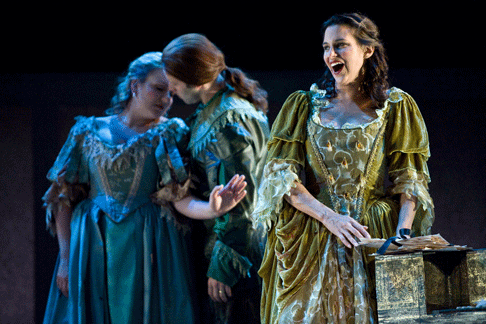
Celeste Lazarenko, Nathan Vale and Natasha Jouhl from Alcina

It is possible that this was conceived deliberately in conjunction with the stage concept. Alcina dwells in a mouldering classical palace, its textiles threadbare, its chandelier crumpled on the floor and its splendid-looking harpsichord flooded with a pool of water. It is a stifling world. And Celeste Lazarenko’s Morgana was subtler than the usual sparkling soubrette: shy and nicely vulnerable, and she has plenty of warmth at the core of her elegantly poised light-lyric soprano.

That is not to say that the performance was short on lustre. Soprano Natasha Jouhl’s account of the title role was exotic, glamorous and fulsomely sung (and not in any way fazed by the shadow of the exceptional Amanda Echalaz, who sang it in the 2005 run). The other lustrous performance, albeit in a more conservative capacity, came from the Bradamante of Carolyn Dobbin, the one cast member common to both Alcina and Flavio, this time in a much more familiar Handelian archetype: the wronged woman in male disguise chasing her faithless beloved. This piece of cross-dressing, one of those things one is generally supposed to have read the synopsis in order to work out, is neatly explained by a staged scene during the overture.

Wendy Dawn Thompson cut a dashing figure as a hot-blooded and easily-distracted young man, but vocally was a frustrating Ruggiero, her pale tone failing to match the weight of the other voices and (especially) failing to engage with the virile masculinity of the orchestral and vocal writing in ‘sta nell'Ircana’ (‘Trapped by a hunter’). It was always a lightish voice, but at the moment seems hollow and dry, as if it’s going through a transition. I wonder if she might be looking at experimenting with some soprano repertoire?

Under conductor Robert Howarth, the orchestral palette was vivid and the playing brisk (the tempo of Oronte’s first aria especially so, tautly delivered by Nathan Vale) if not always refined.

The tour, with its versatile ensemble shared variously between the five operas, continues to Malvern, Exeter, Bath, Snape and Cambridge.

Ruth Elleson © 2009

Send to a friend

Send a link to this article to a friend with an optional message.

Friend's Email Address: (required)

Your Email Address: (required)

Message (optional):