![Salvatore Licitra (Ernani) and Sondra Radvanovsky (Elvira) [Photo by Dan Rest courtesy of Lyric Opera of Chicago]](http://www.operatoday.com/Ernani_Chicago_02.png)
18 Dec 2009
Ernani: The Case for Early Verdi at Lyric Opera of Chicago
Productions of Giuseppe Verdi’s early opera Ernani have become relatively infrequent primarily because of the difficulties of casting the work requiring four demanding roles.
English Touring Opera are delighted to announce a season of lyric monodramas to tour nationally from October to December. The season features music for solo singer and piano by Argento, Britten, Tippett and Shostakovich with a bold and inventive approach to making opera during social distancing.
This tenth of ten Live from London concerts was in fact a recorded live performance from California. It was no less enjoyable for that, and it was also uplifting to learn that this wasn’t in fact the ‘last’ LfL event that we will be able to enjoy, courtesy of VOCES8 and their fellow vocal ensembles (more below …).
Ever since Wigmore Hall announced their superb series of autumn concerts, all streamed live and available free of charge, I’d been looking forward to this song recital by Ian Bostridge and Imogen Cooper.
The Sixteen continues its exploration of Henry Purcell’s Welcome Songs for Charles II. As with Robert King’s pioneering Purcell series begun over thirty years ago for Hyperion, Harry Christophers is recording two Welcome Songs per disc.
Although Stile Antico’s programme article for their Live from London recital introduced their selection from the many treasures of the English Renaissance in the context of the theological debates and upheavals of the Tudor and Elizabethan years, their performance was more evocative of private chamber music than of public liturgy.
In February this year, Albanian soprano Ermonela Jaho made a highly lauded debut recital at Wigmore Hall - a concert which both celebrated Opera Rara’s 50th anniversary and honoured the career of the Italian soprano Rosina Storchio (1872-1945), the star of verismo who created the title roles in Leoncavallo’s La bohème and Zazà, Mascagni’s Lodoletta and Puccini’s Madama Butterfly.
Evidently, face masks don’t stifle appreciative “Bravo!”s. And, reducing audience numbers doesn’t lower the volume of such acclamations. For, the audience at Wigmore Hall gave soprano Elizabeth Llewellyn and pianist Simon Lepper a greatly deserved warm reception and hearty response following this lunchtime recital of late-Romantic song.
Collapsology. Or, perhaps we should use the French word ‘Collapsologie’ because this is a transdisciplinary idea pretty much advocated by a series of French theorists - and apparently, mostly French theorists. It in essence focuses on the imminent collapse of modern society and all its layers - a series of escalating crises on a global scale: environmental, economic, geopolitical, governmental; the list is extensive.
For this week’s Live from London vocal recital we moved from the home of VOCES8, St Anne and St Agnes in the City of London, to Kings Place, where The Sixteen - who have been associate artists at the venue for some time - presented a programme of music and words bound together by the theme of ‘reflection’.
'Such is your divine Disposation that both you excellently understand, and royally entertaine the Exercise of Musicke.’
Amongst an avalanche of new Mahler recordings appearing at the moment (Das Lied von der Erde seems to be the most favoured, with three) this 1991 Mahler Second from the 2nd Kassel MahlerFest is one of the more interesting releases.
‘And there was war in heaven: Michael and his angels fought against the dragon; and the dragon fought and his angels, And prevailed not; neither was their place found any more in heaven … that old serpent … Satan, which deceiveth the whole world: he was cast out into the earth, and his angels were cast out with him.’
If there is one myth, it seems believed by some people today, that probably needs shattering it is that post-war recordings or performances of Wagner operas were always of exceptional quality. This 1949 Hamburg Tristan und Isolde is one of those recordings - though quite who is to blame for its many problems takes quite some unearthing.
There was never any doubt that the fifth of the twelve Met Stars Live in Concert broadcasts was going to be a palpably intense and vivid event, as well as a musically stunning and theatrically enervating experience.
‘Love’ was the theme for this Live from London performance by Apollo5. Given the complexity and diversity of that human emotion, and Apollo5’s reputation for versatility and diverse repertoire, ranging from Renaissance choral music to jazz, from contemporary classical works to popular song, it was no surprise that their programme spanned 500 years and several musical styles.
The Academy of St Martin in the Fields have titled their autumn series of eight concerts - which are taking place at 5pm and 7.30pm on two Saturdays each month at their home venue in Trafalgar Square, and being filmed for streaming the following Thursday - ‘re:connect’.
The London Symphony Orchestra opened their Autumn 2020 season with a homage to Oliver Knussen, who died at the age of 66 in July 2018. The programme traced a national musical lineage through the twentieth century, from Britten to Knussen, on to Mark-Anthony Turnage, and entwining the LSO and Rattle too.
With the Live from London digital vocal festival entering the second half of the series, the festival’s host, VOCES8, returned to their home at St Annes and St Agnes in the City of London to present a sequence of ‘Choral Dances’ - vocal music inspired by dance, embracing diverse genres from the Renaissance madrigal to swing jazz.
Just a few unison string wriggles from the opening of Mozart’s overture to Le nozze di Figaro are enough to make any opera-lover perch on the edge of their seat, in excited anticipation of the drama in music to come, so there could be no other curtain-raiser for this Gala Concert at the Royal Opera House, the latest instalment from ‘their House’ to ‘our houses’.
"Before the ending of the day, creator of all things, we pray that, with your accustomed mercy, you may watch over us."
Productions of Giuseppe Verdi’s early opera Ernani have become relatively infrequent primarily because of the difficulties of casting the work requiring four demanding roles.
In its third production of the current season Lyric Opera of Chicago has not only brought together an outstanding roster of soloists to fill the parts, but the company has also mounted in this new production a splendid scenic backdrop and sets reminiscent of sixteenth-century Spain. Renato Palumbo conducted the Lyric Opera Orchestra with an assured sensitivity for this musical cornucopia of bel canto as well as weighty dramatic scenes and ensembles. In the title role Salvatore Licitra displayed both elegant legato and convincing heft in his emotionally driven arias and participatory scenes. His beloved Elvira, sung in this production by Sondra Radvanovsky, remains one of those challenging Verdian female roles, which draw on all reaches of the soprano voice. Ms. Radvanovsky’s command of the role is admirable for her secure approach in a wide range of carefully executed techniques and colors, and also for her sensitivity to communicating through vocal gesture what the character of Elvira senses at given moments. The remaining lead figures, both in pursuit of Elvira, are sung by baritone Boaz Daniel and bass Giacomo Prestia. Mr. Daniel portrays Carlo, King of Spain, who is later during the third act of the opera elected to the status of Holy Roman Emperor, hence giving a historic anchor to the piece. Mr. Prestia sings the role of Elvira’s uncle, Don Ruy Gomez de Silva, a character representing the honor of the old nobility. Silva plans to marry his niece Elvira shortly after the action commences.
In the first scene of Act I, located in the mountains outside the region of Aragon, the followers of Ernani sing of the importance of wine and freedom in this life. From the very start the Lyric Opera Chorus, directed by Donald Nally, demonstrated a crisp urgency in its support of the action and the title character’s imminent plans. In his aria “Come rugiada al cespite” [“As falling dew upon the flower”] Enrnai details the expected fate of Elvira and his own lamentable future without her presence. Ernani plans with the support of his men to abduct his beloved before Silva can marry her. Licitra showed here notably in his first extended solo piece a careful balance of forte notes used to express passion traced with a legato decorated gracefully to carry the import of his plan. In his cabaletta “O tu que l’alma adora” [“O, you whom my soul adores”] one sensed in Licitra’s performance the conviction that Ernani’s love for Elvira would support at least the intentions of the couple. As a mirror to this first scene the opening of the second depicts Elvira surrounded by a female chorus, here separated from Ernani and awaiting her fate in Silva’s palace. The well-known cavatina “Ernani involami” [“Ernani, take me away”] followed by the cabaletta “Tutto sprezzo” [“ All these I detest”] were together performed by Ms. Radvanovsky with an elegant and committed line as well as a matchless instinct for bel canto technique. Her vocal decorations on “Vola, o tempo” [“Fly, o time”] in this aria were especially telling as they recalled the earlier melismas and textual significance of the piece “Involami.” The extended final note in this cabaletta illustrates the directorial emphasis for combining music and staging in this production. As Radvanovsky holds this last pitch with defiant beauty, she strides past the assembled attendants showing disdain for her surroundings and leaving the chamber with the lyrical wish to be transported even further away.
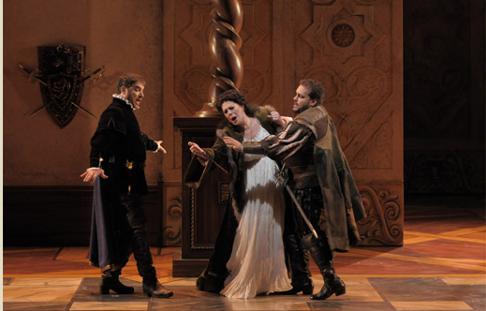 Boaz Daniel (Carlo), Sondra Radvanovsky (Elvira) and Salvatore Licitra (Ernani)
In the next scene of Act I Carlo enters and desires to speak with Elvira in order to press his suit further to win her affections. In the role of King Carlo, Boaz Daniel has found an ideal vehicle for his lyrical baritone voice, at times showing dramatic force commensurate with the dignity of position and at other moments a melodic line suggesting the sincerest devotion of love or duty. In his recitative before the duet with Elvira, Carlo laments his unrequited emotions while clinging to the possibility that she will still relent. Mr. Daniel’s declamation of rising notes on the word “ancora” [“yet”] defined a hope that would propel his actions through the remainder of this and the following act. His ensuing duet with Ms. Radvanovsky showcased both performers in a magnificently sung variety of emotions ranging from the noblewoman’s pride to the demands of the yearning king as melodic suitor. The sudden appearance of Ernani, prepared to abduct his beloved, sets off a trio together with Carlo and Elvira, only to be broken by the equally sudden entrance of Silva. Verdi’s symmetrical structure of aria or set piece followed by ensemble and further complication was staged with appropriately tasteful sets showing the influence of Renaissance art work. This symmetry was then complemented by the final principal, Giacomo Prestia, in the bass role of Silva. He is outraged by the violation of his family’s honor when Ernani and Carlo are found in the company of Elvira. In his moving aria and cabaletta, beginning with the words “Infelice, e tuo credevi” [“O unhappy, and you whom I believed”] Prestia combined the heroic gesture of noble dignity with the menacing tone of securely projected basso notes, both leaving a mark of individuality on the character. Once Carlo’s identity is recognized Silva cannot deny his hospitality. Ernani is provided a means of escape as the act ends.
The start of the second act truly demonstrates the coup of staging at memorable points in this production. Elvira stands with her back to the audience as the curtain rises. The chandeliers begin to brighten as guest now arrive for Elvira’s wedding to Silva. Interiors of the hall as well as the costumes evoke the grandeur of sixteenth-century Spain. When Radvanovsky turns to face the audience, she holds the dagger and communicates through anguished facial expression her plan to stab herself at the altar during the ceremony of marriage. Ernani’s entrance, in the guise of a pilgrim, complicates the wedding, just as do Carlo’s subsequent arrival and demands for justice later in the same act. When Ernani learns of the ceremony, he reveals his identity and offers his life. Only Elvira’s protestations of her planned suicide calm Ernani to the point of a love duet. Here the lyrical yearning so vividly expressed by Licitra and Radvanovsky is interrupted, as before, first when Silva discovers the couple and second when King Carlo arrives at Silva’s palace. Sine Ernani is hidden under the protection of Silva, Carlo demands that the young man be surrendered or the old noble will forfeit his life. The entrance of Elvira provides Carlo with a means of force. As he now abducts the heroine, one of the vocal highlights of this act is Daniel’s performance of the aria “Vien meco sol, di rose” [“Come with me, I shall strew your path with roses”]. Daniel projects the variable nature of the king: after his test of wills and power expressed against Silva, the ravishing sweetness communicated by Daniel in Carlo’s song to Elvira as he leads her away remains a convincing display of his love. After settling their differences, Ernani and Silva now both join in a conspiracy against the King in the hopes of also rescuing Elvira. Ernani offers to forfeit his life at the sound of a horn, the choice and time being left to the discretion of Silva.
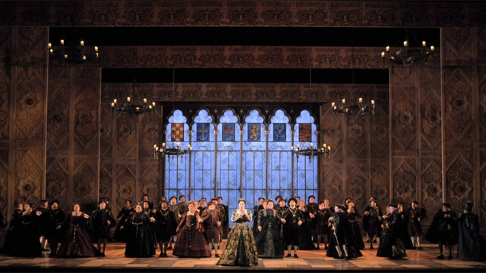 Scene from Ernani
Act III and IV of Ernani illustrate the rising power of the King and his beneficent forgiveness and generosity. At the same time, the offer made by Ernani to Silva is ironically called due; the happiness that the hero seems about to enjoy with Elvira is shattered by his commitment to fulfill his word of honor. In Act III at the tomb of Charlemagne in Aix, Carlo remains hidden to await both the conspirators and the result of the election. When cannon shots announce that he has indeed been chosen as Holy Roman Emperor Carlo steps forward to confront his detractors. In the spirit of Charlemagne, Carlo announces forgiveness for the conspirators and relinquishes Elvira to Ernani in marriage. In the great ensemble ending the act, “O sommo Carlo” [“I too am Carlo”] the baritone — here standing on the tomb of his predecessor — leads the remaining soloists and chorus in an impressive lyrical display suggesting a positive turn to the future for all involved. As Carlo, Daniel began the ensemble with a carefully intoned introduction, his voice rising to noble heights of melodic strength as he led the others to think of the example of the past. Only Silva still vents his rage and need for vengeance at the close of the scene. The tragedy of this vengeance interrupts the renewed period of felicity, with which the brief final act opens. As Ernani and Elvira celebrate their wedding, the calls of the horn remind Ernani of the vow that he has sworn. Silva’s arrival leaves him no choice but to take his own life with honor, a decision through which the protagonists must confront the deeds, oaths, and responsibilities of their past. The principal singers, chorus, and orchestra in Lyric Opera of Chicago’s Ernani have created a production that argues strongly for such continued, fine revivals of Verdi’s 1844 masterpiece.
Salvatore Calomino