![Ashley Holland (Uin-Scî; standing) und Peter Sidhom (Cim-Fen; sitting), in background Marcus Hosch (Moderator) as well as Chor, Kinderchor and Statisterie der Oper Frankfurt [Photo by Wolfgang Runkel courtesy of Oper Frankfurt]](http://www.operatoday.com/oracolo_HQ_07.png)
18 Dec 2009
Frankfurt’s ‘Medium’ Rarities
Encountering Frankfurt Opera’s staging of Leoni’s L’Oracolo and Puccini’s Le Villi, I was reminded of that old saw about the German weather.
English Touring Opera are delighted to announce a season of lyric monodramas to tour nationally from October to December. The season features music for solo singer and piano by Argento, Britten, Tippett and Shostakovich with a bold and inventive approach to making opera during social distancing.
This tenth of ten Live from London concerts was in fact a recorded live performance from California. It was no less enjoyable for that, and it was also uplifting to learn that this wasn’t in fact the ‘last’ LfL event that we will be able to enjoy, courtesy of VOCES8 and their fellow vocal ensembles (more below …).
Ever since Wigmore Hall announced their superb series of autumn concerts, all streamed live and available free of charge, I’d been looking forward to this song recital by Ian Bostridge and Imogen Cooper.
The Sixteen continues its exploration of Henry Purcell’s Welcome Songs for Charles II. As with Robert King’s pioneering Purcell series begun over thirty years ago for Hyperion, Harry Christophers is recording two Welcome Songs per disc.
Although Stile Antico’s programme article for their Live from London recital introduced their selection from the many treasures of the English Renaissance in the context of the theological debates and upheavals of the Tudor and Elizabethan years, their performance was more evocative of private chamber music than of public liturgy.
In February this year, Albanian soprano Ermonela Jaho made a highly lauded debut recital at Wigmore Hall - a concert which both celebrated Opera Rara’s 50th anniversary and honoured the career of the Italian soprano Rosina Storchio (1872-1945), the star of verismo who created the title roles in Leoncavallo’s La bohème and Zazà, Mascagni’s Lodoletta and Puccini’s Madama Butterfly.
Evidently, face masks don’t stifle appreciative “Bravo!”s. And, reducing audience numbers doesn’t lower the volume of such acclamations. For, the audience at Wigmore Hall gave soprano Elizabeth Llewellyn and pianist Simon Lepper a greatly deserved warm reception and hearty response following this lunchtime recital of late-Romantic song.
Collapsology. Or, perhaps we should use the French word ‘Collapsologie’ because this is a transdisciplinary idea pretty much advocated by a series of French theorists - and apparently, mostly French theorists. It in essence focuses on the imminent collapse of modern society and all its layers - a series of escalating crises on a global scale: environmental, economic, geopolitical, governmental; the list is extensive.
For this week’s Live from London vocal recital we moved from the home of VOCES8, St Anne and St Agnes in the City of London, to Kings Place, where The Sixteen - who have been associate artists at the venue for some time - presented a programme of music and words bound together by the theme of ‘reflection’.
'Such is your divine Disposation that both you excellently understand, and royally entertaine the Exercise of Musicke.’
Amongst an avalanche of new Mahler recordings appearing at the moment (Das Lied von der Erde seems to be the most favoured, with three) this 1991 Mahler Second from the 2nd Kassel MahlerFest is one of the more interesting releases.
‘And there was war in heaven: Michael and his angels fought against the dragon; and the dragon fought and his angels, And prevailed not; neither was their place found any more in heaven … that old serpent … Satan, which deceiveth the whole world: he was cast out into the earth, and his angels were cast out with him.’
If there is one myth, it seems believed by some people today, that probably needs shattering it is that post-war recordings or performances of Wagner operas were always of exceptional quality. This 1949 Hamburg Tristan und Isolde is one of those recordings - though quite who is to blame for its many problems takes quite some unearthing.
There was never any doubt that the fifth of the twelve Met Stars Live in Concert broadcasts was going to be a palpably intense and vivid event, as well as a musically stunning and theatrically enervating experience.
‘Love’ was the theme for this Live from London performance by Apollo5. Given the complexity and diversity of that human emotion, and Apollo5’s reputation for versatility and diverse repertoire, ranging from Renaissance choral music to jazz, from contemporary classical works to popular song, it was no surprise that their programme spanned 500 years and several musical styles.
The Academy of St Martin in the Fields have titled their autumn series of eight concerts - which are taking place at 5pm and 7.30pm on two Saturdays each month at their home venue in Trafalgar Square, and being filmed for streaming the following Thursday - ‘re:connect’.
The London Symphony Orchestra opened their Autumn 2020 season with a homage to Oliver Knussen, who died at the age of 66 in July 2018. The programme traced a national musical lineage through the twentieth century, from Britten to Knussen, on to Mark-Anthony Turnage, and entwining the LSO and Rattle too.
With the Live from London digital vocal festival entering the second half of the series, the festival’s host, VOCES8, returned to their home at St Annes and St Agnes in the City of London to present a sequence of ‘Choral Dances’ - vocal music inspired by dance, embracing diverse genres from the Renaissance madrigal to swing jazz.
Just a few unison string wriggles from the opening of Mozart’s overture to Le nozze di Figaro are enough to make any opera-lover perch on the edge of their seat, in excited anticipation of the drama in music to come, so there could be no other curtain-raiser for this Gala Concert at the Royal Opera House, the latest instalment from ‘their House’ to ‘our houses’.
"Before the ending of the day, creator of all things, we pray that, with your accustomed mercy, you may watch over us."
Encountering Frankfurt Opera’s staging of Leoni’s L’Oracolo and Puccini’s Le Villi, I was reminded of that old saw about the German weather.
Don’t like it? Wait five minutes and it will change.
There is a good deal to admire in this double bill, not least of which is the rare opportunity to enjoy two seldom-performed pieces mounted by such a reputable company. However, too often during the evening, I found myself becoming engaged by a tender moment, or beginning to relish a powerful musical development…only to be interrupted by a crass directorial “improvement.”
There are really two separate productions going on here (See: “wait five minutes,” above). One is the relatively straight-forward and conventional telling of the musical drama in rather traditional and genuinely pleasing theatrical staging. Then there is a concurrent, wholly invented television studio experience that is part reality show. Part game show, part National Enquirer, and all colossally ineffective.
Not that I disapprove of the concept outright. Frankfurt Opera itself used this device to brilliant effect with its televangelical Rape of Lucretia two seasons past. What I object to is that director Sandra Leupold took a cheap, easy way out of having to deal with the (admittedly naïve) pleasures to be mined from the two operas at hand.
Hmmmm, how to make these curiosities palatable to today’s audiences? Hmmmm…I know, let’s tart them up with game show “Moderators”! The glitzily-attired actors Ingrid El Sigai and Marcus Hosch do what they can with these irrelevant creatures, but seemed quite self-conscious (maybe pre-occupied with the pay check they would at least be getting…)
The three blue-sequin-gowned Vanna White’s seemed to have wandered in from another show, waiting in vain for a vowel to be bought or a letter to be turned. But worst of all was the inconsiderate and considerable obstruction by the “cameramen” and “stage managers” who would interpose themselves between the soloists and the audience. No fooling I spent one touching soprano aria relegated to looking at a burly extra’s butt as he “televised” her performance to a giant on-stage screen…that…again, no kidding…had a sound delay! Looked like a badly dubbed movie on German TV.
Where the hell to look then? The viola section? The surtitles? The exit????
Heike Scheele’s set and costume design was at its worst in the utilitarian television studio which comprised the encompassing space for the shows. However, within the confines of the raised circle on which the actual operas were performed, there was much that was pleasantly colorful, representational, and traditional.
I especially found Mr. Scheele’s Chinese costumes for the Leoni to be character-specific and beautifully rendered; the rustic Puccini clothing was also quite delightful, although perhaps the tutu’d chorus nod to Giselle was just too over the top. I also appreciated the clever and appropriate scenic insets that he devised for both pieces,and the competent lighting from Joachim Klein. The show-within-the show, that is to say the actual operas, was often very agreeable.
The credit for that has to begin with the fine idiomatic playing elicited from the pit by conductor Stefan Solyom. He never once flagged in presenting these two (let’s be honest) weaker compositions with commitment and authority. He seemed to wring every bit of musical excellence he could from his orchestra, and kept the evening buoyant and forward-moving. He also ably partnered his hard-working singers. Matthias Koehler’s chorus, and Michael Clark’s children’s chorus were likewise also very well-prepared, but suffered the fate of being clumsily and busily deployed in this mess of a concept.
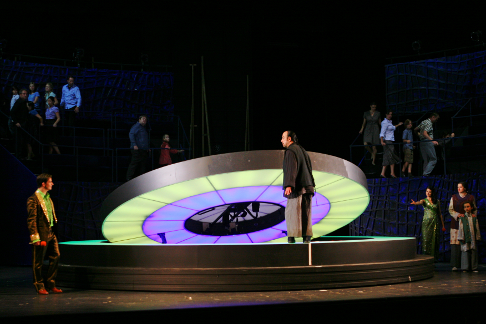 Marcus Hosch (Moderator), Peter Sidhom (Cim-Fen), Ingrid El Sigai (Moderatorin), Katharina Magiera (Hua-Quî), Tobias Jantsch (Hu-Cî) and Chor, Kinderchor and Statisterie der Oper Frankfurt in background
While L’oracolo may have its confusing pseudo-Asian dramaturgy, any minor musical longeurs were glossed over with committed performances. As Cim-Fen (opium den owner) Peter Sidhorn may not have offered the most suave singing, but compensated with great presence, the same that could be said of his interpretation of Guglielmo (Le Villi). Ashley Holland’s mellifluous voice was arguably the finest performance in Chinatown, as the learned doctor Uin-Sci. Franz Mayer put his soft-grained, affecting instrument to good use as the rich tradesman Hu-Tsin and Katharina Magiera made the most of her brief moment as Hua-Qui revealing a gorgeous, creamy mezzo.
One of the reasons for this mounting had to be to showcase local favorites, Annalisa Raspagliosi and Carlo Ventre, both of whom were cast in both operas.
Ms. Raspagliosi has already had a big career with big credentials, not least of which was a happy association with the legendary Pavarotti. Here she is undertaking Ah-Joe and more notably Anna in Le Villi. The latter suits her gifts more than the former. At this point in her development, she reminds me of the great Renata Scotto for Anna also commands an unerring sense of projecting the text, effortlessly embodies the character at hand, and seems incapable of a musical false move.
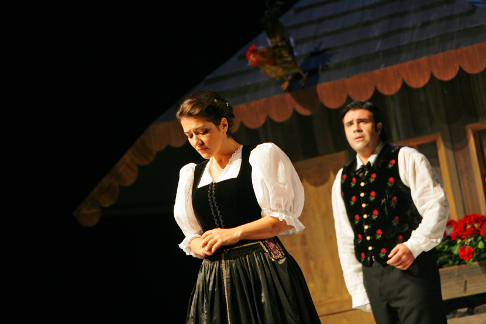 Annalisa Raspagliosi (Anna) and Carlo Ventre (Roberto)
That said, like Renata of yore, she also is beginning to sound a bit like a supremely gifted lyric soprano who has ventured a bit too far into heavier territory (Tosca, anyone?). Her high notes still float, but not without some discernible effort. Her sense of line still commands, but not without a bit of gear-shifting here and there. And the vibrato has gotten a bit more, shall we say, generous? Still, she offers an assured assumption of these two heroines, is lovely as lovely can be, and her Frankfurt public adore her. And why shouldn’t they? In an era of pretenders to the throne, her singing is still a connection with Old World Glories.
Before the Puccini, tenor Carlo Ventre was announced as indisposed, something I had suspected during the Leoni where his vocalizing as San-Lui seemed a bit cautious with meslimas a bit labored. Once our indulgence was requested so he could continue as the second opera’s Roberto (and who the hell else knows the role?), Mr. Ventre actually sang with more assurance, and even with real abandon. He is a fine singer with a burnished tone, and if a few phrases were husbanded carefully and a few notes grew rough-edged, he not only gave a pleasurable account of his two assignments, but also saved the night!
Like with the German weather then, while I had a great time discovering these two operas in staged versions for the first time, and while I enjoyed so many of the components, I found myself waiting, nay wishing for a change for sunnier horizons. Were the staging to be re-imagined losing the television concept entirely, I can predict the remaining elements would make a far superior evening at the opera.
James Sohre