07 Jan 2010
Cendrillon in Marseille
Rare repertory but not truly rare, Massenet’s Cendrillon makes an appearance from time to time.
English Touring Opera are delighted to announce a season of lyric monodramas to tour nationally from October to December. The season features music for solo singer and piano by Argento, Britten, Tippett and Shostakovich with a bold and inventive approach to making opera during social distancing.
This tenth of ten Live from London concerts was in fact a recorded live performance from California. It was no less enjoyable for that, and it was also uplifting to learn that this wasn’t in fact the ‘last’ LfL event that we will be able to enjoy, courtesy of VOCES8 and their fellow vocal ensembles (more below …).
Ever since Wigmore Hall announced their superb series of autumn concerts, all streamed live and available free of charge, I’d been looking forward to this song recital by Ian Bostridge and Imogen Cooper.
The Sixteen continues its exploration of Henry Purcell’s Welcome Songs for Charles II. As with Robert King’s pioneering Purcell series begun over thirty years ago for Hyperion, Harry Christophers is recording two Welcome Songs per disc.
Although Stile Antico’s programme article for their Live from London recital introduced their selection from the many treasures of the English Renaissance in the context of the theological debates and upheavals of the Tudor and Elizabethan years, their performance was more evocative of private chamber music than of public liturgy.
In February this year, Albanian soprano Ermonela Jaho made a highly lauded debut recital at Wigmore Hall - a concert which both celebrated Opera Rara’s 50th anniversary and honoured the career of the Italian soprano Rosina Storchio (1872-1945), the star of verismo who created the title roles in Leoncavallo’s La bohème and Zazà, Mascagni’s Lodoletta and Puccini’s Madama Butterfly.
Evidently, face masks don’t stifle appreciative “Bravo!”s. And, reducing audience numbers doesn’t lower the volume of such acclamations. For, the audience at Wigmore Hall gave soprano Elizabeth Llewellyn and pianist Simon Lepper a greatly deserved warm reception and hearty response following this lunchtime recital of late-Romantic song.
Collapsology. Or, perhaps we should use the French word ‘Collapsologie’ because this is a transdisciplinary idea pretty much advocated by a series of French theorists - and apparently, mostly French theorists. It in essence focuses on the imminent collapse of modern society and all its layers - a series of escalating crises on a global scale: environmental, economic, geopolitical, governmental; the list is extensive.
For this week’s Live from London vocal recital we moved from the home of VOCES8, St Anne and St Agnes in the City of London, to Kings Place, where The Sixteen - who have been associate artists at the venue for some time - presented a programme of music and words bound together by the theme of ‘reflection’.
'Such is your divine Disposation that both you excellently understand, and royally entertaine the Exercise of Musicke.’
Amongst an avalanche of new Mahler recordings appearing at the moment (Das Lied von der Erde seems to be the most favoured, with three) this 1991 Mahler Second from the 2nd Kassel MahlerFest is one of the more interesting releases.
‘And there was war in heaven: Michael and his angels fought against the dragon; and the dragon fought and his angels, And prevailed not; neither was their place found any more in heaven … that old serpent … Satan, which deceiveth the whole world: he was cast out into the earth, and his angels were cast out with him.’
If there is one myth, it seems believed by some people today, that probably needs shattering it is that post-war recordings or performances of Wagner operas were always of exceptional quality. This 1949 Hamburg Tristan und Isolde is one of those recordings - though quite who is to blame for its many problems takes quite some unearthing.
There was never any doubt that the fifth of the twelve Met Stars Live in Concert broadcasts was going to be a palpably intense and vivid event, as well as a musically stunning and theatrically enervating experience.
‘Love’ was the theme for this Live from London performance by Apollo5. Given the complexity and diversity of that human emotion, and Apollo5’s reputation for versatility and diverse repertoire, ranging from Renaissance choral music to jazz, from contemporary classical works to popular song, it was no surprise that their programme spanned 500 years and several musical styles.
The Academy of St Martin in the Fields have titled their autumn series of eight concerts - which are taking place at 5pm and 7.30pm on two Saturdays each month at their home venue in Trafalgar Square, and being filmed for streaming the following Thursday - ‘re:connect’.
The London Symphony Orchestra opened their Autumn 2020 season with a homage to Oliver Knussen, who died at the age of 66 in July 2018. The programme traced a national musical lineage through the twentieth century, from Britten to Knussen, on to Mark-Anthony Turnage, and entwining the LSO and Rattle too.
With the Live from London digital vocal festival entering the second half of the series, the festival’s host, VOCES8, returned to their home at St Annes and St Agnes in the City of London to present a sequence of ‘Choral Dances’ - vocal music inspired by dance, embracing diverse genres from the Renaissance madrigal to swing jazz.
Just a few unison string wriggles from the opening of Mozart’s overture to Le nozze di Figaro are enough to make any opera-lover perch on the edge of their seat, in excited anticipation of the drama in music to come, so there could be no other curtain-raiser for this Gala Concert at the Royal Opera House, the latest instalment from ‘their House’ to ‘our houses’.
"Before the ending of the day, creator of all things, we pray that, with your accustomed mercy, you may watch over us."
Rare repertory but not truly rare, Massenet’s Cendrillon makes an appearance from time to time.
One of the more notable recent revivals occurred at the Opéra National du Rhin (Strasbourg) in 2003 in the mise en scène of French born director/choreographer Renaud Doucet and Canadian designer André Barbe. The production is well traveled, including a stopover at the New York City Opera two years ago, and just now it was again revived in a splendid evening in Marseille (December 29.)
This staging team is far better known in the U.S. and Canada than in Europe, in fact the entire 2009-2010 four opera season of Florida Grand Opera (Miami) consists of stagings by Messieurs Doucet and Barbe. Was it not in the 1950’s that the exodus to Florida began?
The Doucet/Barbe Cendrillon looks backwards at the fabulous American 50’s, our out-sized and shiny kitchen appliances, our long and sleek automobiles, the giant juke boxes and the big screens for our Hollywood movies. Like all French glances at the U.S. this one too is vaguely anti-American, rubbing it in that though we may have all these flashy contraptions we do not have royalty and titles — i.e. breeding, that which money cannot buy.
Thus at the center of the Doucet/Barbe production is the American princess, Grace Kelly whose kingdom, Monaco, is just down the road from Marseille, and whose fairy tale royal marriage filled the giant black and white movie screen suspended from a branch of Massenet’s giant, magical third act oak tree. The coloratura incantations of Cinderella’s fairy godmother had brought the Prince and Cinderella together for a vocally sumptuous if chaste seduction scene at the drive-in movies.
The Doucet/Barbe production wore its concept like the skin-tight, low-cut gown of the 1953 Calendar girl hanging above the juke box. Cinderella, here named Lucette, emerged scrubbing, from the oven of a giant Admiral [brand name] stove, the giant kitchen radio expelled first the magical tones and then the personage of her fairy godmother. Per the fairy tale the dream soon vanished. Lucette awakened among endless rows of the cracker-box homes of an American subdivision, only to find herself soon again at the Prince[ton] ball (get it? — he had a P on his varsity sweater).
In Marseille conductor Cyril Diederich made Massenet’s marvelous score move seamlessly from the opera buffa fantasies of Lucette’s father and her stepmother and stepsisters to the late nineteenth century style opera seria heartrending outpourings of Cinderella, from the musical banality of balletic processions to the kinetic brilliance of above-the-staff singing. You had to pinch yourself to keep from believing it to be the most delightful Rosenkavalier you could possibly imagine. After his initial downbeat Mo. Diederich’s Cendrillon never touched ground, vindicating Massenet’s score as the most magnificent of French musical confections after Hoffmann!
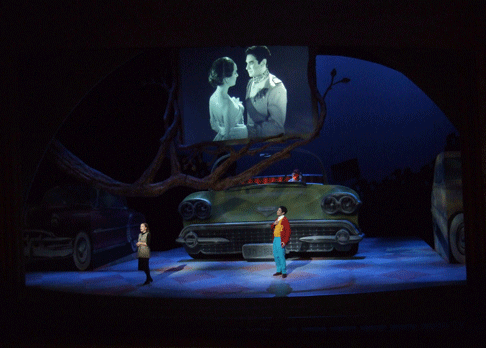
The stage was in fact seen through the distorted lens of a crystal ball, somethings huge, somethings small, nothing as it really is. The costumes were fabulous exaggerations too, only Cinderella was left in a plain, gray skirt and sweater. But were those the colors (pinks, purples and greens) and shapes of the 1950’s? Certainly Messieurs Doucet and Barbe did their research, and certainly knowingly threw in some of the electric colors of the 60’s, and a pure 60’s Cadillac grill at the drive-in movies to boot.
Singing is solid in Marseille, and this Cendrillon was no exception. Canadian born, Juilliard trained mezzo soprano Julie Boulianne was Lucette, her beautifully even, bronze-hued tone was easy to imagine as the ideal singing voice of the regal Grace Kelly, plus she possesses a fine upper extension able to project Massenet’s very occasional sentimental exuberance. Her studied polish however betrayed her artistic youth. Prince Charming was Canadian tenor Frédéric Antoun who trained at Philadelphia’s Curtis Institute and is a veteran of the New York City Opera production. He is handsome, brooding and accomplished, and just right for twisted takes on the heroes of his fach (Almaviva, Tamino, Nemorino, etc.).
Baritone Francois Le Roux took Pandolfe (Lucette’s father) well beyond the caricature of his costume to the highest level of later buffo style, magnifying ever word and smallest feeling to truly human proportion. Lilana Faraon was the Fairy Godmother of your dreams, her coloratura impeccable, her diminutive figure irreale and her energy indefatigable. Veteran Marseille mezzo soprano Marie-Ange Todorovitch made hay of singing a comic role for once (she is most often the stalwart heavy-duty mezzo in Marseille), and Julie Mossay and Diana Axentil were truly believable Miami Beach adolescent females.
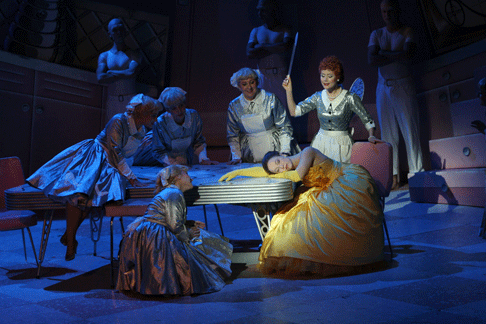
Choreographer Doucet’s production requires four zany ballerinas and three beautiful female jugglers, and a lively small chorus that does not mind executing a few dance steps, not to mention a brief pas de trois by the stepmother and stepsisters. In Marseille the Doucet/Barbe production achieved a near perfect balance of real and irreale, of humor and sentiment, and of spoof and beloved fairytale,
Massenet’s original Prince Charming is a soprano trouser role to be sung by a so-called Falcon soprano, a dark-toned French soprano voice, though in modern productions it is most often transposed for a male voice, satisfying current, particularly French sensibilities. The 1983 New York City Opera production though used a female Prince Charming (Suzanne Marsee) to reportedly wonderful effect.
This same 1983 NYCO production marked the first use of supertitles in the occidental world. Then NYCO general director Beverly Sills had seen supertitles used in Chinese opera in Peking and thought it might be a good idea to let her audiences know what was happening in this unfamiliar opera while it was happening. Now, a mere twenty-five years later, in spite of the excellent diction of the all Francophone cast, even in Marseille this Cendrillon was supertitled!
Michael Milenski