![Toby Spence as Tom Rakewell [Photo by Johan Persson courtesy of the Royal Opera House]](http://www.operatoday.com/ROH_01341.png)
25 Jan 2010
London’s Rambunctious Rake
Covent Garden has revived director Robert Lepage’s popular and well-traveled version of The Rake’s Progress with often thrilling results.
English Touring Opera are delighted to announce a season of lyric monodramas to tour nationally from October to December. The season features music for solo singer and piano by Argento, Britten, Tippett and Shostakovich with a bold and inventive approach to making opera during social distancing.
This tenth of ten Live from London concerts was in fact a recorded live performance from California. It was no less enjoyable for that, and it was also uplifting to learn that this wasn’t in fact the ‘last’ LfL event that we will be able to enjoy, courtesy of VOCES8 and their fellow vocal ensembles (more below …).
Ever since Wigmore Hall announced their superb series of autumn concerts, all streamed live and available free of charge, I’d been looking forward to this song recital by Ian Bostridge and Imogen Cooper.
The Sixteen continues its exploration of Henry Purcell’s Welcome Songs for Charles II. As with Robert King’s pioneering Purcell series begun over thirty years ago for Hyperion, Harry Christophers is recording two Welcome Songs per disc.
Although Stile Antico’s programme article for their Live from London recital introduced their selection from the many treasures of the English Renaissance in the context of the theological debates and upheavals of the Tudor and Elizabethan years, their performance was more evocative of private chamber music than of public liturgy.
In February this year, Albanian soprano Ermonela Jaho made a highly lauded debut recital at Wigmore Hall - a concert which both celebrated Opera Rara’s 50th anniversary and honoured the career of the Italian soprano Rosina Storchio (1872-1945), the star of verismo who created the title roles in Leoncavallo’s La bohème and Zazà, Mascagni’s Lodoletta and Puccini’s Madama Butterfly.
Evidently, face masks don’t stifle appreciative “Bravo!”s. And, reducing audience numbers doesn’t lower the volume of such acclamations. For, the audience at Wigmore Hall gave soprano Elizabeth Llewellyn and pianist Simon Lepper a greatly deserved warm reception and hearty response following this lunchtime recital of late-Romantic song.
Collapsology. Or, perhaps we should use the French word ‘Collapsologie’ because this is a transdisciplinary idea pretty much advocated by a series of French theorists - and apparently, mostly French theorists. It in essence focuses on the imminent collapse of modern society and all its layers - a series of escalating crises on a global scale: environmental, economic, geopolitical, governmental; the list is extensive.
For this week’s Live from London vocal recital we moved from the home of VOCES8, St Anne and St Agnes in the City of London, to Kings Place, where The Sixteen - who have been associate artists at the venue for some time - presented a programme of music and words bound together by the theme of ‘reflection’.
'Such is your divine Disposation that both you excellently understand, and royally entertaine the Exercise of Musicke.’
Amongst an avalanche of new Mahler recordings appearing at the moment (Das Lied von der Erde seems to be the most favoured, with three) this 1991 Mahler Second from the 2nd Kassel MahlerFest is one of the more interesting releases.
‘And there was war in heaven: Michael and his angels fought against the dragon; and the dragon fought and his angels, And prevailed not; neither was their place found any more in heaven … that old serpent … Satan, which deceiveth the whole world: he was cast out into the earth, and his angels were cast out with him.’
If there is one myth, it seems believed by some people today, that probably needs shattering it is that post-war recordings or performances of Wagner operas were always of exceptional quality. This 1949 Hamburg Tristan und Isolde is one of those recordings - though quite who is to blame for its many problems takes quite some unearthing.
There was never any doubt that the fifth of the twelve Met Stars Live in Concert broadcasts was going to be a palpably intense and vivid event, as well as a musically stunning and theatrically enervating experience.
‘Love’ was the theme for this Live from London performance by Apollo5. Given the complexity and diversity of that human emotion, and Apollo5’s reputation for versatility and diverse repertoire, ranging from Renaissance choral music to jazz, from contemporary classical works to popular song, it was no surprise that their programme spanned 500 years and several musical styles.
The Academy of St Martin in the Fields have titled their autumn series of eight concerts - which are taking place at 5pm and 7.30pm on two Saturdays each month at their home venue in Trafalgar Square, and being filmed for streaming the following Thursday - ‘re:connect’.
The London Symphony Orchestra opened their Autumn 2020 season with a homage to Oliver Knussen, who died at the age of 66 in July 2018. The programme traced a national musical lineage through the twentieth century, from Britten to Knussen, on to Mark-Anthony Turnage, and entwining the LSO and Rattle too.
With the Live from London digital vocal festival entering the second half of the series, the festival’s host, VOCES8, returned to their home at St Annes and St Agnes in the City of London to present a sequence of ‘Choral Dances’ - vocal music inspired by dance, embracing diverse genres from the Renaissance madrigal to swing jazz.
Just a few unison string wriggles from the opening of Mozart’s overture to Le nozze di Figaro are enough to make any opera-lover perch on the edge of their seat, in excited anticipation of the drama in music to come, so there could be no other curtain-raiser for this Gala Concert at the Royal Opera House, the latest instalment from ‘their House’ to ‘our houses’.
"Before the ending of the day, creator of all things, we pray that, with your accustomed mercy, you may watch over us."
Covent Garden has revived director Robert Lepage’s popular and well-traveled version of The Rake’s Progress with often thrilling results.
First and foremost, the Royal Opera House’s Rake boasts an A-list cast that is as fine as can currently be assembled. Of especial interest to me was young bass Kyle Ketelsen’s role debut as Nick Shadow. He definitely did not disappoint. Mr. Ketelsen always offers a consistent, rich, and suave tonal delivery and he is possessed of one of the most secure techniques of any voice heard before the public today.
His is a sizable instrument which can easily ring out in the house one minute, and scale back to a hushed, intense sotto voce the next. He bought his usual intelligence and superb musicianship to bear in what has to be considered a major role assumption in his growing repertoire (and reputation). As wonderful as is his vocalizing, Kyle also scores big — make that waaaaaay big — as an actor. In fact, I would be hard pressed to think of any male singer active that is his equal for stage presence, character delineation, vocal color, uninhibited movement, and dramatic understanding. The card scene could have served as Masters Class in theatrical nuance.
Repeated performances and even more experience will only deepen his already commendable interpretation. You heard it from me: Kyle Ketelsen will be the Nick Shadow of choice for future productions. I am not alone, the entire audience roared its approval with a vociferous ovation.
Happily, he was in great company. Toby Spence as Tom Rakewell served up splendid, secure singing all evening, and he managed to touch me deeply in his final scene as no one has before. My previous outing with the staged opera was limited to two disparate but troublesome productions in Aix and Salzburg respectively, but both starring the late Jerry Hadley in one of his best roles.
Although Jerry had more squillo in his voice, the concepts sadly kept him on the surface of the role. Mr. Spence was able to delve deeply into the character’s psyche, and while he appears and acts suitably boyish, his real-time maturity has been deployed effectively in defining Tom’s life journey and descent into madness.
He is a highly accomplished lyric tenor to be sure, but like many such well-schooled light voices, the artist can be counted upon to deliver more in the area of consistency of pleasing tone, than can be easily offered in terms of varied dramatic utterance. It is to his credit that he used his considerable acting skill to create a plausible illusion of varied tonal color.
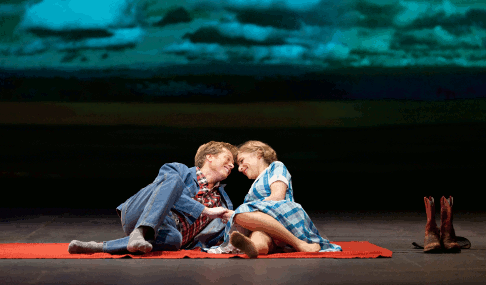 Toby Spence as Tom Rakewell and Rosemary Joshua as Anne Trulove
Another brilliant lyric voice and vibrant stage presence was on hand in the person of Rosemary Joshua’s Anne. This wonderful artist goes from strength to strength and she, too, has an awesome arsenal of technical skills at her command. Just listen to her soaring fearlessly through the most angular phrases and meandering melismas, and then turn around to melt our hearts with utterly focused limpid singing of the first order. Kate Royal had been advertised for the part, but while Ms. Joshua offers a slightly more mature take on the role, she is slim, lovely, and still has the Wow Factor for me, as when I first heard her Cleopatra in Miami and said “Wow, who is this fabulous soprano?”
Patricia Bardon, a veteran of the 2008 mounting of this production, returned as Baba the Turk and successfully managed her rich bottom range and ringing top to deliver a fully committed traversal of one of opera’s most unique characters. She looked smashing, too, pulling off the difficult task of being bearded but yet seeming alluringly sexy. Stalwart comprimario Graham Clark treated us to a vocally secure and theatrically vibrant turn as the auctioneer Sellem, and company principal Jeremy White was solid of voice and stature as Trulove. Frances McCafferty seemed game to do anything (and did) as a randy Mother Goose, although there were a few frayed notes at the extremes of the range.
The orchestra had a remarkably fine night, not only playing the rhythmically challenging score cleanly, but also investing Stravinsky’s masterpiece with all the vibrant panache and passion it needs to make its mark. This can be attributed to the controlled baton of Ingo Metzmacher. I have encountered the maestro’s work on several occasions now. He is never less than inspired, and his musical stewardship is never less than remarkable. It is pleasure to watch his star on the rise.
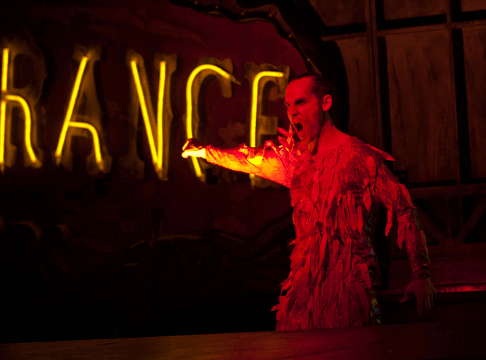 Kyle Ketelsen as Nick Shadow
Stage director Rober Lepage is always preceded by his large reputation, and for once it is a reputation founded on thoughtful experimentation informed by a respect for the original work. Mr. Lepage’s interpretation of this challenging piece is never less than hugely entertaining and ultimately it is enormously affecting. He has managed to find the honesty in Auden’s dark humor, and delivered some well-calculated laughs all the while retaining the underlying serious narrative. He was ably abetted in this fanciful pursuit by the witty set design of Carl Fillion; the colorful, characterful costumes by François Barbeau; and the evocative lighting devised by Boris Firquet. (It should be noted that Sybille Wilson has directed the revival, presumably with fidelity to the original staging.)
The production team has loosely devised their vision around a concept of Hollywood in its (now-) glorified heyday, with nods to such iconic films as Sunset Boulevard, The Snake Pit, Destry Rides Again, A Star is Born, among others. Nick Shadow is presented as an old school film director, a veritable Cecil B. De-vil, often riding herd and riding high over the proceedings from a camera crane and therefrom controlling the fates of his players.
This decidedly allowed for many images of great resonance, and some wholly engaging set changes which we came to anticipate with relish. I will never forget the slow inflation of Tom’s blow-up Hollywood star dressing trailer, or the disappearance of the lasciviously poised Goose and Tom as they sunk through the center of the red draped bed to the depths of the trap door, nor Anne’s goofy convertible car ride with scarf billowing in the breeze.
However, it has to also be said…it didn’t quite work as a totally integrated piece of theatre. At the end of the day, had I not read the program notes I might not have grasped this overall conceit until we were well into the piece. Unlike the recent Fanciulla in Amsterdam that established its intent early on to tap into Old Hollywood images, this Rake apparently began on a flat plain with an oil derrick in …where? Texas? Oklahoma? I was willing to go with that, but it soon seemed a red herring of sorts. When we finally start to get it, we wasted some time and attention playing catch-up in retrospect.
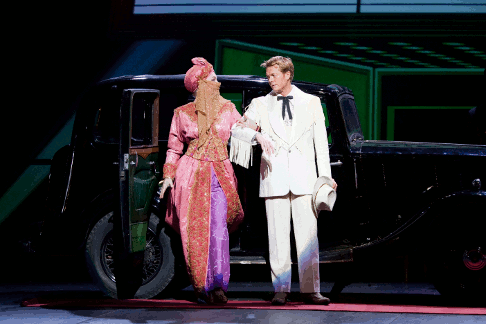 Patricia Bardon as Baba the Turk and Toby Spence as Tom Rakewell
Nevertheless, it cannot be denied that The Rake’s Progress was a highly diverting, conscientiously considered, and wholly professional evening at the opera. By assembling a world class cast and pairing them with its usual awesome musical and theatrical assets, the Royal Opera House has once again reminded me that it is Europe’s premiere company.
James Sohre