![Elizabeth Futral as Hanna Glawari [Photo by Dan Rest courtesy of the Lyric Opera of Chicago]](http://www.operatoday.com/Futral_MW_Chicago.png)
29 Jan 2010
Lyric Opera of Chicago’s The Merry Widow
Melodic and scenic gaiety predominates in Lyric Opera of Chicago’s new production of Franz Lehár’s The Merry Widow.
English Touring Opera are delighted to announce a season of lyric monodramas to tour nationally from October to December. The season features music for solo singer and piano by Argento, Britten, Tippett and Shostakovich with a bold and inventive approach to making opera during social distancing.
This tenth of ten Live from London concerts was in fact a recorded live performance from California. It was no less enjoyable for that, and it was also uplifting to learn that this wasn’t in fact the ‘last’ LfL event that we will be able to enjoy, courtesy of VOCES8 and their fellow vocal ensembles (more below …).
Ever since Wigmore Hall announced their superb series of autumn concerts, all streamed live and available free of charge, I’d been looking forward to this song recital by Ian Bostridge and Imogen Cooper.
The Sixteen continues its exploration of Henry Purcell’s Welcome Songs for Charles II. As with Robert King’s pioneering Purcell series begun over thirty years ago for Hyperion, Harry Christophers is recording two Welcome Songs per disc.
Although Stile Antico’s programme article for their Live from London recital introduced their selection from the many treasures of the English Renaissance in the context of the theological debates and upheavals of the Tudor and Elizabethan years, their performance was more evocative of private chamber music than of public liturgy.
In February this year, Albanian soprano Ermonela Jaho made a highly lauded debut recital at Wigmore Hall - a concert which both celebrated Opera Rara’s 50th anniversary and honoured the career of the Italian soprano Rosina Storchio (1872-1945), the star of verismo who created the title roles in Leoncavallo’s La bohème and Zazà, Mascagni’s Lodoletta and Puccini’s Madama Butterfly.
Evidently, face masks don’t stifle appreciative “Bravo!”s. And, reducing audience numbers doesn’t lower the volume of such acclamations. For, the audience at Wigmore Hall gave soprano Elizabeth Llewellyn and pianist Simon Lepper a greatly deserved warm reception and hearty response following this lunchtime recital of late-Romantic song.
Collapsology. Or, perhaps we should use the French word ‘Collapsologie’ because this is a transdisciplinary idea pretty much advocated by a series of French theorists - and apparently, mostly French theorists. It in essence focuses on the imminent collapse of modern society and all its layers - a series of escalating crises on a global scale: environmental, economic, geopolitical, governmental; the list is extensive.
For this week’s Live from London vocal recital we moved from the home of VOCES8, St Anne and St Agnes in the City of London, to Kings Place, where The Sixteen - who have been associate artists at the venue for some time - presented a programme of music and words bound together by the theme of ‘reflection’.
'Such is your divine Disposation that both you excellently understand, and royally entertaine the Exercise of Musicke.’
Amongst an avalanche of new Mahler recordings appearing at the moment (Das Lied von der Erde seems to be the most favoured, with three) this 1991 Mahler Second from the 2nd Kassel MahlerFest is one of the more interesting releases.
‘And there was war in heaven: Michael and his angels fought against the dragon; and the dragon fought and his angels, And prevailed not; neither was their place found any more in heaven … that old serpent … Satan, which deceiveth the whole world: he was cast out into the earth, and his angels were cast out with him.’
If there is one myth, it seems believed by some people today, that probably needs shattering it is that post-war recordings or performances of Wagner operas were always of exceptional quality. This 1949 Hamburg Tristan und Isolde is one of those recordings - though quite who is to blame for its many problems takes quite some unearthing.
There was never any doubt that the fifth of the twelve Met Stars Live in Concert broadcasts was going to be a palpably intense and vivid event, as well as a musically stunning and theatrically enervating experience.
‘Love’ was the theme for this Live from London performance by Apollo5. Given the complexity and diversity of that human emotion, and Apollo5’s reputation for versatility and diverse repertoire, ranging from Renaissance choral music to jazz, from contemporary classical works to popular song, it was no surprise that their programme spanned 500 years and several musical styles.
The Academy of St Martin in the Fields have titled their autumn series of eight concerts - which are taking place at 5pm and 7.30pm on two Saturdays each month at their home venue in Trafalgar Square, and being filmed for streaming the following Thursday - ‘re:connect’.
The London Symphony Orchestra opened their Autumn 2020 season with a homage to Oliver Knussen, who died at the age of 66 in July 2018. The programme traced a national musical lineage through the twentieth century, from Britten to Knussen, on to Mark-Anthony Turnage, and entwining the LSO and Rattle too.
With the Live from London digital vocal festival entering the second half of the series, the festival’s host, VOCES8, returned to their home at St Annes and St Agnes in the City of London to present a sequence of ‘Choral Dances’ - vocal music inspired by dance, embracing diverse genres from the Renaissance madrigal to swing jazz.
Just a few unison string wriggles from the opening of Mozart’s overture to Le nozze di Figaro are enough to make any opera-lover perch on the edge of their seat, in excited anticipation of the drama in music to come, so there could be no other curtain-raiser for this Gala Concert at the Royal Opera House, the latest instalment from ‘their House’ to ‘our houses’.
"Before the ending of the day, creator of all things, we pray that, with your accustomed mercy, you may watch over us."
Melodic and scenic gaiety predominates in Lyric Opera of Chicago’s new production of Franz Lehár’s The Merry Widow.
Paris in the opening years of the twentieth century is evoked in shifting venues from the Petrovenian embassy in Act I to the widow’s mansion and to Maxim’s in Acts II and III. The widow Hannah Glawari is sung by Elizabeth Futral in a performance ranging from touching sentimentality to lyrical purity and joyous sparkle in duets and ensembles. Her suitor from the past, Count Danilo Danilovich, as portrayed by Roger Honeywell moves convincingly from the pleasure-seeking rake to the man who still loves Hannah despite circumstances that interrupted their earlier courtship. A secondary romantic involvement is pursued between the married Valencienne and her admirer Camille de Rosillon, sung and acted plaintively in this production by Andriana Chuchman and Stephen Costello respectively. A large supporting cast is drawn into the comedic and wistful resolution of Hannah’s fortunes and amorous interests.
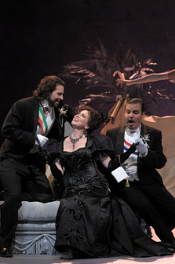 Paul La Rosa, Elizabeth Futral and David Portillo
After a spirited orchestral introduction led by conductor Emannuel Villaume
the first act of Lehár’s operetta introduces both celebration and
conflict. This scene, as staged in Lyric Opera’s new production,
communicates an appropriate amount of business, replete with arrivals, wooing,
and worries over the homeland. Baron Zeta broaches this latter topic by
accepting congratulations in behalf of the Petrovenian head of state while at
once lamenting the precarious financial issues of the homeland. In his
portrayal of Zeta, Dale Travis assumes a Central European accent and delivers
an effective mix of enthusiasm and anguish. After summarizing the economic
concerns, he insists that the recently widowed Hanna Glawari must remarry a
Petrovenian citizen so that her inheritance might remain in the domestic
treasury. During Zeta’s distracted narration of such details his wife
Valencienne is subjected to the repeated attentions of the nobleman Camille de
Rosillon. Although obviously flattered by these advances, Valencienne expresses
her irritation when Camille writes “I love you” on her fan. In the
duet “Listen please” Valencienne reminds him of her intentions to
remain faithful to her husband Zeta and suggests that he marry another.
Chuchman and Costello fulfill the individual roles of Valencienne and Camille
admirably yet their vocal and dramatic talents seem transformed to a still
higher level when they sing together. In this first duet they epitomize the
conflicts of love and duty as their voices blend to communicate a convincing
emotional fervor.
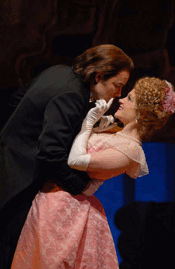 Stephen Costello and Andriana Chuchman
Once the young couple leaves, the widow Hanna Glawari appears, trying to
deflect the repeated attempts at adulation from men who wish to curry her
favor. In her first aria (“Gentlemen, how kind”) Ms. Futral strikes
a balance between a woman who demonstrates a vocally receptive sense of being
flattered and the realistic widow who suspects any suitor of opportunism. As
Hanna, for the present, leaves and repeated calls for Danilo’s needed
presence are sounded (“Affluent widows double in charm”), the
bachelor enters a near-empty stage. While staggering in apparent inebriation
from the top of a staircase Roger Honeywell portrays Danilo not so much as
dissolute but rather as one avoiding the confrontation of daily responsibility
by losing himself in the swirl of activity at Maxim’s. In his aria
“Oh, Fatherland” Honeywell muses with wistfulness on the duties of
a minor nobleman that he fulfills for his country, but activities of the
evening cause a suspension of the sense of homeland. When Hanna reenters she
finds Danilo, in utter exhaustion, asleep on a divan. Ms Futral attempts to
mask the surprise of Hanna, just as Mr. Honeywell’s Danilo can only
appear confused while he recovers his composure. A renewed attraction between
the principals, interrupted by the realities of an earlier, societal marriage,
is evident for a moment before distance again sets in. Danilo insists that he
will never express love for Hanna, while others vie for a dance with the widow.
When she suggests such a dance with Danilo, he offers it to any other man for
10000 francs. Hanna is incensed and Danilo seems, at first, resolved in his
sullenness. Yet Honeywell shows his character softening, and both agree finally
to the proposed dance. As the act concludes Hanna and Danilo, as portrayed
here, seem temporarily reconciled, if only for the evening, in a dance and song
that bears a glimmer of more for the future.
In Act II of the operetta the action takes place in the garden of the widow’s Parisian home. Hungarian dances are performed first to celebrate the ruler’s natal day: in Lyric Opera’s production both colorful costumes and skillful choreography assure a lively introduction to the celebration. As an extension of these festivities the widow sings the traditional Hungarian song of the vilja. Ms. Futral performed the justly famous song of the wood-sprite, or vilja, with moving emotional force. As she described the feelings of the huntsman who becomes enamored of the sprite in the forest, Ms. Futral’s character itself seemed to bloom, so that buried emotions could again be kindled. A further encounter with Danilo, who arrives to participate in the widow’s reception, contributes to renewed confusion and bruised emotions, with both characters stomping away in opposite directions. The scene is then left to the naïve pair Valencienne and Camille, who both avail themselves of the solitude to discuss openly the state of their love. Despite the protestations of Valencienne, Camille serenades her with the aria “Just as the rosebud blossoms in the light of May.” Mr. Costello flourished here as an ardent lover in the solo aria in which his vocal modulations and use of legato were especially well received. The two withdraw into the garden’s pavilion in time for Valencienne’s husband Zeta to return and peer curiously into the enclosure. Although he at first believes that he sees his wife with Camille, Hanna changes places with Valencienne in order to save her reputation. The widow and Camille emerge from the pavilion declaring their intention to marry, an announcement which confuses Zeta and irritates even further Danilo. Mr. Honeywell gave convincing expression to his pique in the aria “Fall in love often,” as he rushed off at the close of the act to console himself in diversion at Maxim’s.
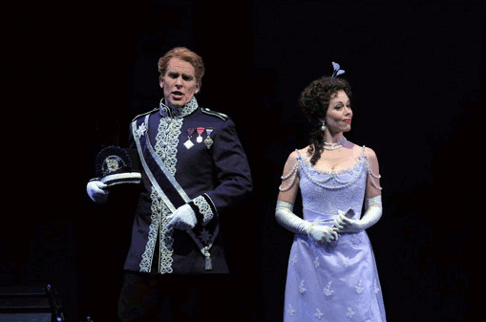 Roger Honeywell and Elizabeth Futral
It is indeed here at Maxim’s that the numerous conflicts and emotional tensions are ultimately settled during Act III of the operetta. After the mood is set by an orchestral introduction including strains from the “Merry Widow Waltz,” we see the various girls of the club along with Valencienne dancing to entertain Danilo. Further communication from the homeland prompts the widow to admit that she never intended marriage to Camille and that her motives consisted in the protection of another woman’s honor. At this Danilo admits his love for Hanna, and they sing the duet “Strings are sighing.” Futral and Honeywell express their bond, leading eventually to the consent of marriage, in touching unison as they conclude aptly on the lines “We’ve gone soaring to the heights” and “It’s you I love alone!” Only the breach between Valencienne and Zeta must be repaired. When the jealous husband discovers the fan on which Camille had written of his love, Valencienne convinces Zeta to read the declaration on the reverse: “To my loving husband from his adoring wife.” All is now well in the emotional world of The Merry Widow, as depicted in Lyric Opera of Chicago’s delightfully musical production.
Salvatore Calomino