18 Jan 2010
Phaedra at the Barbican
Most musical of mourners, weep anew!
Not all to that bright station dared to climb
And happier they their happiness who knew
Whose tapers yet burn through that night of time
English Touring Opera are delighted to announce a season of lyric monodramas to tour nationally from October to December. The season features music for solo singer and piano by Argento, Britten, Tippett and Shostakovich with a bold and inventive approach to making opera during social distancing.
This tenth of ten Live from London concerts was in fact a recorded live performance from California. It was no less enjoyable for that, and it was also uplifting to learn that this wasn’t in fact the ‘last’ LfL event that we will be able to enjoy, courtesy of VOCES8 and their fellow vocal ensembles (more below …).
Ever since Wigmore Hall announced their superb series of autumn concerts, all streamed live and available free of charge, I’d been looking forward to this song recital by Ian Bostridge and Imogen Cooper.
The Sixteen continues its exploration of Henry Purcell’s Welcome Songs for Charles II. As with Robert King’s pioneering Purcell series begun over thirty years ago for Hyperion, Harry Christophers is recording two Welcome Songs per disc.
Although Stile Antico’s programme article for their Live from London recital introduced their selection from the many treasures of the English Renaissance in the context of the theological debates and upheavals of the Tudor and Elizabethan years, their performance was more evocative of private chamber music than of public liturgy.
In February this year, Albanian soprano Ermonela Jaho made a highly lauded debut recital at Wigmore Hall - a concert which both celebrated Opera Rara’s 50th anniversary and honoured the career of the Italian soprano Rosina Storchio (1872-1945), the star of verismo who created the title roles in Leoncavallo’s La bohème and Zazà, Mascagni’s Lodoletta and Puccini’s Madama Butterfly.
Evidently, face masks don’t stifle appreciative “Bravo!”s. And, reducing audience numbers doesn’t lower the volume of such acclamations. For, the audience at Wigmore Hall gave soprano Elizabeth Llewellyn and pianist Simon Lepper a greatly deserved warm reception and hearty response following this lunchtime recital of late-Romantic song.
Collapsology. Or, perhaps we should use the French word ‘Collapsologie’ because this is a transdisciplinary idea pretty much advocated by a series of French theorists - and apparently, mostly French theorists. It in essence focuses on the imminent collapse of modern society and all its layers - a series of escalating crises on a global scale: environmental, economic, geopolitical, governmental; the list is extensive.
For this week’s Live from London vocal recital we moved from the home of VOCES8, St Anne and St Agnes in the City of London, to Kings Place, where The Sixteen - who have been associate artists at the venue for some time - presented a programme of music and words bound together by the theme of ‘reflection’.
'Such is your divine Disposation that both you excellently understand, and royally entertaine the Exercise of Musicke.’
Amongst an avalanche of new Mahler recordings appearing at the moment (Das Lied von der Erde seems to be the most favoured, with three) this 1991 Mahler Second from the 2nd Kassel MahlerFest is one of the more interesting releases.
‘And there was war in heaven: Michael and his angels fought against the dragon; and the dragon fought and his angels, And prevailed not; neither was their place found any more in heaven … that old serpent … Satan, which deceiveth the whole world: he was cast out into the earth, and his angels were cast out with him.’
If there is one myth, it seems believed by some people today, that probably needs shattering it is that post-war recordings or performances of Wagner operas were always of exceptional quality. This 1949 Hamburg Tristan und Isolde is one of those recordings - though quite who is to blame for its many problems takes quite some unearthing.
There was never any doubt that the fifth of the twelve Met Stars Live in Concert broadcasts was going to be a palpably intense and vivid event, as well as a musically stunning and theatrically enervating experience.
‘Love’ was the theme for this Live from London performance by Apollo5. Given the complexity and diversity of that human emotion, and Apollo5’s reputation for versatility and diverse repertoire, ranging from Renaissance choral music to jazz, from contemporary classical works to popular song, it was no surprise that their programme spanned 500 years and several musical styles.
The Academy of St Martin in the Fields have titled their autumn series of eight concerts - which are taking place at 5pm and 7.30pm on two Saturdays each month at their home venue in Trafalgar Square, and being filmed for streaming the following Thursday - ‘re:connect’.
The London Symphony Orchestra opened their Autumn 2020 season with a homage to Oliver Knussen, who died at the age of 66 in July 2018. The programme traced a national musical lineage through the twentieth century, from Britten to Knussen, on to Mark-Anthony Turnage, and entwining the LSO and Rattle too.
With the Live from London digital vocal festival entering the second half of the series, the festival’s host, VOCES8, returned to their home at St Annes and St Agnes in the City of London to present a sequence of ‘Choral Dances’ - vocal music inspired by dance, embracing diverse genres from the Renaissance madrigal to swing jazz.
Just a few unison string wriggles from the opening of Mozart’s overture to Le nozze di Figaro are enough to make any opera-lover perch on the edge of their seat, in excited anticipation of the drama in music to come, so there could be no other curtain-raiser for this Gala Concert at the Royal Opera House, the latest instalment from ‘their House’ to ‘our houses’.
"Before the ending of the day, creator of all things, we pray that, with your accustomed mercy, you may watch over us."
Most musical of mourners, weep anew!
Not all to that bright station dared to climb
And happier they their happiness who knew
Whose tapers yet burn through that night of time
Peace, peace! he is not dead, he doth not sleep
He has awakened from the dream of life
He is a portion of the loveliness
Which once he made more lovely…
(P.B. Shelley, “Adonais”)
Oh, those androgynously desirable hunter-heroes, shattered to death by their own horses, gored on a Boar’s tusks or eaten by their own hounds… what right could they do, trying to appease horny step-mothers and adoring goddesses all at once? Henze’s latest opera (his fourteenth) feels like a story that just had to be set to music like this, the first part telling the tale of the death of Hippolytus as related by Euripides, and the second based around the Ovidian myth of the god reborn as a part of the Universe.
Those of us who grew up with The Golden Bough are in our element here, the setting of Henze’s work dealing respectively with ancient Greece and the area of Italy around Nemi (close to the composer’s home) associated with the cult of Virbius, the ‘twice man’ who is restored to life at the behest of the goddess Artemis. The merely delightful L’Upupa was going to be Henze’s last opera - ‘I think that (13) is enough’ but in 2005 he was inspired to create a new piece on the subject of the love and death of Phaedra and her stepson Hippolytus, finishing the first act before a near-fatal illness brought about an hiatus during which his partner nursed him back to health, then himself died at only 63. Henze then went on to compose the life-affirming second act, in which Hippolytus is not dead but has ‘awakened from the dream of life.’
You can’t escape the autobiographical element - Henze lost his near-lifetime’s companion soon after almost dying himself (‘The coffin was ordered, the death notices printed’) so a Romantic work concerning the links between desire and love, between art and nature and between the living and the dead, was a natural outcome. For me, hearing Phaedra took me back to the Five Neapolitan Songs and the cantata Whispers from Heavenly Death; - these are much earlier works but they seem to inhabit the same area of the psyche, and deal with similar existential concerns, the setting of ‘Darest thou now, O Soul / Walk out with me toward the unknown region’ from the latter work very much springing to mind during the third part of the second act of Phaedra.
The music is above all spare yet Romantic, minimal in resources (only 23 players) yet often colossal in impact, and makes wonderful use of extraneous sound devices, especially in the scene depicting the earthquake - in fact you could hardly ask for more of that sense which Beethoven describes as uniquely Handelian, ‘of achieving great effects through little means.’ The techniques asked of the singers range from outright speech through Sprechgesang to coloratura, always in the service of the text. Lehnert’s libretto ideally partners the other-worldly sense of the music, and even when the sung voice is absent the orchestra still seems to be singing, as when the flutes and horns announce the naming of Virbius in phrases which seem full of ‘Provençal song, and sunburnt mirth.’
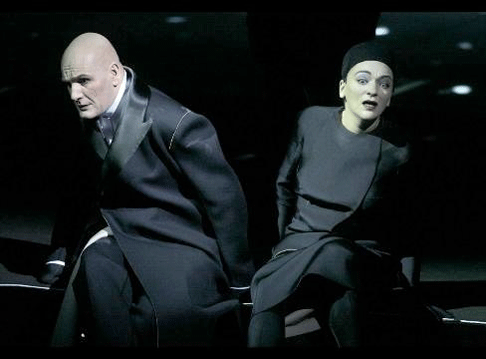 John Mark Ainsley as Hippolytus and Maria Riccarda Wesseling as Phaedra in the original Berlin production.
The performances are, as you would expect, world-class: this is after all the original cast and instrumental ensemble, and under Michael Boder’s direction they give as authoritative an account of the music as one could wish for, and which must have delighted the composer, who was present for the occasion. Maria Riccarda Wesseling was a gripping, sensual, passionate Phaedra, conveying not only her character’s cruelty and self-absorption but also her overwhelming vitality - when she was taunting Hippolytus you could almost feel the energy crackling around her.
The role of Hippolyt was written for John Mark Ainsley, and he inhabits it with absolute mastery, in sovereign voice throughout, his authority in the first act as commanding as his vulnerability in the second is touching. ‘Ich bin hier in meinem Anfang’ sings Hippolyt / Virbius after his rebirth, and the sense of both fragility and awe was superbly conveyed. This was as complete an assumption of an operatic role as you are likely to see on any stage.
Axel Köhler’s Artemis displayed similar commitment, in music written to test the counter-tenor range to its limits - it’s typical of Henze that this character should be set for this voice type, since doing so both confounds expectations and neatly links the music to Henze’s influences in the Baroque. Marlis Peterson was a fluent, statuesque Aphrodite, her avowal of vengeance with Phaedra one of the high points of the evening, and Lauri Vasar’s silky baritone was the ideal vehicle for the Minotaur’s sonorous reflections.
Will Phaedra become a staple of the repertoire? As a ‘Chamber Opera’ it requires fairly minimal forces, but its demands are such that those forces must be of the very best - indeed it is difficult to imagine the work being sung by anyone other than these artists. Its timing makes it problematic to programme, although one could envisage a performance alongside Britten’s cantata on the same subject - however it is staged, it is a beautiful, delicate work whose ambiguities may not have wide appeal. Henze is apparently working on a new piece at the moment, so we can hope that Phaedra may well not be his swan song.
In keeping with the sense of looking forward, this evening was not only the culmination of the Barbican’s Henze weekend, but it also represented the first instalment of the 2010 ‘Present Voices’ series, which showcases contemporary operas. The series continues on March 26th with the UK premiere of Peter Eötvös’ Angels in America (based on the play by Tony Kushner), and ends on May 15th with the UK premiere of After Life by the Dutch composer Michel van der Aa, a work which, like Henze’s, presents us with characters who are at a point between Earth and Heaven.
Melanie Eskenazi