![Kristin Lewis as Leonora and Walter Fraccaro as Manrico [Photo by Michele Crosera courtesy of Teatro Comunale, Padua]](http://www.operatoday.com/Trovatore_Padua_01.gif)
08 Jan 2010
Quality opera just round the corner
Well into the 1960s, ‘provincial theaters’ were the backbone of Italy’s operatic culture.
English Touring Opera are delighted to announce a season of lyric monodramas to tour nationally from October to December. The season features music for solo singer and piano by Argento, Britten, Tippett and Shostakovich with a bold and inventive approach to making opera during social distancing.
This tenth of ten Live from London concerts was in fact a recorded live performance from California. It was no less enjoyable for that, and it was also uplifting to learn that this wasn’t in fact the ‘last’ LfL event that we will be able to enjoy, courtesy of VOCES8 and their fellow vocal ensembles (more below …).
Ever since Wigmore Hall announced their superb series of autumn concerts, all streamed live and available free of charge, I’d been looking forward to this song recital by Ian Bostridge and Imogen Cooper.
The Sixteen continues its exploration of Henry Purcell’s Welcome Songs for Charles II. As with Robert King’s pioneering Purcell series begun over thirty years ago for Hyperion, Harry Christophers is recording two Welcome Songs per disc.
Although Stile Antico’s programme article for their Live from London recital introduced their selection from the many treasures of the English Renaissance in the context of the theological debates and upheavals of the Tudor and Elizabethan years, their performance was more evocative of private chamber music than of public liturgy.
In February this year, Albanian soprano Ermonela Jaho made a highly lauded debut recital at Wigmore Hall - a concert which both celebrated Opera Rara’s 50th anniversary and honoured the career of the Italian soprano Rosina Storchio (1872-1945), the star of verismo who created the title roles in Leoncavallo’s La bohème and Zazà, Mascagni’s Lodoletta and Puccini’s Madama Butterfly.
Evidently, face masks don’t stifle appreciative “Bravo!”s. And, reducing audience numbers doesn’t lower the volume of such acclamations. For, the audience at Wigmore Hall gave soprano Elizabeth Llewellyn and pianist Simon Lepper a greatly deserved warm reception and hearty response following this lunchtime recital of late-Romantic song.
Collapsology. Or, perhaps we should use the French word ‘Collapsologie’ because this is a transdisciplinary idea pretty much advocated by a series of French theorists - and apparently, mostly French theorists. It in essence focuses on the imminent collapse of modern society and all its layers - a series of escalating crises on a global scale: environmental, economic, geopolitical, governmental; the list is extensive.
For this week’s Live from London vocal recital we moved from the home of VOCES8, St Anne and St Agnes in the City of London, to Kings Place, where The Sixteen - who have been associate artists at the venue for some time - presented a programme of music and words bound together by the theme of ‘reflection’.
'Such is your divine Disposation that both you excellently understand, and royally entertaine the Exercise of Musicke.’
Amongst an avalanche of new Mahler recordings appearing at the moment (Das Lied von der Erde seems to be the most favoured, with three) this 1991 Mahler Second from the 2nd Kassel MahlerFest is one of the more interesting releases.
‘And there was war in heaven: Michael and his angels fought against the dragon; and the dragon fought and his angels, And prevailed not; neither was their place found any more in heaven … that old serpent … Satan, which deceiveth the whole world: he was cast out into the earth, and his angels were cast out with him.’
If there is one myth, it seems believed by some people today, that probably needs shattering it is that post-war recordings or performances of Wagner operas were always of exceptional quality. This 1949 Hamburg Tristan und Isolde is one of those recordings - though quite who is to blame for its many problems takes quite some unearthing.
There was never any doubt that the fifth of the twelve Met Stars Live in Concert broadcasts was going to be a palpably intense and vivid event, as well as a musically stunning and theatrically enervating experience.
‘Love’ was the theme for this Live from London performance by Apollo5. Given the complexity and diversity of that human emotion, and Apollo5’s reputation for versatility and diverse repertoire, ranging from Renaissance choral music to jazz, from contemporary classical works to popular song, it was no surprise that their programme spanned 500 years and several musical styles.
The Academy of St Martin in the Fields have titled their autumn series of eight concerts - which are taking place at 5pm and 7.30pm on two Saturdays each month at their home venue in Trafalgar Square, and being filmed for streaming the following Thursday - ‘re:connect’.
The London Symphony Orchestra opened their Autumn 2020 season with a homage to Oliver Knussen, who died at the age of 66 in July 2018. The programme traced a national musical lineage through the twentieth century, from Britten to Knussen, on to Mark-Anthony Turnage, and entwining the LSO and Rattle too.
With the Live from London digital vocal festival entering the second half of the series, the festival’s host, VOCES8, returned to their home at St Annes and St Agnes in the City of London to present a sequence of ‘Choral Dances’ - vocal music inspired by dance, embracing diverse genres from the Renaissance madrigal to swing jazz.
Just a few unison string wriggles from the opening of Mozart’s overture to Le nozze di Figaro are enough to make any opera-lover perch on the edge of their seat, in excited anticipation of the drama in music to come, so there could be no other curtain-raiser for this Gala Concert at the Royal Opera House, the latest instalment from ‘their House’ to ‘our houses’.
"Before the ending of the day, creator of all things, we pray that, with your accustomed mercy, you may watch over us."
Well into the 1960s, ‘provincial theaters’ were the backbone of Italy’s operatic culture.
Typically seating 200 to 600, offering reduced seasons of just a few popular titles, hosting strolling companies and partly drawing from semiprofessional forces as to orchestras and choirs, they worked as an efficient low-entry circuit nationwide, so that young talents might be discovered and acquire stage experience, while mature professionals could age gracefully while waiting for retirement.
That pattern went nearly lost during the following decades, as growing travel opportunities on one side, and multimedia diffusion of grand opera productions on the other, compelled many a minor house to shut up shop. However, part of it is resurfacing in a more sophisticated form. Aware of unavoidable competition from opera DVDs and cheap live beaming in neighborhood cinemas, provincial opera theaters now reopen under the aegis of local Councilors for Culture and Education, putting a premium on artistic quality rather than on business, albeit within the constraint of limited public budgets.
Padua’s Teatro Comunale, named for Giuseppe Verdi, is one such example. “Less is more” is the motto for this small but savvy house that offers two productions a season, with fashionable directors, elegant but essential sets and emerging musical talents from the world over. Coproductions with its peers in the area, Rovigo and Bassano del Grappa, multiply the impact and grant Padua denizens the experience of live opera just round the corner — for ludicrous investments. This lovely production of Trovatore, for example, did cost the local taxpayer a mere Euro 105,134.06 — all included.
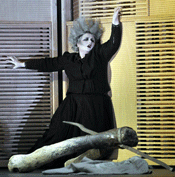 Anna Smirnova as Azucena
It updates the action from Medieval Spain to some unspecified episode of modern class warfare, or, according to the director’s notes, to the days of Resistenza, the anti-Nazi guerrilla in Italy during the 1940s. While the consistency of this metamorphosis remains questionable under several viewpoints, it allows director Denis Krief — in charge of costume design as well as of sets and lighting — to contrast the rival parties by outfitting Count di Luna and his troopers in military uniforms resembling an early version of today’s Italian Polizia di Stato and Manrico’s forces (including the hard-working Gypsies) in casual civilian clothing. Simple, clear and low-budget enough. Both Leonora and her lady-in-waiting Ines wear elegant evening gowns befitting their social rank; as to Azucena, she stands midway between a punk star and the German diva Brigitte Helm featuring the Whore of Babylon in the 1927 cult movie Metropolis.
Even though the stage is rather large, Krief uses the space well and moves his people within the framework of a gigantic book, whose wooden pages, around 5.50 meters tall, are meant to remind that Verdi’s gloomy narration is both historic and a fairy tale. Their diversely carved surfaces, turned by the stagehands after each scene, also provide an ever-changing enhancement to the hall’s acoustic. Sound wizardry through a frugal technology not involving any electronic equipment.
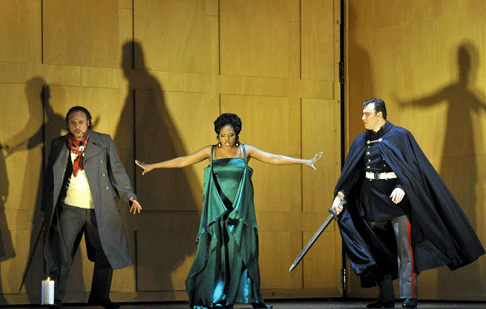 Vitaliy Biliy as Conte di Luna, Walter Fraccaro as Manrico and Kristin Lewis as Leonora
Conductor Omer Meir Wellber clearly appreciates how fine an orchestrator Verdi was, as I heard many woodwind colors that often go overlooked, while the strategic role of the offstage choir and band was given due prominence. The young Israeli maestro, still in his late twenties, is a wonderful talent. His debut at Padua, in late 2008 with Aida, got him no less than the Toscanini Award from the Italian association of music critics. A similar story to Kristin Lewis’, a budding soprano from Little Rock, Arkansas, whose appearance as Aida on said production won her a row of international invitations for the same role. From her first phrase as Leonora she gave the impression of an almost ideal Verdian performer — indeed her ample, soft-grained lyrical tone and generous chest notes made her singing the delight of the evening.
As Azucena, the Russian mezzo Anna Smirnova impressed with her vast range of vocal color and dramatic accents of uncommon intensity. Ferrando, a somewhat perfunctory character who opens the opera by explaining the background that sets the plot in motion, then practically disappears, was impersonated by Roberto Tagliavini. With his big, solid voice and strong stage presence, he offered a preview of the vocal treasures he has in store, leaving me with the desire to hear more.
The two leading men, tenor Walter Fraccaro as Manrico and Ukraine’s baritone Vitaliy Biliy as Count di Luna, are both good singers who interpret their roles with much ardor. Both have some dramatic shortcomings, though. In Biliy’s case the problem lies in acting. Even though he’s tall and commands the stage as a military leader should, his gestures are stock, failing to convey the character’s moments of doubt, brief repentance, and final desperation.
Carlo Vitali