![Caroline Copeland of the New York Baroque Dance Company with Opera Lafayette. [Photo by Louis Forget courtesy of Opera Lafayette]](http://www.operatoday.com/Armide_creditLouisForget.gif)
11 Feb 2010
Armide by Opera Lafayette
Gluck’s Armide, as semi-staged (costumed dancers but no scenery) at the Rose Theater by the Washington-based Opera Lafayette, was exactly what Gluck designed the piece to be: a supremely elegant entertainment.
English Touring Opera are delighted to announce a season of lyric monodramas to tour nationally from October to December. The season features music for solo singer and piano by Argento, Britten, Tippett and Shostakovich with a bold and inventive approach to making opera during social distancing.
This tenth of ten Live from London concerts was in fact a recorded live performance from California. It was no less enjoyable for that, and it was also uplifting to learn that this wasn’t in fact the ‘last’ LfL event that we will be able to enjoy, courtesy of VOCES8 and their fellow vocal ensembles (more below …).
Ever since Wigmore Hall announced their superb series of autumn concerts, all streamed live and available free of charge, I’d been looking forward to this song recital by Ian Bostridge and Imogen Cooper.
The Sixteen continues its exploration of Henry Purcell’s Welcome Songs for Charles II. As with Robert King’s pioneering Purcell series begun over thirty years ago for Hyperion, Harry Christophers is recording two Welcome Songs per disc.
Although Stile Antico’s programme article for their Live from London recital introduced their selection from the many treasures of the English Renaissance in the context of the theological debates and upheavals of the Tudor and Elizabethan years, their performance was more evocative of private chamber music than of public liturgy.
In February this year, Albanian soprano Ermonela Jaho made a highly lauded debut recital at Wigmore Hall - a concert which both celebrated Opera Rara’s 50th anniversary and honoured the career of the Italian soprano Rosina Storchio (1872-1945), the star of verismo who created the title roles in Leoncavallo’s La bohème and Zazà, Mascagni’s Lodoletta and Puccini’s Madama Butterfly.
Evidently, face masks don’t stifle appreciative “Bravo!”s. And, reducing audience numbers doesn’t lower the volume of such acclamations. For, the audience at Wigmore Hall gave soprano Elizabeth Llewellyn and pianist Simon Lepper a greatly deserved warm reception and hearty response following this lunchtime recital of late-Romantic song.
Collapsology. Or, perhaps we should use the French word ‘Collapsologie’ because this is a transdisciplinary idea pretty much advocated by a series of French theorists - and apparently, mostly French theorists. It in essence focuses on the imminent collapse of modern society and all its layers - a series of escalating crises on a global scale: environmental, economic, geopolitical, governmental; the list is extensive.
For this week’s Live from London vocal recital we moved from the home of VOCES8, St Anne and St Agnes in the City of London, to Kings Place, where The Sixteen - who have been associate artists at the venue for some time - presented a programme of music and words bound together by the theme of ‘reflection’.
'Such is your divine Disposation that both you excellently understand, and royally entertaine the Exercise of Musicke.’
Amongst an avalanche of new Mahler recordings appearing at the moment (Das Lied von der Erde seems to be the most favoured, with three) this 1991 Mahler Second from the 2nd Kassel MahlerFest is one of the more interesting releases.
‘And there was war in heaven: Michael and his angels fought against the dragon; and the dragon fought and his angels, And prevailed not; neither was their place found any more in heaven … that old serpent … Satan, which deceiveth the whole world: he was cast out into the earth, and his angels were cast out with him.’
If there is one myth, it seems believed by some people today, that probably needs shattering it is that post-war recordings or performances of Wagner operas were always of exceptional quality. This 1949 Hamburg Tristan und Isolde is one of those recordings - though quite who is to blame for its many problems takes quite some unearthing.
There was never any doubt that the fifth of the twelve Met Stars Live in Concert broadcasts was going to be a palpably intense and vivid event, as well as a musically stunning and theatrically enervating experience.
‘Love’ was the theme for this Live from London performance by Apollo5. Given the complexity and diversity of that human emotion, and Apollo5’s reputation for versatility and diverse repertoire, ranging from Renaissance choral music to jazz, from contemporary classical works to popular song, it was no surprise that their programme spanned 500 years and several musical styles.
The Academy of St Martin in the Fields have titled their autumn series of eight concerts - which are taking place at 5pm and 7.30pm on two Saturdays each month at their home venue in Trafalgar Square, and being filmed for streaming the following Thursday - ‘re:connect’.
The London Symphony Orchestra opened their Autumn 2020 season with a homage to Oliver Knussen, who died at the age of 66 in July 2018. The programme traced a national musical lineage through the twentieth century, from Britten to Knussen, on to Mark-Anthony Turnage, and entwining the LSO and Rattle too.
With the Live from London digital vocal festival entering the second half of the series, the festival’s host, VOCES8, returned to their home at St Annes and St Agnes in the City of London to present a sequence of ‘Choral Dances’ - vocal music inspired by dance, embracing diverse genres from the Renaissance madrigal to swing jazz.
Just a few unison string wriggles from the opening of Mozart’s overture to Le nozze di Figaro are enough to make any opera-lover perch on the edge of their seat, in excited anticipation of the drama in music to come, so there could be no other curtain-raiser for this Gala Concert at the Royal Opera House, the latest instalment from ‘their House’ to ‘our houses’.
"Before the ending of the day, creator of all things, we pray that, with your accustomed mercy, you may watch over us."
Gluck’s Armide, as semi-staged (costumed dancers but no scenery) at the Rose Theater by the Washington-based Opera Lafayette, was exactly what Gluck designed the piece to be: a supremely elegant entertainment.
The voices filled the small theater, the string section of the small orchestra was full enough to thrill, the dances were delicious, the French diction superb.
Armida (in French Armide), the heartless pagan sorceress who hopes to undermine the Crusades by capturing the Christian champion, Rinaldo (Renaud), only to fall in love with him herself, first appeared in Tasso’s Gerusalemme Liberata, last of the great Italian Renaissance epics. Until the nineteenth century, all literate folk knew these stories (and, in Italy, read them), and their tales of love and magic were familiar tropes, each presenting a particular love problem. In Armida’s case, can the enchantment of love, which corrupts her ability to perform witchcraft, outweigh the allure to Rinaldo of glory and duty? In other words, can a woman balance a career with amour? And would a man give up for love what a woman is willing to give up for love? And should he? Innumerable composers contributed Armida operas to the debate, among them Lully, Handel, Haydn, Rossini, even Dvorak. In these works, Armida often gets — but never holds — her man.
That fine line between love and hate attracts audiences, not just composers. At the climax of Gluck’s opera — as a stunt, he had set the same Quinault libretto Lully had used in his Armide ninety years before, just to show he could write a “modern” opera without the help of a “modern” poet — Armide, determined to subdue her passion for Renaud, invokes La Haine, the goddess Hatred, to drive this love from her heart — only to call off the Furies in mid-spell. La Haine is offended by Armide’s shilly-shallying, and Renaud soon abandons her. The Crusade must go on, and Renaud, another Aeneas, must go to Italy to found the House of Este, Tasso’s patrons.
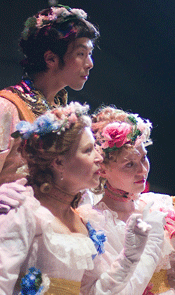 Junichi Fukuda, Rachel List and Joy Havens of the New York Baroque Dance Company with Opera Lafayette.
Thirty years ago, when Armide was presented at Carnegie Hall by an
organization calling itself the Friends of French Opera, the producers were
unable to find a cast capable of performing Gluck’s declamatory melody.
Among the variously maladroit styles that evening long ago, the one thoroughly
enjoyable performance was given by the late Bianca Berini, an old-fashioned
Verdi mezzo, portraying La Haine. Lacking scenery, Berini chewed Carnegie Hall
itself down to the lath and plaster. Today, when the grand Verdi manner is
almost extinct, a crop of singers capable of performing Gluck adeptly has
appeared on the scene — I am thinking, in particular, of Christine
Brewer’s Alceste, David Daniels’s Orfeo, Danielle de Niese’s
Euridice, Vinson Cole’s Admète, Krassimira Stoyanova’s Iphigénie en
Aulide, Ekaterina Gubanova’s Clytemnestre. We must now add Dominique
Labelle’s Armide for Opera Lafayette.
Labelle has an unusual voice, pastel fire in a broad palette of hues, carefully displayed here to indicate haughty indifference, voluptuous flirtation, strident rage and, ultimately, despair. Gluck puts Armide through her paces, but Labelle could handle everything he tossed her way.
Stephanie Houtzeel, as La Haine, was a treat for connoisseurs of audible and visible over-the-top hauteur, but she lacked the depths of voice ideal for this contralto role. I found William Burden — a notable Pylade in Iphigénie in Tauride at the New York City Opera — pallid and uncertain in the early, heroic scenes of his role, though his pretty tenor grew in size and warmth as the amorous duets progressed and the intensity of his feelings evolved. Judith van Wanroij displayed a glossy soprano of generous size in three small roles. Nathalie Paulin, her companion in three others, gave pleasure but with less fullness and more classic restraint. Veteran William Sharp sang a pagan king of great glamour. Robert Getchell, who drew particular applause, and Darren Perry did well by the comic roles of the knights sent to reclaim the lost Renaud for the Christian cause — constantly distracted by spirits masquerading as the girls they left back home.
The orchestra takes its place as a full participant in any performance of Armide. The score is full of scene-painting: tempests rise and fall, ravines and ghoul-haunted woodlands are traversed, Furies are summoned from the depths of Hell, and sylphs glide on from some poetic Arcady. Gluck seizes every opportunity to depict activity, atmosphere and setting — curiously enough, not with the winds and brasses that most composers rely on for such things (though these are present), but almost entirely through the strings, the ways they are played, the rhythms they record or interrupt: basses slash and grumble, violins surge and tremble. Is Gluck consciously recalling, for this libretto from a previous century, that Louis XIV’s first court orchestra consisted entirely of violins (the first time in history that twenty instruments ever played in tune) and that composers were long reluctant to add flutes to such a mix, much less bassoons or horns? Or is it merely that he’s so good with strings he doesn’t need to bother with anything else? Certainly, without drowning anyone out, the music carries the singers in Armide rather than merely accompanying them. Ryan Brown’s dancing and ardent conducting inspired great melodramatic storms of sound to alternate with the elegant dances that make up so much of any French grand opera of the period.
This being the case, Opera Lafayette was content to leave the scenery and costumes (aside from the six dancers of the New York Baroque Dance Company) to Gluck’s music and our imaginations. The Rose Theater — which I estimate is barely twice the size of the jewel-box Residenz-Theater in Munich where Mozart’s Idomeneo premiered — is an ideal space for Gluck or almost any other eighteenth-century opera other than those depending on special scenic effects. Voices sound big and juicy without forcing, a small orchestra and chorus sound enormous.
Dance always played a large part in French grand opera, and reconstructing French court dance has long been Catherine Turocy’s specialty. Her dancers here enacted battling warriors, masked temptations, courting shepherds and rag-headed demons with steps that hovered between mime and formal dance. They were always entertaining and generally relevant to the story, and when masked evincing an impersonality appropriate to spirits summoned and embodied by a great and enigmatic witch.
John Yohalem