![Nino Surguladze as Dorabella [Photo by Richard Hubert Smith courtesy of Royal Opera House]](http://www.operatoday.com/Surguladze_Dorabella_ROH.gif)
02 Feb 2010
Così fan tutte, Covent Garden
First seen in 1995, and here receiving its seventh revival, Jonathan Miller’s Così fan tutte has lost none of its power to unsettle and discomfort.
English Touring Opera are delighted to announce a season of lyric monodramas to tour nationally from October to December. The season features music for solo singer and piano by Argento, Britten, Tippett and Shostakovich with a bold and inventive approach to making opera during social distancing.
This tenth of ten Live from London concerts was in fact a recorded live performance from California. It was no less enjoyable for that, and it was also uplifting to learn that this wasn’t in fact the ‘last’ LfL event that we will be able to enjoy, courtesy of VOCES8 and their fellow vocal ensembles (more below …).
Ever since Wigmore Hall announced their superb series of autumn concerts, all streamed live and available free of charge, I’d been looking forward to this song recital by Ian Bostridge and Imogen Cooper.
The Sixteen continues its exploration of Henry Purcell’s Welcome Songs for Charles II. As with Robert King’s pioneering Purcell series begun over thirty years ago for Hyperion, Harry Christophers is recording two Welcome Songs per disc.
Although Stile Antico’s programme article for their Live from London recital introduced their selection from the many treasures of the English Renaissance in the context of the theological debates and upheavals of the Tudor and Elizabethan years, their performance was more evocative of private chamber music than of public liturgy.
In February this year, Albanian soprano Ermonela Jaho made a highly lauded debut recital at Wigmore Hall - a concert which both celebrated Opera Rara’s 50th anniversary and honoured the career of the Italian soprano Rosina Storchio (1872-1945), the star of verismo who created the title roles in Leoncavallo’s La bohème and Zazà, Mascagni’s Lodoletta and Puccini’s Madama Butterfly.
Evidently, face masks don’t stifle appreciative “Bravo!”s. And, reducing audience numbers doesn’t lower the volume of such acclamations. For, the audience at Wigmore Hall gave soprano Elizabeth Llewellyn and pianist Simon Lepper a greatly deserved warm reception and hearty response following this lunchtime recital of late-Romantic song.
Collapsology. Or, perhaps we should use the French word ‘Collapsologie’ because this is a transdisciplinary idea pretty much advocated by a series of French theorists - and apparently, mostly French theorists. It in essence focuses on the imminent collapse of modern society and all its layers - a series of escalating crises on a global scale: environmental, economic, geopolitical, governmental; the list is extensive.
For this week’s Live from London vocal recital we moved from the home of VOCES8, St Anne and St Agnes in the City of London, to Kings Place, where The Sixteen - who have been associate artists at the venue for some time - presented a programme of music and words bound together by the theme of ‘reflection’.
'Such is your divine Disposation that both you excellently understand, and royally entertaine the Exercise of Musicke.’
Amongst an avalanche of new Mahler recordings appearing at the moment (Das Lied von der Erde seems to be the most favoured, with three) this 1991 Mahler Second from the 2nd Kassel MahlerFest is one of the more interesting releases.
‘And there was war in heaven: Michael and his angels fought against the dragon; and the dragon fought and his angels, And prevailed not; neither was their place found any more in heaven … that old serpent … Satan, which deceiveth the whole world: he was cast out into the earth, and his angels were cast out with him.’
If there is one myth, it seems believed by some people today, that probably needs shattering it is that post-war recordings or performances of Wagner operas were always of exceptional quality. This 1949 Hamburg Tristan und Isolde is one of those recordings - though quite who is to blame for its many problems takes quite some unearthing.
There was never any doubt that the fifth of the twelve Met Stars Live in Concert broadcasts was going to be a palpably intense and vivid event, as well as a musically stunning and theatrically enervating experience.
‘Love’ was the theme for this Live from London performance by Apollo5. Given the complexity and diversity of that human emotion, and Apollo5’s reputation for versatility and diverse repertoire, ranging from Renaissance choral music to jazz, from contemporary classical works to popular song, it was no surprise that their programme spanned 500 years and several musical styles.
The Academy of St Martin in the Fields have titled their autumn series of eight concerts - which are taking place at 5pm and 7.30pm on two Saturdays each month at their home venue in Trafalgar Square, and being filmed for streaming the following Thursday - ‘re:connect’.
The London Symphony Orchestra opened their Autumn 2020 season with a homage to Oliver Knussen, who died at the age of 66 in July 2018. The programme traced a national musical lineage through the twentieth century, from Britten to Knussen, on to Mark-Anthony Turnage, and entwining the LSO and Rattle too.
With the Live from London digital vocal festival entering the second half of the series, the festival’s host, VOCES8, returned to their home at St Annes and St Agnes in the City of London to present a sequence of ‘Choral Dances’ - vocal music inspired by dance, embracing diverse genres from the Renaissance madrigal to swing jazz.
Just a few unison string wriggles from the opening of Mozart’s overture to Le nozze di Figaro are enough to make any opera-lover perch on the edge of their seat, in excited anticipation of the drama in music to come, so there could be no other curtain-raiser for this Gala Concert at the Royal Opera House, the latest instalment from ‘their House’ to ‘our houses’.
"Before the ending of the day, creator of all things, we pray that, with your accustomed mercy, you may watch over us."
First seen in 1995, and here receiving its seventh revival, Jonathan Miller’s Così fan tutte has lost none of its power to unsettle and discomfort.
This is not a buffa trifle, which sends the audience home feeling amused and rather smug; indeed, discussing Charles Lamb’s description of the work as an ‘artificial comedy’, in the programme Miller himself notes that “within such as idiom the awkward improbabilities of the plot can be seen as a device that helps to make the opera more, rather than less, serious”.
Certainly, the visual impression created by the stark, but elegant, modern sets — scattered with a few throwaway allusions to the grand classical tragedies of Gluck — is one of coldness and aloofness. The ladies’ house is mid-refurbishment, and in such minimalist surroundings, with little to distract the eye or nourish the soul, it’s no wonder that the cast are enwrapped in solitude, absorbed by their mirrors, magazines and iPods. Having updated the original production, Miller cleverly uses such props to lighten the cynicism: Despina types the marriage contract on a laptop, and the ubiquitous mobile ’phones crop up in almost every scene — the sisters snap away with their cameras, Alfonso ‘calls a friend’ to summon a military drum roll, and a sweeping flourish on the continuo neatly serves as a tinkling ring tone.
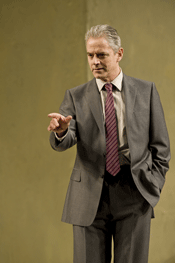 William Shimell as Alfonso
The uniformly accomplished cast certainly had the measure of the concept,
and the acting was superb throughout. Relaxing into her glamorous boots, Nino
Surguladze enjoyed flirting and flouncing as a coquettish Dorabella; 'È amore
un ladroncello' proved that she was equally secure at both ends of her
register, and displayed her warm, supple tone. Sally Matthews offered a
controlled, detailed performance as Fiordiligi, alert to the subtle nuances,
intensely introspective and self-restrained. Indeed, in her effort to totally
embody the staid stoic, Matthews tried a little too hard, and her voice was at
times rather too inflexible; she certainly had the technical arsenal to cope
with the outlandish angular leaps of ‘Come scoglio’, and the high B
at the end of 'Per pietà' was spot on; her unravelling in Act 2 was conveyed by
a rich array of different vocal colours, and she displayed an impressively
resonant lower register; but, overall her voice lacked a certain warmth, and
her arias failed to move this listener. Maybe this was apt for Miller’s
conception, but it felt a bit too flinty and dry for me — we marvelled at
the technical prowess, laughed at her pride, pitied her fall, but did not
genuinely feel for her in her disillusionment.
The boys enjoyed their outlandish disguises — flowing locks, bandannas, black leather and shades — indulging in much horseplay, posturing and melodrama. As a heavy metal aficionado, Gulglielmo (Troy Cook) was suitably cock-sure, and petulant in his comeuppance, angrily muttering uncharitable thoughts during the Ab canon at the wedding. Charles Castronovo has a light but emotive voice, perfect for the soulful hippie, Ferrando; he was on outstanding form all evening. His cavatina, ‘Tradito, schernito dal perfido cor’ was ravishing. And, in his duet with Matthews, ‘Per gli amplessi’, both characters were not only effortlessly seductive, but rightly and totally absorbed by the beauty of their own singing and by their romantic vision of Love.
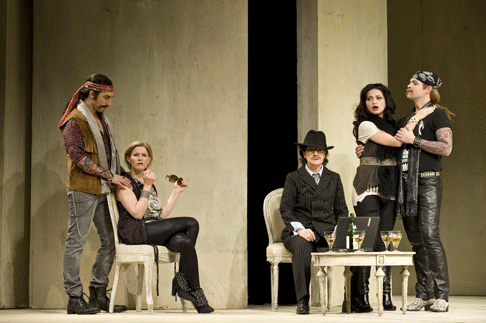 (Left to Right) Charles Castronovo as Ferrando, Sally Matthews as Fiordiligi, Helene Schneiderman as Despina, Nino Surguladze as Dorabella and Troy Cook as Guglielmo
Don Alfonso (William Shimell) was appropriately cool and debonair, elegantly reclining to observe the shenanigans with amused distaste, but sometimes too detached to be convincing as the arch manipulator. From the opening trio, he seemed underpowered vocally although he did warm up as proceedings progressed, playing a more decisive role in ‘Soave sia il vento’; and, in fact, the lack of lustre to his tone, and the frequent absence of vibrato, did lend him a sad, resigned air, as he subtly guided his dupes from the sidelines.
Helene Schneiderman was a natural as Despina, an amoral good-time girl who really couldn’t see what the fuss was all about, and who encouraged us to see the idiocy of her mistresses’ self-delusions. Both of her two short arias were proficiently despatched, but it was in the recitatives that she shone, as a sharp PA, soothing the over-anxious ladies with cups of Starbucks and Prozac, rattling off the witty barbs and lampooning their pretensions.
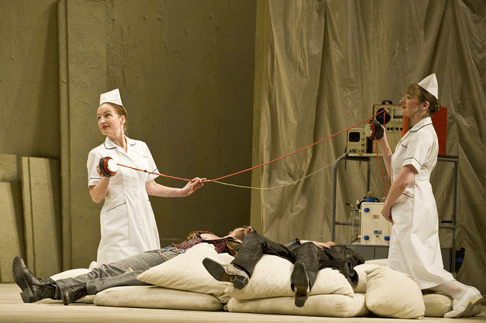 A scene from Così fan tutte
Making her debut at the ROH Julia Jones created a light-hearted, flippant musical fabric, expertly teasing out the woodwind solos which play such a subtle role in the drama. Balance and unity between stage and pit was superb, although I would have liked a swifter pace at times.
It may be an opera of ‘pairs’ but ultimately Miller’s ‘couples’ are isolated individuals, alone with only their self-regard for companionship. Mozart’s music may evoke the supreme beauty of love, and suggest the sincerity of their affections, but the musical and dramatic irony is piquant. Miller’s vision punctures the profundity of their self-deceiving ardour, and his symbolism is apt: as the intense self-absorption of Fiordiligi, as she gazes adoringly into the mirror, suggests, the only thing these solipsists truly love is themselves.
Da Ponte’s libretto has been condemned as absurd, cynically immoral and tritely trivial — Miller’s reading is all these things … and utterly convincing! The great Charles Rosen complained that Così was not ‘true to life’ but merely faithful to an eighteenth-century view of human nature, but I would suggest that Miller proves him wrong. The opera is to some extent a ‘closed system’; but this is not to say that it is not relevant to the outside world, or a reflection of our own. While the mobile ’phone gags may be less fresh than they were fifteen years ago, Miller’s updating, with its unconsoling conclusion, succeeds in convincing us that not only are ‘they all the same’, but so are we.
Claire Seymour