02 Feb 2010
Parsifal on the Cote d’Azur
Parsifal had its first performances in Bayreuth in 1882 where it was soon seen by Wagner’s soul mate Friedrich Nietzsche. And there the friendship ended.
English Touring Opera are delighted to announce a season of lyric monodramas to tour nationally from October to December. The season features music for solo singer and piano by Argento, Britten, Tippett and Shostakovich with a bold and inventive approach to making opera during social distancing.
This tenth of ten Live from London concerts was in fact a recorded live performance from California. It was no less enjoyable for that, and it was also uplifting to learn that this wasn’t in fact the ‘last’ LfL event that we will be able to enjoy, courtesy of VOCES8 and their fellow vocal ensembles (more below …).
Ever since Wigmore Hall announced their superb series of autumn concerts, all streamed live and available free of charge, I’d been looking forward to this song recital by Ian Bostridge and Imogen Cooper.
The Sixteen continues its exploration of Henry Purcell’s Welcome Songs for Charles II. As with Robert King’s pioneering Purcell series begun over thirty years ago for Hyperion, Harry Christophers is recording two Welcome Songs per disc.
Although Stile Antico’s programme article for their Live from London recital introduced their selection from the many treasures of the English Renaissance in the context of the theological debates and upheavals of the Tudor and Elizabethan years, their performance was more evocative of private chamber music than of public liturgy.
In February this year, Albanian soprano Ermonela Jaho made a highly lauded debut recital at Wigmore Hall - a concert which both celebrated Opera Rara’s 50th anniversary and honoured the career of the Italian soprano Rosina Storchio (1872-1945), the star of verismo who created the title roles in Leoncavallo’s La bohème and Zazà, Mascagni’s Lodoletta and Puccini’s Madama Butterfly.
Evidently, face masks don’t stifle appreciative “Bravo!”s. And, reducing audience numbers doesn’t lower the volume of such acclamations. For, the audience at Wigmore Hall gave soprano Elizabeth Llewellyn and pianist Simon Lepper a greatly deserved warm reception and hearty response following this lunchtime recital of late-Romantic song.
Collapsology. Or, perhaps we should use the French word ‘Collapsologie’ because this is a transdisciplinary idea pretty much advocated by a series of French theorists - and apparently, mostly French theorists. It in essence focuses on the imminent collapse of modern society and all its layers - a series of escalating crises on a global scale: environmental, economic, geopolitical, governmental; the list is extensive.
For this week’s Live from London vocal recital we moved from the home of VOCES8, St Anne and St Agnes in the City of London, to Kings Place, where The Sixteen - who have been associate artists at the venue for some time - presented a programme of music and words bound together by the theme of ‘reflection’.
'Such is your divine Disposation that both you excellently understand, and royally entertaine the Exercise of Musicke.’
Amongst an avalanche of new Mahler recordings appearing at the moment (Das Lied von der Erde seems to be the most favoured, with three) this 1991 Mahler Second from the 2nd Kassel MahlerFest is one of the more interesting releases.
‘And there was war in heaven: Michael and his angels fought against the dragon; and the dragon fought and his angels, And prevailed not; neither was their place found any more in heaven … that old serpent … Satan, which deceiveth the whole world: he was cast out into the earth, and his angels were cast out with him.’
If there is one myth, it seems believed by some people today, that probably needs shattering it is that post-war recordings or performances of Wagner operas were always of exceptional quality. This 1949 Hamburg Tristan und Isolde is one of those recordings - though quite who is to blame for its many problems takes quite some unearthing.
There was never any doubt that the fifth of the twelve Met Stars Live in Concert broadcasts was going to be a palpably intense and vivid event, as well as a musically stunning and theatrically enervating experience.
‘Love’ was the theme for this Live from London performance by Apollo5. Given the complexity and diversity of that human emotion, and Apollo5’s reputation for versatility and diverse repertoire, ranging from Renaissance choral music to jazz, from contemporary classical works to popular song, it was no surprise that their programme spanned 500 years and several musical styles.
The Academy of St Martin in the Fields have titled their autumn series of eight concerts - which are taking place at 5pm and 7.30pm on two Saturdays each month at their home venue in Trafalgar Square, and being filmed for streaming the following Thursday - ‘re:connect’.
The London Symphony Orchestra opened their Autumn 2020 season with a homage to Oliver Knussen, who died at the age of 66 in July 2018. The programme traced a national musical lineage through the twentieth century, from Britten to Knussen, on to Mark-Anthony Turnage, and entwining the LSO and Rattle too.
With the Live from London digital vocal festival entering the second half of the series, the festival’s host, VOCES8, returned to their home at St Annes and St Agnes in the City of London to present a sequence of ‘Choral Dances’ - vocal music inspired by dance, embracing diverse genres from the Renaissance madrigal to swing jazz.
Just a few unison string wriggles from the opening of Mozart’s overture to Le nozze di Figaro are enough to make any opera-lover perch on the edge of their seat, in excited anticipation of the drama in music to come, so there could be no other curtain-raiser for this Gala Concert at the Royal Opera House, the latest instalment from ‘their House’ to ‘our houses’.
"Before the ending of the day, creator of all things, we pray that, with your accustomed mercy, you may watch over us."
Parsifal had its first performances in Bayreuth in 1882 where it was soon seen by Wagner’s soul mate Friedrich Nietzsche. And there the friendship ended.
Nietzsche and possibly most everyone else have been ever after bewildered by Wagner’s renunciation of love. After all love had always been the overwhelming motivation for the antics of Wagnerian mythology.
In 1883 Nietzsche began his winter sojourns to Nice and the mild winters of the French riviera where he envisioned his diatribe Nietzsche contra Wagner. But neither Parsifal nor any other Wagnerian masterpieces have been frequent visitors to this gentle climate of subtle sensual beauty. And not only because climatic subtlety and cruel philosophy seem at odds with one another, but also because when Nice re-built its opera house in 1882 the city fathers looked to old Italian theaters as models rather than to the latest theatrical theories and techniques from Bayreuth. Wagner’s mature operas are simply too huge to stuff into a small horse-shoe theater of delicate decoration.
The Opéra de Nice is now considered one of the finest monuments of belle époque architecture. With recent renovations and modifications it adequately serves much of the repertory. But for the really big stuff the Opéra de Nice (the name of the opera company and its theater are the same) takes over the 2500 seat Salle Apollon in what is called the Acropolis, an architectural monstrosity designed in the late 1970‘s that holds five other performing spaces, an exhibition hall and a bowling alley or two as well.
The Opéra de Nice is in transition, its new management transforming it into a somewhat adventurous opera company with a serious production standard. This production of Parsifal was its first adventure, and a striking success. Not that artistic chances were taken — it was the 2004 production from the Grand Théâtre de Genève, the metteurs en scène were the Swiss minimalist designer Roland Aeschlimann and the American minimalist choreographer Lucinda Childs. In Nice their original Geneva staging was realized by Dagmar Pischel who imbued it with vibrant new life.
This superb production was well served by a strong cast, led by Kurt Rydl as Gurnemanz whose dramatic presence never faltered and fortunately his voice gained focus as the afternoon progressed (January 17) making his lengthy narrations a powerful frame for Wagner’s Easter saga. Parsifal himself was American Gary Lehman who has effected a transition from baritone to a splendid heldentenor of total security with power to burn. He was willing to attempt the acting of the innocent fool (surely one of opera’s more thankless tasks) redeeming his seeming dramatic naivete with fine vocal art. Russian soprano Elena Zhidkova defined the many facets of Kundry with dramatic precision, and sang securely and beautifully, her second act seduction and supplication convincingly delivered, her third act submission uncomfortable to watch (Nietzsche would have wretched).
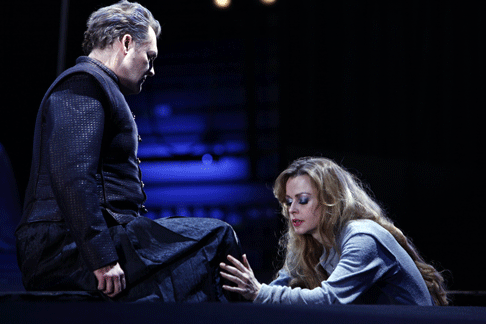
The antagonist was English baritone Peter Sidhom, the truly mad magician Klingsor who raged with Wagnerian élan, and was suitably stricken dumb. Finnish bass Jukka Rasilainen can and did possess a black tinted, i.e. colorless voice, ideal for the pitiful state of Amfortas, and well used to document his long suffering. He was well costumed in dreadlocks and black cloth, and then in white face for his death made poignant indeed with the dead Kundry draped across his lap. These two figures in this touching pietà was the culminating moment of this sculptural production.
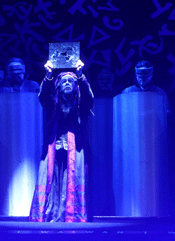
Aeschlimann and Childs made this Parsifal a ritual of death, the staging realized in poses and tableaus on a sloping stage platform broken by a long horizontal gash, its fore stage area embossed with the names of the knights of the Holy Grail, presumably their and perhaps our own tombs. The tabernacle was giant diminishing perfect circles where finally the grail appeared, a revolving faceted extra-terrestrial object that shone with all the cinematic panache of Stanley Kubrick’s 2001.
This inspired minimalism allowed the vivid vocal and musical performances to prevail, and bring us to a state of purification — even Nietzsche found the music of Parsifal to be sublimely beautiful (and maybe finding sublimity is redemption enough these days). Conductor Philippe Auguin paced the prelude very slowly, at first excruciatingly slow, but with time this unworldly pace took us to another realm — rarified teutonic mythology — and it was here that some of Wagner’s greatest music poured forth from the Orchestre Philharmonique de Nice for nearly five hours. Perhaps the poetry of Bayreuth was missing (and we did applaud after the first act), but very real Wagnerian musico-sensual pleasures were notably apparent making this Parsifal’s redemption an unforgettable afternoon on the Cote d’Azur.
N.B. All the subordinate roles were taken by quite accomplished, i.e. world class, performers. This Parsifal was an auspicious new beginning for the Opéra de Nice.
Michael Milenski