English Touring Opera are delighted to announce a season of lyric monodramas to tour nationally from October to December. The season features music for solo singer and piano by Argento, Britten, Tippett and Shostakovich with a bold and inventive approach to making opera during social distancing.
This tenth of ten Live from London concerts was in fact a recorded live performance from California. It was no less enjoyable for that, and it was also uplifting to learn that this wasn’t in fact the ‘last’ LfL event that we will be able to enjoy, courtesy of VOCES8 and their fellow vocal ensembles (more below …).
Ever since Wigmore Hall announced their superb series of autumn concerts, all streamed live and available free of charge, I’d been looking forward to this song recital by Ian Bostridge and Imogen Cooper.
The Sixteen continues its exploration of Henry Purcell’s Welcome Songs for Charles II. As with Robert King’s pioneering Purcell series begun over thirty years ago for Hyperion, Harry Christophers is recording two Welcome Songs per disc.
Although Stile Antico’s programme article for their Live from London recital introduced their selection from the many treasures of the English Renaissance in the context of the theological debates and upheavals of the Tudor and Elizabethan years, their performance was more evocative of private chamber music than of public liturgy.
In February this year, Albanian soprano Ermonela Jaho made a highly lauded debut recital at Wigmore Hall - a concert which both celebrated Opera Rara’s 50th anniversary and honoured the career of the Italian soprano Rosina Storchio (1872-1945), the star of verismo who created the title roles in Leoncavallo’s La bohème and Zazà, Mascagni’s Lodoletta and Puccini’s Madama Butterfly.
Evidently, face masks don’t stifle appreciative “Bravo!”s. And, reducing audience numbers doesn’t lower the volume of such acclamations. For, the audience at Wigmore Hall gave soprano Elizabeth Llewellyn and pianist Simon Lepper a greatly deserved warm reception and hearty response following this lunchtime recital of late-Romantic song.
Collapsology. Or, perhaps we should use the French word ‘Collapsologie’ because this is a transdisciplinary idea pretty much advocated by a series of French theorists - and apparently, mostly French theorists. It in essence focuses on the imminent collapse of modern society and all its layers - a series of escalating crises on a global scale: environmental, economic, geopolitical, governmental; the list is extensive.
For this week’s Live from London vocal recital we moved from the home of VOCES8, St Anne and St Agnes in the City of London, to Kings Place, where The Sixteen - who have been associate artists at the venue for some time - presented a programme of music and words bound together by the theme of ‘reflection’.
Amongst an avalanche of new Mahler recordings appearing at the moment (Das Lied von der Erde seems to be the most favoured, with three) this 1991 Mahler Second from the 2nd Kassel MahlerFest is one of the more interesting releases.
‘And there was war in heaven: Michael and his angels fought against the dragon; and the dragon fought and his angels, And prevailed not; neither was their place found any more in heaven … that old serpent … Satan, which deceiveth the whole world: he was cast out into the earth, and his angels were cast out with him.’
If there is one myth, it seems believed by some people today, that probably needs shattering it is that post-war recordings or performances of Wagner operas were always of exceptional quality. This 1949 Hamburg Tristan und Isolde is one of those recordings - though quite who is to blame for its many problems takes quite some unearthing.
There was never any doubt that the fifth of the twelve Met Stars Live in Concert broadcasts was going to be a palpably intense and vivid event, as well as a musically stunning and theatrically enervating experience.
‘Love’ was the theme for this Live from London performance by Apollo5. Given the complexity and diversity of that human emotion, and Apollo5’s reputation for versatility and diverse repertoire, ranging from Renaissance choral music to jazz, from contemporary classical works to popular song, it was no surprise that their programme spanned 500 years and several musical styles.
The Academy of St Martin in the Fields have titled their autumn series of eight concerts - which are taking place at 5pm and 7.30pm on two Saturdays each month at their home venue in Trafalgar Square, and being filmed for streaming the following Thursday - ‘re:connect’.
The London Symphony Orchestra opened their Autumn 2020 season with a homage to Oliver Knussen, who died at the age of 66 in July 2018. The programme traced a national musical lineage through the twentieth century, from Britten to Knussen, on to Mark-Anthony Turnage, and entwining the LSO and Rattle too.
With the Live from London digital vocal festival entering the second half of the series, the festival’s host, VOCES8, returned to their home at St Annes and St Agnes in the City of London to present a sequence of ‘Choral Dances’ - vocal music inspired by dance, embracing diverse genres from the Renaissance madrigal to swing jazz.
Just a few unison string wriggles from the opening of Mozart’s overture to Le nozze di Figaro are enough to make any opera-lover perch on the edge of their seat, in excited anticipation of the drama in music to come, so there could be no other curtain-raiser for this Gala Concert at the Royal Opera House, the latest instalment from ‘their House’ to ‘our houses’.
Gil Shohat, now 35 and Israeli’s top classical composer, was 15 when
in the ‘80s he saw Hanoch Levin’s The Child Dream on stage in his native Tel Aviv. Shohat, of course, knew Levin’s work well, for throughout early decades in the history of Israel he — its outstanding dramatist — had served somewhat as the conscience of a nation tormented defining itself within its pain-wrought beginnings.
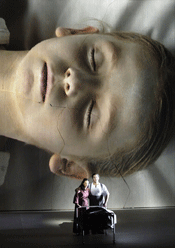
Gil Shohat: The Child Dreams Libretto based on a play by Hanoch Levin
“I knew then that I would compose Dream, said Shohat in a post-performance interview in the Tel Aviv Opera House, where
the premiere of the opera had taken place on January 18. Shohat’s plans
were seconded by Israeli Opera general director Hanna Munitz, who had also
sensed the operatic potential of drama when she saw it on stage.
Touched by the deep despair of the story and the genuine poetry of the text,
Munitz commissioned Dream for her company. It is the first opera
composed on any Levin text. Point of departure for Levin was the 1977 film
Voyage of the Damned, the story of the St. Louis, the ship unable
to attain landing rights for its fleeing refugees during World War II. But
this, it must be stressed, is no more than raw material for what is now
Child Dream.
True, the opera underscores the degree to which the Holocaust remains today
a defining experience for the Israeli consciousness, yet the local critic who
placed the new opera “among the most depressing and despair-radiating
operas of the repertoire” missed the point of the transformation of the
story through music achieved by Shohat and his director Omri Nizan. (Nizan, an
old hand at the Cameri Theater, helped Shohat with minor changes in the text
— nothing was added — and then served in the vastly more important
role as director of the production.)
For through music the child at the center of the drama becomes much more
than a single child and his story is far greater than the tale of one
individual example of injustice. The Child is now a young Everyman with hopes
for a better and more just world. That this world is closed to him — and
not just by the near-criminality of captain of the ship that might have brought
salvation — elevates Dream to the level of mythic
universality. The story is quickly told. The Mother hopes to escape with her
son on the ship. The Captain demands payment “in the flesh.” The
ship reaches a ghost-like island, but passengers are not allowed to disembark
by the despotic governor, the second evil figure in the story.
In one of the most moving moments in the score — 2 hours and 30
minutes with one intermission — a crippled child — mezzo Shira Raz
— comments:
I’m a poet.
I write about you who come out of the fog
and return and disappear in it. I weep over your fate
and sketch it.
your faces approaching tell the tale of delusion;
but all human failure is stamped on the back of your
departing neck.
The Crippled Child speaks above and across the play for Levin himself who
sees little but frustration and failure in the attempted escape.
The final act — an apotheosis of sorts — breaks with the seeming
realism of the earlier three acts (and it was wise, therefore, to insert the
intermission at this point). Dozens of “dead” children suspended
above the stage whisper of their fate while the female nonet that opened the
opera sings again of their sorry situation.
There is a Straussian sadness about this conclusion; it its muted melancholy
it recalls the elder composer’s Metamorphosen, the
“mourning for Munich” that he wrote after the destruction of his
native city. It is deeply felt and moving music that might well become a
concert piece in its own right.
And as the many who visit the memorial to children victims of the Holocaust
in Jerusalem’s Yad Vashem experience not consolation but rather the hope
beyond hopelessness so essential in any confrontation with the vast inhumanity
of the 20th century, here too there is an elevation beyond meaningless
suffering.
Child Dream is an ambitious work calling for a cast
of 20, all drawn from the roster of the resident company. Outstanding among
them were Larissa Tetuev as the Mother, a role she shared later with Ira
Bertman, Hila Baggio as the child and Noah Briger as the Captain.
In only his second season as IO music director, David Stern extracted
exemplary playing from the Rishon Le-Zion Orchestra, the company’s pit
band. Sets and costumes were effectively designed by Austrian-born Gottried
Helnwein. Lighting by Avi Yonah Bueno contributes to making this a colorful
show engaging to the eye.
Shohat has documented his superlative command of the composer’s craft
in an incredible long and diverse catalgue. In Dream, however, he
travels on no new turf, but concentrates rather on giving musical meaning to an
unusually demanding text.
Dream is written for reduced orchestra, and outstanding is the
manner in which Shohat has woven the piano into the ensemble to achieve unusual
effects. (The composer is a concretizing pianist as well.)
It is unavoidable that some find the opera with its focus on the death of
children depressing and even morbid. In so doing, they overlook the strong
element of empathy that Shohat’s music brings to Levin’s turgid
story. In the final analysis, Child Dream is an
affirmative work that deserves to be seen outside Israel.
The production celebrates the 35th anniversary of Israeli Opera; it further
marks the 10th anniversary of Hanoch Levin’s death and the centennial of
the founding of Tel Aviv.