Subscribe to
Opera Today

Receive articles and news via RSS feeds or email subscription.


twitter_logo[1].gif


UCP_9780226043425.gif

Recently in Reviews

Brahms Third in San Francisco

Nicola Luisotti and the San Francisco Opera Orchestra climbed out of the War Memorial pit, braved the wind whipped bay and held spellbound an audience at Cal Performances’ Zellerbach Auditorium at UC Berkeley.

Ariane et Barbe-Bleue on Blu-Ray

Paul Dukas’ Ariane et Barbe-Bleue, first heard in 1907, once seemed important. Arturo Toscanini conducted the Met premiere in 1911 with Farrar and later arranged some of its music for a 1947 recording with his NBC Symphony.

Glyndebourne: Ariadne auf Naxos

Utterly mad but absolutely right — Richard Strauss’s Ariadne auf Naxos started the Glyndebourne 2013 season with an explosion. Strauss could hardly have made his intentions more clear. Ariadne auf Naxos is not “about” Greek myth so much as a satire on art and the way art is made.

Wozzeck at ENO

“Man is an abyss. It makes one dizzy to look into it.” So utters Georg Büchner’s Woyzeck, repeating what was also a recurring motif in the playwright’s own letters.

Mulhouse: Rare Britten Well Done

National Opera Company of the Rhine has marked this year’s Benjamin Britten celebration with a remarkably compelling, often gripping new production of the seldom-seen Owen Wingrave.

Frankfurt's Intriguing Idomeneo

Once upon a time, Frankfurt Opera had the baddest ass reputation in Germany as “the” cutting edge producer of must-see opera.

Rigoletto at Lyric Opera of Chicago

Productions of Giuseppe Verdi’s Rigoletto can serve as a vehicle for individual singers to make a strong impression and become afterward associated with specific roles in the opera.

Britten Sinfonia with Ian Bostridge

Just in case we were not aware that the evening’s programme was ‘themed’, the Britten Sinfonia designed a visual accompaniment to their musical exploration of night, sleep and dreams.

Aida, Manitoba Opera

Poor Aida! She never seems to have anything go her way.

Superlative singing: Don Carlo, Royal Opera House

Is it possible to upstage Jonas Kaufmann? Kaufmann was brilliant in this Verdi Don Carlo at the Royal Opera House, London, but the rest of the cast was so good that he was but first among equals. Don Carlo is a vehicle for stars, but this time the stars were everyone on stage and in the pit. Even the solo arias, glorious as they are, grow organically out of perfect ensemble. This was a performance that brought out the true beauty of Verdi's music.

Sarah Connolly: French Song at Wigmore Hall

The big names were absent: Duparc, D’Indy, Debussy, Ravel … and while Fauré, Chausson, Roussel and several members of Les Six put in an appearance, in less than familiar guises, this survey of French song of the early 20th century and interwar years deliberately took us on a journey through infrequently travelled terrain.

Rare restoration: Handel’s Esther 1720

Composed between 1718 and 1720, Handel’s Esther is sometimes described as the ‘first English Oratorio’, but is in fact a hybrid form, mixing elements of oratorio, masque, pastoral and opera.

The Damnation of Faust, London

Hector Berlioz's légende dramatique, La Damnation de Faust, exists somewhere between cantata and opera. Berlioz's flexible attitude to dramatic form made the piece unworkable on the stages of early 19th century Paris and his music is so vivid that you wonder whether the piece needs staging at all.

Elizabeth Connell Memorial Concert, St John's Smith Square

St. John’s Smith Square was the site of Elizabeth Connell’s final London concert, intended as a farewell to London on her moving to Australia. It was rendered ultimately final by her unexpected death.

Aida with all the Trimmings, Even a Blue Silk Elephant!

With the building of the Suez Canal, Egypt became more interesting to Western Europeans. Khedive Ismail Pasha wanted a hymn by Verdi for the opening of a new opera house in Cairo, but the composer said he did not write occasional pieces.

Die Zauberflöte, Royal Opera

Back for its fourth revival, David McVicar’s 2003 production of Mozart’s Die Zauberflöte has much charm, beauty and artistry.

Kaufmann Wagner

The economics of the recording companies dictate much that is not ideal. Wagner’s operas were not composed as they were in order to permit the extraction of bleeding chunks, even on those occasions when strophic song forms do occur.

The Marriage of Figaro Ends Season at Arizona Opera

Wolfgang Amadeus Mozart's opera The Marriage of Figaro has a libretto by Lorenzo daPonte based on the French play La folle journée, ou le Mariage de Figaro (The Crazy Day or the Marriage of Figaro) by Pierre Caron de Beaumarchais (1732-1799).

Baden’s Flute Goes Barefoot in the Park

For its world class Easter Festival, Baden-Baden mounted a Die Zauberflöte that owed more to the grey penitential doldrums of Lent than to the unbridled jubilance of re-birth.

Bonjour M. Gauguin in Berkeley

Once Berkeley Opera, renamed West Edge Opera, this enterprising company offers the Bay Area’s only serious alternative to corporate opera, to wit Bonjour M. Gauguin.

OPERA TODAY ARCHIVES »

Reviews

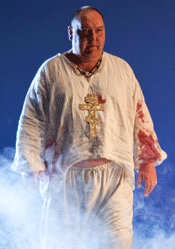
Lynton Black as Drago
23 Mar 2010

Genoveva — Schumann at UCL Opera, London

Genoveva and Lohengrin both premiered in the summer of 1850. Wagner disparaged Schumann, as he disparaged Mendelssohn (Schumann’s hero). Wagner’s opinions were influential. Genoveva has been eclipsed, saddled with a reputation for being hard to stage.

Robert Schumann: Genoveva op 81

Bibi Heal: Genoveva, Adam Green: Siegfried, Richard Rowe: Golo, Magdalen Ashman: Margaretha, Lynton Black: Drago, Ed Davison: Bishop Hilulfus, Simon Hall: Balthasar, Dan Hawkins: Caspar, Nick Goodman: Conrad. Chorus and Orchestra of University College. Charles Peebles: conductor. Emma Rivlin: Director,Christopher Giles: set designer, Ryszard Andrezejewski: costumes, Dan Swerdlow: lighting, Nichoilas Hall: fight director, Dena Lague: choreographer. University College Opera, Bloomsbury Theatre, UCL . London 22nd March 2010

Above: Lynton Black as Drago


Yet Schumann could write dramatic music as the much-loved Overture demonstrates, and the music in the Overture infuses the opera. His songs prove how well he could write for voice. His range as composer was wider than Wagner’s, and he was formidably well-read. What might Schumann have achieved had he continued writing after the age of 45?

UCL Opera is an unusually adventurous company. Since 1951 it has staged no less than 19 world or British premieres, and last year staged Ernest Bloch’s Macbeth . Next year, they’re planning Weber’s Die drei Pintos (completed by Mahler). Because UCL Opera does repertoire where there’s little entrenched performance tradition, its approach can be fresh and imaginative.

The original folk tale on which Genoveva is based dates back to the Middle Ages. Indeed it’s the basis of stories like Snow White, for in legend, Genoveva lived in the forest, protected by animals and by her virtue. Significantly, though, Schumann rejected the medieval concept, choosing instead to base his opera on Friedrich Hebbel’s more psychological drama, published only four years previously. Schumann wanted a “modern” take on the story. As Hebbel said “Any drama will come alive only to the extent that it expresses the spirit of the age which brings it forth”.

Schumnann’s Genoveva focuses on fundamentals — good versus evil, integrity versus deceit, the individual against the mob. Such concepts apply just as much today as they did in Schumann’s time. Its basis is the dynamic between Golo and Genoveva, who isn’t as passive as the legend would have. This gives the opera inherent drama and energy, which a really good performance can bring out.

Schumann’s orchestration is colourful. Genoveva and Seigfried have just married, but he’s going off to war. Glorious trumpet fanfares, woodwind and drums depict the excitement of battle. Alone, and isolated, Genoveva’s music is tender, heightening her confrontations with Golo and the baying mob. Later, when Drago’s ghost appears, Schumann’s dark, gloomy textures would have evoked, to his audience, the Wolf Glen scene in Weber’s Der Freischütz.

There’s plenty of incident in this narrative - a rape, mob violence, murder and of course the ghost and the witch. The sharpness of the German original is muted in English. Although the translation is by David Pountney, it’s clumsy and doesn’t adapt well to the musical line. However, it’s unrealistic to expect a largely student cast to sing idiomatically in a foreign language, and audiences might justifiably complain if they don’t know the libretto.

Perhaps, too, the drama might have been much more pointed if the set wasn’t quite so self-consciously medieval. Although the story is supposed to happen at the time of Charlemagne, Schumann (and Hebbel) quite explicitly understood the setting as allegory for universal concepts. Yet again, though, it’s asking too much of a production like this to be too ambitious. Audiences who don’t know the opera need to be guided into it gently.

What was good about the direction (Emma Rivlin) was that it didn’t gloss over the violence. The rape scene is graphic. Drago is beaten to death by the mob, whipped into frenzy by Golo’s accusations. Later Balthasar and Caspar (Simon Hall and Dan Hawkins) take yobbish delight in humiliating Genoveva. The fight scenes were well choreographed.

Unlike most student companies, UCL Opera employs professionals in key roles. In Genoveva, this makes a difference as Schumann writes the parts using the full range of each voice type. The duets and trios are so well written that the voices are clearly differentiated. Bibi Heal and Richard Rowe as Genoveva and Golo, acquitted themselves well.

Adam Green’s Seigfried was unusually impressive. He’s a natural actor, who brings depth and credibility to the part. Green’s Seigfried is sexy and charismatic. You can understand why Genoveva will suffer so much for his sake. It’s more than conventional loyalty. Also impressive was Lynton Black as Drago, the servant who is murdered as a scapegoat. When he reappears as a ghost he frightens Golo’s fellow plotter Margarethe (Magdalen Ashman) so much that she tells Siegfried the truth.

Perhaps the Bloomsbury Theatre is on the small side for an opera like this, with fairly large chorus and orchestra, at times overwhelming the voices. Yet again, that’s not really a fault. It is much more important that performers are enthusiastic and energetic, and enter into the spirit of the music. Genoveva is raw drama, after all, and a few ragged edges are a small price to pay when performances are as committed as this. That, ultimately, is the point of UCL Opera, to raise new generations to learn and care about operas that are off the beaten track.

Anne Ozorio
Send to a friend

Send a link to this article to a friend with an optional message.

Friend's Email Address: (required)

Your Email Address: (required)

Message (optional):