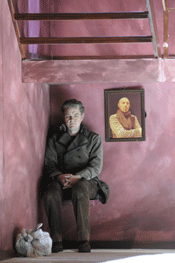
![Keith Ikaia-Purdy as Carlo/Rolla [Photo by Jacqueline Krause-Burberg courtesy of Badisches Staatstheater]](http://www.operatoday.com/Raeuber_14.gif)
05 Mar 2010
Karlsruhe: Rare Verdi, Well Done
The Baden State Theatre's new mounting of I Masnadieri may not completely be the production of one’s dreams.
English Touring Opera are delighted to announce a season of lyric monodramas to tour nationally from October to December. The season features music for solo singer and piano by Argento, Britten, Tippett and Shostakovich with a bold and inventive approach to making opera during social distancing.
This tenth of ten Live from London concerts was in fact a recorded live performance from California. It was no less enjoyable for that, and it was also uplifting to learn that this wasn’t in fact the ‘last’ LfL event that we will be able to enjoy, courtesy of VOCES8 and their fellow vocal ensembles (more below …).
Ever since Wigmore Hall announced their superb series of autumn concerts, all streamed live and available free of charge, I’d been looking forward to this song recital by Ian Bostridge and Imogen Cooper.
The Sixteen continues its exploration of Henry Purcell’s Welcome Songs for Charles II. As with Robert King’s pioneering Purcell series begun over thirty years ago for Hyperion, Harry Christophers is recording two Welcome Songs per disc.
Although Stile Antico’s programme article for their Live from London recital introduced their selection from the many treasures of the English Renaissance in the context of the theological debates and upheavals of the Tudor and Elizabethan years, their performance was more evocative of private chamber music than of public liturgy.
In February this year, Albanian soprano Ermonela Jaho made a highly lauded debut recital at Wigmore Hall - a concert which both celebrated Opera Rara’s 50th anniversary and honoured the career of the Italian soprano Rosina Storchio (1872-1945), the star of verismo who created the title roles in Leoncavallo’s La bohème and Zazà, Mascagni’s Lodoletta and Puccini’s Madama Butterfly.
Evidently, face masks don’t stifle appreciative “Bravo!”s. And, reducing audience numbers doesn’t lower the volume of such acclamations. For, the audience at Wigmore Hall gave soprano Elizabeth Llewellyn and pianist Simon Lepper a greatly deserved warm reception and hearty response following this lunchtime recital of late-Romantic song.
Collapsology. Or, perhaps we should use the French word ‘Collapsologie’ because this is a transdisciplinary idea pretty much advocated by a series of French theorists - and apparently, mostly French theorists. It in essence focuses on the imminent collapse of modern society and all its layers - a series of escalating crises on a global scale: environmental, economic, geopolitical, governmental; the list is extensive.
For this week’s Live from London vocal recital we moved from the home of VOCES8, St Anne and St Agnes in the City of London, to Kings Place, where The Sixteen - who have been associate artists at the venue for some time - presented a programme of music and words bound together by the theme of ‘reflection’.
'Such is your divine Disposation that both you excellently understand, and royally entertaine the Exercise of Musicke.’
Amongst an avalanche of new Mahler recordings appearing at the moment (Das Lied von der Erde seems to be the most favoured, with three) this 1991 Mahler Second from the 2nd Kassel MahlerFest is one of the more interesting releases.
‘And there was war in heaven: Michael and his angels fought against the dragon; and the dragon fought and his angels, And prevailed not; neither was their place found any more in heaven … that old serpent … Satan, which deceiveth the whole world: he was cast out into the earth, and his angels were cast out with him.’
If there is one myth, it seems believed by some people today, that probably needs shattering it is that post-war recordings or performances of Wagner operas were always of exceptional quality. This 1949 Hamburg Tristan und Isolde is one of those recordings - though quite who is to blame for its many problems takes quite some unearthing.
There was never any doubt that the fifth of the twelve Met Stars Live in Concert broadcasts was going to be a palpably intense and vivid event, as well as a musically stunning and theatrically enervating experience.
‘Love’ was the theme for this Live from London performance by Apollo5. Given the complexity and diversity of that human emotion, and Apollo5’s reputation for versatility and diverse repertoire, ranging from Renaissance choral music to jazz, from contemporary classical works to popular song, it was no surprise that their programme spanned 500 years and several musical styles.
The Academy of St Martin in the Fields have titled their autumn series of eight concerts - which are taking place at 5pm and 7.30pm on two Saturdays each month at their home venue in Trafalgar Square, and being filmed for streaming the following Thursday - ‘re:connect’.
The London Symphony Orchestra opened their Autumn 2020 season with a homage to Oliver Knussen, who died at the age of 66 in July 2018. The programme traced a national musical lineage through the twentieth century, from Britten to Knussen, on to Mark-Anthony Turnage, and entwining the LSO and Rattle too.
With the Live from London digital vocal festival entering the second half of the series, the festival’s host, VOCES8, returned to their home at St Annes and St Agnes in the City of London to present a sequence of ‘Choral Dances’ - vocal music inspired by dance, embracing diverse genres from the Renaissance madrigal to swing jazz.
Just a few unison string wriggles from the opening of Mozart’s overture to Le nozze di Figaro are enough to make any opera-lover perch on the edge of their seat, in excited anticipation of the drama in music to come, so there could be no other curtain-raiser for this Gala Concert at the Royal Opera House, the latest instalment from ‘their House’ to ‘our houses’.
"Before the ending of the day, creator of all things, we pray that, with your accustomed mercy, you may watch over us."
The Baden State Theatre's new mounting of I Masnadieri may not completely be the production of one’s dreams.
But then, does anyone really dream of I Masnadieri? One thing absolutely dreamy about the performance was the starry cast, a first rate quartet of soloists that could hold its own in any major international house. Indeed, when I remarked to a Viennese colleague that I thought the Staatsoper might be happy with these fine vocalists he retorted: “Are you kidding? They would be jealous!”
Barbara Dobrzanska continues to be one of my most favorite spinto sopranos. Having first been bowled over by her Suor Angelica, I subsequently marveled at her Butterfly, admired her Desdemona and Elisabetta in equal measure, and was wrung out emotionally by her tender Liu. But Amalia is one of those early-mid-Verdi hybrid roles that requires in equal part: steely dramatic output over the sometimes noisily scored oom-pah-ing band, heroic Bellini-holdover lyric singing, and Donizettian coloratura fireworks (make up your mind, Giuseppe!). True to form, the Divine Miss D swept all those challenges before her with great elan.
 Klaus Schneider as Arminio
As ever, her knowing skill in crafting an arching vocal line was informed by her unerring musicality as she presented a well-rounded, varied, and eminently interesting characterization. What was a revelation to me was the facility with which she casually tossed off the exposed roulades and fiorituri, and the telling way each vocal gesture was meaningfully couched. Add to this Barbara’s sincere acting and unaffected stage presence, and we have yet another memorable role form this highly talented artist. Don’t know why she is not regularly treading the world stages by now, but the local public should (and does) rejoice in her continued presence in Karlsruhe.
Another company treasure is tenor Keith Ikaia-Purdy who seems born to sing these Verdi heroes. Although his burnished, ringing tone really shines above the staff, there is a warmly solid presence in the lower reaches as well. That said, the first aria lies a bit ungratefully in the fringes just upward of the middle of the voice, although he negotiated it reliably with his sound technique and professional skill. It was after this opening number that Mr. Ikaia-Purdy really came into his own, and he lavished us with some beautiful phrasing and heartfelt commitment, full of Bergonzian portamento and Verdian temperament. Moreover, he and Ms. Dobrzanska partner each other exceptionally well, and as they rose above the orchestra at full volume, the exquisite outpouring of molten vocalism was overwhelming.
Kammersänger Konstantin Gorny contributed a beautifully judged account of not only Massimiliano, but also Pastor Moser. His richly orotund, cavernous bass is powerfully deployed to outstanding effect. Mr. Gorny wrung the most out his every phrase, and is a stylish Verdian. His instrument lacks the biting edge of many other Russian singers (not a bad thing!), and when the orchestra is playing fortissimo he can blend into the instrumental fabric a bit. But this is a very minor observation in what was a commanding portrayal.
Baritone Stefan Stoll rounded out the quartet with an assured assumption of the role of Francseco. Mr. Stoll has a real Italianate ping in his upper register, and especially relished the many high-lying outbursts that gave great pleasure. Lower down, the tone got a bit more diffuse, sounding more German-generic, although always healthy and well-placed. In the small role of Arminio, Klaus Schneider was secure and did all that was required.
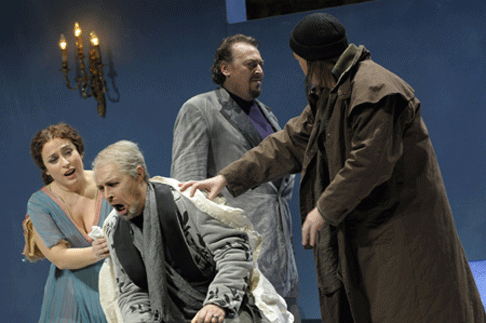 Barbara Dobrzanska as Amalia, Konstantin Gorny as Massimiliano/Moser, Stefan Stoll as Francesco and Klaus Schneider as Arminio
The orchestra had an exceptionally fine evening, playing with brio and stylistic acumen under the inspiring baton of conductor Jochem Hochstenbach. The Maestro not only found good variety in this lesser Verdi, but also maintained the dramatic shape with an unerring sense of pace and color. Johann Ludwig’s cello solo was achingly beautiful. The chorus (and ‘extra’ Chor) were schooled to a fare-thee-well (or an addio) by Ulrich Wagner.
Director Alexander Schulin’s idiosyncratic staging was quirky, to be sure, but he displayed the great, rare gift of making the relationships deeply personal and believably clarifying the story. This is no mean feat, given that the far-fetched machinations of the libretto pretty much follow the improbabilities of the original Schiller concoction. Mr. Schulin started with an imposing unit design by Christoph Sehl as realized by Michele Lorenzini. At curtain rise, a coolly beautiful, blue-green tinted photo-realistic forest drop was revealed. The three leading men wandered variously across the stage in front of it, passing each other without acknowledgment, like lost souls in Purgatory. So far so good.
The drop subsequently flew out to reveal an imposing two-story family manse with a large main reception hall stage left, a stairwell and landing in the center, and a greenhouse stage right topped by a second floor bed room/study, all meticulously constructed and dressed with meaningful, well-chosen furnishings. Behind it was an identical forest drop. And that, my friends, was all. And it was more than enough. In fact, it was splendidly compact.
Carlo plays his first scene isolated in the greenhouse (forest). Bad boy Francesco commandeers and prowls his space in the bed room above like Scarpia in the Farnese Palace. Massimiliano presides over the immense drawing room. Amalia first wanders the stairwell, belonging to none of the above. Lest these visuals sound blunt or obvious, they were essential in establishing and defining the shifting levels of power between the principals.
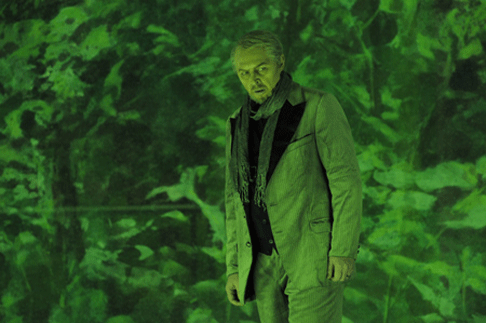 Konstantin Gorny as Massimiliano/Moser
Mr. Schulin showed a deft touch with any number of problematic plot points. Massimiliano’s false “death” was beautifully communicated to us with a subtle ‘take’ from Francesco. The dramatic device of then plopping the coffin on Francesco’s (power) bed as a bier was inspired. The musico-dramatic device of doubling the bass to also sing the priest was brilliant, with the baritone therefore confessing his transgressions not just to a “father” but to “his” father. The similar doubling of Carlo as Rolla, however, made no sense whatsoever. (Ah well, it saved another singer’s fee…)
Although almost all of Ursina Zürcher’s brooding costumes were right on the mark in helping with character development, one widely missed the mark for me, and unfortunately that was the molting Schmatte that was thrown on Amalia, who started out looking like a frump in an ill-fitting cocktail dress at the opening of a Chattanooga Shopping Mall. Over time, one rumply layer after another was torn away and although Barbara looked progressively more shapely, I wish wish I could say that any of the variations truly flattered the diva as she should be.
One such strip tease was the result of Francesco having begun to manhandle her, with her shimmying out of his grasp leaving a layer of organdy. The over-sexed baritone had obviously been told to communicate arousal, but once he had possession of her dress I was not sure if he wanted to climax on it or wear it. (Or both?) The director also frequently has the principals doing stage business in their “room” while a solo is being sung in another. A less experienced hand (or cast) could easily become a distraction, but it is to everyone’s credit that the whole staging is well-calculated to point up dramatic focus. The company was greatly assisted by the well-conceived and atmospheric lighting design from Stefan Woinke.
Karlsruhe has served up a rare treat with its theatrically cogent, musically vivid, immensely satisfying I Masnadieri.
James Sohre