Subscribe to
Opera Today

Receive articles and news via RSS feeds or email subscription.


twitter_logo[1].gif


UCP_9780226043425.gif

Recently in Reviews

Wozzeck at ENO

“Man is an abyss. It makes one dizzy to look into it.” So utters Georg Büchner’s Woyzeck, repeating what was also a recurring motif in the playwright’s own letters.

Mulhouse: Rare Britten Well Done

National Opera Company of the Rhine has marked this year’s Benjamin Britten celebration with a remarkably compelling, often gripping new production of the seldom-seen Owen Wingrave.

Frankfurt's Intriguing Idomeneo

Once upon a time, Frankfurt Opera had the baddest ass reputation in Germany as “the” cutting edge producer of must-see opera.

Rigoletto at Lyric Opera of Chicago

Productions of Giuseppe Verdi’s Rigoletto can serve as a vehicle for individual singers to make a strong impression and become afterward associated with specific roles in the opera.

Britten Sinfonia with Ian Bostridge

Just in case we were not aware that the evening’s programme was ‘themed’, the Britten Sinfonia designed a visual accompaniment to their musical exploration of night, sleep and dreams.

Aida, Manitoba Opera

Poor Aida! She never seems to have anything go her way.

Superlative singing: Don Carlo, Royal Opera House

Is it possible to upstage Jonas Kaufmann? Kaufmann was brilliant in this Verdi Don Carlo at the Royal Opera House, London, but the rest of the cast was so good that he was but first among equals. Don Carlo is a vehicle for stars, but this time the stars were everyone on stage and in the pit. Even the solo arias, glorious as they are, grow organically out of perfect ensemble. This was a performance that brought out the true beauty of Verdi's music.

Sarah Connolly: French Song at Wigmore Hall

The big names were absent: Duparc, D’Indy, Debussy, Ravel … and while Fauré, Chausson, Roussel and several members of Les Six put in an appearance, in less than familiar guises, this survey of French song of the early 20th century and interwar years deliberately took us on a journey through infrequently travelled terrain.

Rare restoration: Handel’s Esther 1720

Composed between 1718 and 1720, Handel’s Esther is sometimes described as the ‘first English Oratorio’, but is in fact a hybrid form, mixing elements of oratorio, masque, pastoral and opera.

The Damnation of Faust, London

Hector Berlioz's légende dramatique, La Damnation de Faust, exists somewhere between cantata and opera. Berlioz's flexible attitude to dramatic form made the piece unworkable on the stages of early 19th century Paris and his music is so vivid that you wonder whether the piece needs staging at all.

Elizabeth Connell Memorial Concert, St John's Smith Square

St. John’s Smith Square was the site of Elizabeth Connell’s final London concert, intended as a farewell to London on her moving to Australia. It was rendered ultimately final by her unexpected death.

Aida with all the Trimmings, Even a Blue Silk Elephant!

With the building of the Suez Canal, Egypt became more interesting to Western Europeans. Khedive Ismail Pasha wanted a hymn by Verdi for the opening of a new opera house in Cairo, but the composer said he did not write occasional pieces.

Die Zauberflöte, Royal Opera

Back for its fourth revival, David McVicar’s 2003 production of Mozart’s Die Zauberflöte has much charm, beauty and artistry.

Kaufmann Wagner

The economics of the recording companies dictate much that is not ideal. Wagner’s operas were not composed as they were in order to permit the extraction of bleeding chunks, even on those occasions when strophic song forms do occur.

The Marriage of Figaro Ends Season at Arizona Opera

Wolfgang Amadeus Mozart's opera The Marriage of Figaro has a libretto by Lorenzo daPonte based on the French play La folle journée, ou le Mariage de Figaro (The Crazy Day or the Marriage of Figaro) by Pierre Caron de Beaumarchais (1732-1799).

Baden’s Flute Goes Barefoot in the Park

For its world class Easter Festival, Baden-Baden mounted a Die Zauberflöte that owed more to the grey penitential doldrums of Lent than to the unbridled jubilance of re-birth.

Bonjour M. Gauguin in Berkeley

Once Berkeley Opera, renamed West Edge Opera, this enterprising company offers the Bay Area’s only serious alternative to corporate opera, to wit Bonjour M. Gauguin.

Mahler Lieder, Wigmore Hall

In the first of pianist Julius Drake’s three-part series, ‘Perspectives’, our gaze was directed at Gustav Mahler’s eclectic musical responses to human experiences: from the trauma and distress of anguished love to the sweet contentment of true friendship, from the agonised introspection of the artist to the diverse dramas of human interaction.

Cinderella Goes to the Opera

The Los Angeles opera company marketed its spring production of Rossini's La Cenerentola as Cinderella though there is no opera by that name. The libretto of La Cenerentola is not the Cinderella story we know.

Die Walküre, Paris

The Paris Opéra has not staged a full Ring Cycle since 1957, but its current season will conclude with a correction of this grand operatic gap.

OPERA TODAY ARCHIVES »

Reviews

 Alan Oke as M. K. Gandhi [Photo by Alastair Muir/ENO]
17 Mar 2010

Philip Glass: Satyagraha, ENO, London 2010

Philip Glass's Satyagraha at the English National Opera, at the Coliseum, London, proves that modern minimalism can be extraordinarily moving. The secret is to open your soul, as Gandhi did, when he searched the Baghavad-Gita for inspiration.

Philip Glass: Satyagraha

Alan Oke: Gandhi; Elena Xanthoudakis: Miss Schlesen; Janis Kelly: Mrs Naidoo; Stephanie Marshall: Kasrurbai; Ashley Holland: Mr Kallenbach; James Gower: Parsi Rustomji and Lord Krishna ;Anne Mason: Mrs Alexander; Roger Poulton:Prince Arjuna. Skills Ensemble. Improbable. Phelim McDermott: Director. Julian Crouch: Set Designer. Kevin Pollard: Costumes. Stuart Stratford: Conductor. English National Opera,The Coliseum, London. 25th February 2010

Above: Alan Oke as M. K. Gandhi

All photos by Alastair Muir/ENO


Satyagraha doesn’t sound promising in theory, because it’s sung in Sanskrit and Glass’s repetitive monotones drone on shapelessly. But for once, that’s the whole point, that words alone are meaningless. Real change is brought about when people think and act.

The story is set in Gandhi’s youth, when he still believed that conventional, middle class ideas could change things. While he lived in South Africa, he was a facsimile of the British middle class intellectual, agitating through the press, hoping thus to change the entrenched colonial system.His big breakthrough came when he switched to direct action. By swapping his tweed three-piece suit for a simple cotton loincloth, he was making a truly radical statement: you don’t change the power structure by playing its own games.

Glass’s strange repetitive music works perfectly with the theme, too. His cadences hardly vary, so you worry that the musicians will get RSI. Yet listen carefully, and the repeats mutate in microtones, gradually shifting gears, so that when there’s a flight into lyricism, it strikes you all the more. This unrushed monotony is as natural as breathing. Hindus chant the word “Om” endlessly, until the vibration enters their bodies, allowing their minds to float, beyond consciousness. So it is with Glass’s music, informed by other and older traditions than western music.Your focus shifts inwards, beyond outward form.

There was exceptionally idiomatic playing from the ENO orchestra, conducted by Stuart Stratford. When the orchestra took their bows, parts of the audience went wild with enthusiasm. Clearly an audience that knows new music, or accepts it on its own terms. Satyagraha is the biggest selling contemporary opera the ENO has produced.

The text is in Sanskrit, which most people, including Indians, don’t understand. This is deliberate because what Gandhi discovered was that words and meaning aren’t the same thing. Hence the scene from the epic myth of Arjuna. The hero’s enemies are puppets, men with sticks who crumble when moved. Scene titles appear, like chapter headings in books, but what unfolds on stage isn’t narrative. Tolstoy and Tagore appear in panels above the stage. You don’t really need to know who they are, because the idea is that you’ll want to find out more, later.This opera moves outside the box in time and space!

There are so many amazing images in this production that it’s hard to take them all in at once. Some are striking, like the giant puppets that descend menacingly on Gandhi, corralled by bigots singing “hahahaha”. Others are elusive, like the fish which materializes in the second act. It doesn’t matter if we don’t get them all. Like words, images are hints of meaning, not meaning in themselves. Like poetry, meaning is oblique, revealing itrself slowly.
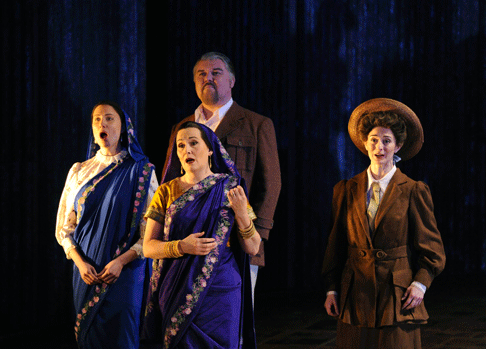
Satyagraha_001.gifStephanie Marshall as Kasturbai Gandhi’s wife, Elena Xanthoudakis as Miss Schlesen Gandhi’s secretary, Janis Kelly as Mrs Naidoo’s Indian co-worker and Ashley Holland Mr Kallenbach’s European co-worker

Because Glass’s music is so unusual, and his text obscure, staging in this opera is even more important than usual. Phelim McDermott, Julian Crouch and Improbable and their team have created a theatrical masterpiece which is sensitive and well-informed.

The staging is so atmospheric that the simple clean lines of the Third Act come as quite a shock. Gandhi sits front stage while a man ascends a ladder. The reference is Martin Luther King. who adapted the principles of Satyagraha to the Civil Rights Movement. At the premiere in 2007, I thought this act was too abrupt a change from the sepia-tinted mystery that had gone before, and that the image of King waving to the clouds was contrived, as if designed for American audiences who might not appreciate how powerful the British Empire once was.Since then, Barack Obama has become President. But have we really”reached the mountain top”?

On the other hand, the spareness of this Act hones in on Alan Oke as Gandhi. Perhaps it’s significant that until this stage in the opera, Oke sings with an ensemble or remains relatively quiet. Now he’s centre focus. He sings two extended “arias”, the first with its references to “athletes of the spirit” who hold steadfast unto death. The second is more lyrical for he’s expressing transcendence. Oke has matured into the part, and is singing with greater depth and dignity than three years ago. He’s in his element now. You don’t need to know the exact words he’s singing, because he conveys their sense with such conviction. Also more comfortable this time, in the role of Miss Schlesen, is Elena Xanthoudakis: whose sings lovely flights of lyrical beauty. Musically, this production is even better than before, superb performances all round. It’s far tighter than the Stuttgart production available on DVD. Let’s hope this one is preserved on film. It’s a classic.

Anne Ozorio

Send to a friend

Send a link to this article to a friend with an optional message.

Friend's Email Address: (required)

Your Email Address: (required)

Message (optional):