![Emma Matthews as Vixen Sharp-Ears and Marnie Carr as Hare [Photo by Johan Persson courtesy of The Royal Opera House]](http://www.operatoday.com/VIXEN-2010_01269-MATTHEWS%20AS%20VIXEN%20%26%20CARR%20AS%20HARE-%28C%29PERSSON.png)
21 Mar 2010
The Cunning Little Vixen, London
An enchanting evening at Covent Garden:
English Touring Opera are delighted to announce a season of lyric monodramas to tour nationally from October to December. The season features music for solo singer and piano by Argento, Britten, Tippett and Shostakovich with a bold and inventive approach to making opera during social distancing.
This tenth of ten Live from London concerts was in fact a recorded live performance from California. It was no less enjoyable for that, and it was also uplifting to learn that this wasn’t in fact the ‘last’ LfL event that we will be able to enjoy, courtesy of VOCES8 and their fellow vocal ensembles (more below …).
Ever since Wigmore Hall announced their superb series of autumn concerts, all streamed live and available free of charge, I’d been looking forward to this song recital by Ian Bostridge and Imogen Cooper.
The Sixteen continues its exploration of Henry Purcell’s Welcome Songs for Charles II. As with Robert King’s pioneering Purcell series begun over thirty years ago for Hyperion, Harry Christophers is recording two Welcome Songs per disc.
Although Stile Antico’s programme article for their Live from London recital introduced their selection from the many treasures of the English Renaissance in the context of the theological debates and upheavals of the Tudor and Elizabethan years, their performance was more evocative of private chamber music than of public liturgy.
In February this year, Albanian soprano Ermonela Jaho made a highly lauded debut recital at Wigmore Hall - a concert which both celebrated Opera Rara’s 50th anniversary and honoured the career of the Italian soprano Rosina Storchio (1872-1945), the star of verismo who created the title roles in Leoncavallo’s La bohème and Zazà, Mascagni’s Lodoletta and Puccini’s Madama Butterfly.
Evidently, face masks don’t stifle appreciative “Bravo!”s. And, reducing audience numbers doesn’t lower the volume of such acclamations. For, the audience at Wigmore Hall gave soprano Elizabeth Llewellyn and pianist Simon Lepper a greatly deserved warm reception and hearty response following this lunchtime recital of late-Romantic song.
Collapsology. Or, perhaps we should use the French word ‘Collapsologie’ because this is a transdisciplinary idea pretty much advocated by a series of French theorists - and apparently, mostly French theorists. It in essence focuses on the imminent collapse of modern society and all its layers - a series of escalating crises on a global scale: environmental, economic, geopolitical, governmental; the list is extensive.
For this week’s Live from London vocal recital we moved from the home of VOCES8, St Anne and St Agnes in the City of London, to Kings Place, where The Sixteen - who have been associate artists at the venue for some time - presented a programme of music and words bound together by the theme of ‘reflection’.
'Such is your divine Disposation that both you excellently understand, and royally entertaine the Exercise of Musicke.’
Amongst an avalanche of new Mahler recordings appearing at the moment (Das Lied von der Erde seems to be the most favoured, with three) this 1991 Mahler Second from the 2nd Kassel MahlerFest is one of the more interesting releases.
‘And there was war in heaven: Michael and his angels fought against the dragon; and the dragon fought and his angels, And prevailed not; neither was their place found any more in heaven … that old serpent … Satan, which deceiveth the whole world: he was cast out into the earth, and his angels were cast out with him.’
If there is one myth, it seems believed by some people today, that probably needs shattering it is that post-war recordings or performances of Wagner operas were always of exceptional quality. This 1949 Hamburg Tristan und Isolde is one of those recordings - though quite who is to blame for its many problems takes quite some unearthing.
There was never any doubt that the fifth of the twelve Met Stars Live in Concert broadcasts was going to be a palpably intense and vivid event, as well as a musically stunning and theatrically enervating experience.
‘Love’ was the theme for this Live from London performance by Apollo5. Given the complexity and diversity of that human emotion, and Apollo5’s reputation for versatility and diverse repertoire, ranging from Renaissance choral music to jazz, from contemporary classical works to popular song, it was no surprise that their programme spanned 500 years and several musical styles.
The Academy of St Martin in the Fields have titled their autumn series of eight concerts - which are taking place at 5pm and 7.30pm on two Saturdays each month at their home venue in Trafalgar Square, and being filmed for streaming the following Thursday - ‘re:connect’.
The London Symphony Orchestra opened their Autumn 2020 season with a homage to Oliver Knussen, who died at the age of 66 in July 2018. The programme traced a national musical lineage through the twentieth century, from Britten to Knussen, on to Mark-Anthony Turnage, and entwining the LSO and Rattle too.
With the Live from London digital vocal festival entering the second half of the series, the festival’s host, VOCES8, returned to their home at St Annes and St Agnes in the City of London to present a sequence of ‘Choral Dances’ - vocal music inspired by dance, embracing diverse genres from the Renaissance madrigal to swing jazz.
Just a few unison string wriggles from the opening of Mozart’s overture to Le nozze di Figaro are enough to make any opera-lover perch on the edge of their seat, in excited anticipation of the drama in music to come, so there could be no other curtain-raiser for this Gala Concert at the Royal Opera House, the latest instalment from ‘their House’ to ‘our houses’.
"Before the ending of the day, creator of all things, we pray that, with your accustomed mercy, you may watch over us."
An enchanting evening at Covent Garden:
what with this and The
Gambler, things seem to be looking up, following a dispiriting spell
in the Christof Loy doldrums. Indeed, the theatrical and musical magic woven
here could not stand further removed from the pretentious dreariness inflicted
upon new productions of Lulu
and Tristan
und Isolde. Bill Bryden’s production of The Cunning Little
Vixen was first staged in 1990 but, twenty years on, it is yet to look
tired. For this, William Dudley’s designs deserve a great deal of credit.
There is to action and staging a crucial sense of life, in all its complexity,
never more ambiguous than when it is apparently straightforward. The
life-cycle, human or animal — should the distinction even be made?
— is the guiding force, in every sense, of Janáček’s drama,
and so, appropriately enough, one sees a huge circle on stage, which provides a
treadmill for walking as well as a frame in which the first act’s
acrobatic ‘Spirit of the Vixen’ may swing. Here, form is wondrously
imparted to the Vixen’s dream, both for the eye and the ear. Humour,
arguably more immediate, if less idiomatic, when sung in English, was present
too, for instance in the portrayal of the clannish farmyard hens, large and
contented, unable to heed the Vixen’s siren-voice of feminist revolt. It
is, however, the interplay between wondrous machinery and Nature that
penetrates to the very heart of the opera. This both highlighted such
relationships in the score and put me in mind of another Royal Opera
production: David McVicar’s Magic Flute — never more
magical than when heard under Sir Colin Davis (available on DVD). Lighting
(Paule Johnson), colours, and scenery ensure that Nature is present,
overflowing in her abundance, without being domesticated or prettified; for
there is wildness aplenty in Janáček’s score, and this must be
reflected in the action.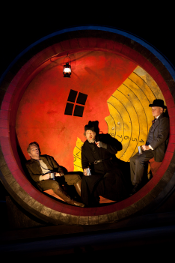 (Left to Right) Christopher Maltman as Forester, Jeremy White as Priest and Robin Leggate as Schoolmaster
It must, of course, above all be expressed by the orchestra, and so it was here. The name of Sir Charles Mackerras is so indelibly associated with Janáček’s music that one might take for granted his excellence. However, I doubt that even the most jaded listener — note that one must listen, rather than passively consume — could have done so in this case. The angularities of Janáček’s score, so often ironed out by conductors not so intimately attuned to the idiom, were immediate and telling, but they were always integrated into a longer line, never aggressive, let alone exhibitionistic, for their own sake: the opposing temptation to smoothing out. Equally apparent, and again never merely for their own sake, were the ravishing beauties of the score’s extraordinary sound-world — extraordinary even by Janáček’s standards. One example would be that utterly characteristic high string sound, split into several parts, which one might be tempted to call Straussian, but which is in reality quite different, if anything more akin to the Schoenberg of Gurrelieder. (Janáček was greatly interested in the music of the Second Viennese School.) Building of climaxes was masterly, above all in the great, pantheistic conclusion, so redolent, or rather prophetic, of the Glagolitic Mass. Life goes on, yet is transformed, transfigured. Tension had sagged slightly, I thought, both on stage and in the musical performance, during the first half of the third act, but this conclusion certainly compensated. As Sir Charles’s aforementioned knighted colleague sounds so effortlessly right in Mozart, so does Mackerras in Janáček. How odd, then, that this was the first time he had conducted the work at Covent Garden, though not quite so odd as the fact that Bryden’s production has no predecessors in the house. (Having said that, The Cunning Little Vixen received its Paris premiere as recently as 2008, and then in a production borrowed from Lyons.)
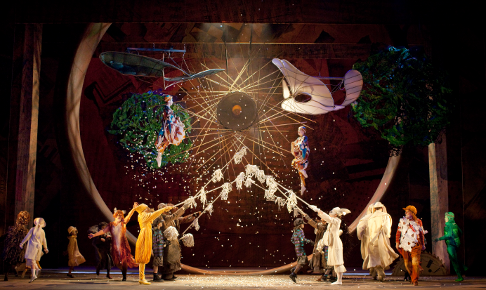 A scene from The Cunning Little Vixen
If Mackerras and the orchestra, which throughout played superlatively, a match for any other ensemble, were the brightest stars in the firmament, then they were ably supported by much of the cast. Most impressive of all was Christopher Maltman, whose Forester grew in stature, as he should, as the work progressed. The final transfiguration was as much his as the natural world’s. Elisabeth Meister, a Jette Paker Young Artist, had originally been slated to sing the roles of the Rooster and the Jay, but had to replace Emma Bell at very short notice, the latter having been rushed to hospital for an emergency appendectomy. Meister proved a winning replacement, moving in her love for the Vixen: an anthropomorphic fantasy, maybe, but an irresistible one. Sadly, Emma Matthews brought no especial individuality to the title role, though she did nothing especially wrong either. Many of the smaller roles, however, were sharply etched, most memorably Matthew Rose’s poacher, Harašta, Robin Leggate’s lovelorn Schoolmaster, and Jeremy White, both as priest and badger. The children, drawn from various London schools, did not disappoint either.
Performance in English did not disconcert me as much as I had feared. There is loss, of course, in terms of the music’s relationship to the language’s speech-rhythms, but this registered less than it had during ENO’s Katya Kabanova earlier in the week. Perhaps it was a better translation; there was certainly more opportunity, often very well taken, for wit. Banking jokes may be easy, but sometimes we should be grateful for any weapon we have. One gripe though: why start at 8 p.m.? It made no especial difference to me, but a 7.30 start would have been of help to those who had to travel out of London, or who simply wished to dine a little earlier. Such practical reservations should not detract, however, from a triumphant return to form for the Royal Opera.
The Cunning Little Vixen will be broadcast by BBC Radio 3 on Saturday 15 May at 6 p.m.
Mark Berry