![Sarah Tynan as Adina [Photo by Tristram Kenton / ENO]](http://www.operatoday.com/Elixir_ENO_01.png)
09 Mar 2010
The Elixir of Love at ENO
As a medic with a keen knowledge of psychology, Jonathan Miller probably knows a thing or two about elixirs and placebos.
English Touring Opera are delighted to announce a season of lyric monodramas to tour nationally from October to December. The season features music for solo singer and piano by Argento, Britten, Tippett and Shostakovich with a bold and inventive approach to making opera during social distancing.
This tenth of ten Live from London concerts was in fact a recorded live performance from California. It was no less enjoyable for that, and it was also uplifting to learn that this wasn’t in fact the ‘last’ LfL event that we will be able to enjoy, courtesy of VOCES8 and their fellow vocal ensembles (more below …).
Ever since Wigmore Hall announced their superb series of autumn concerts, all streamed live and available free of charge, I’d been looking forward to this song recital by Ian Bostridge and Imogen Cooper.
The Sixteen continues its exploration of Henry Purcell’s Welcome Songs for Charles II. As with Robert King’s pioneering Purcell series begun over thirty years ago for Hyperion, Harry Christophers is recording two Welcome Songs per disc.
Although Stile Antico’s programme article for their Live from London recital introduced their selection from the many treasures of the English Renaissance in the context of the theological debates and upheavals of the Tudor and Elizabethan years, their performance was more evocative of private chamber music than of public liturgy.
In February this year, Albanian soprano Ermonela Jaho made a highly lauded debut recital at Wigmore Hall - a concert which both celebrated Opera Rara’s 50th anniversary and honoured the career of the Italian soprano Rosina Storchio (1872-1945), the star of verismo who created the title roles in Leoncavallo’s La bohème and Zazà, Mascagni’s Lodoletta and Puccini’s Madama Butterfly.
Evidently, face masks don’t stifle appreciative “Bravo!”s. And, reducing audience numbers doesn’t lower the volume of such acclamations. For, the audience at Wigmore Hall gave soprano Elizabeth Llewellyn and pianist Simon Lepper a greatly deserved warm reception and hearty response following this lunchtime recital of late-Romantic song.
Collapsology. Or, perhaps we should use the French word ‘Collapsologie’ because this is a transdisciplinary idea pretty much advocated by a series of French theorists - and apparently, mostly French theorists. It in essence focuses on the imminent collapse of modern society and all its layers - a series of escalating crises on a global scale: environmental, economic, geopolitical, governmental; the list is extensive.
For this week’s Live from London vocal recital we moved from the home of VOCES8, St Anne and St Agnes in the City of London, to Kings Place, where The Sixteen - who have been associate artists at the venue for some time - presented a programme of music and words bound together by the theme of ‘reflection’.
'Such is your divine Disposation that both you excellently understand, and royally entertaine the Exercise of Musicke.’
Amongst an avalanche of new Mahler recordings appearing at the moment (Das Lied von der Erde seems to be the most favoured, with three) this 1991 Mahler Second from the 2nd Kassel MahlerFest is one of the more interesting releases.
‘And there was war in heaven: Michael and his angels fought against the dragon; and the dragon fought and his angels, And prevailed not; neither was their place found any more in heaven … that old serpent … Satan, which deceiveth the whole world: he was cast out into the earth, and his angels were cast out with him.’
If there is one myth, it seems believed by some people today, that probably needs shattering it is that post-war recordings or performances of Wagner operas were always of exceptional quality. This 1949 Hamburg Tristan und Isolde is one of those recordings - though quite who is to blame for its many problems takes quite some unearthing.
There was never any doubt that the fifth of the twelve Met Stars Live in Concert broadcasts was going to be a palpably intense and vivid event, as well as a musically stunning and theatrically enervating experience.
‘Love’ was the theme for this Live from London performance by Apollo5. Given the complexity and diversity of that human emotion, and Apollo5’s reputation for versatility and diverse repertoire, ranging from Renaissance choral music to jazz, from contemporary classical works to popular song, it was no surprise that their programme spanned 500 years and several musical styles.
The Academy of St Martin in the Fields have titled their autumn series of eight concerts - which are taking place at 5pm and 7.30pm on two Saturdays each month at their home venue in Trafalgar Square, and being filmed for streaming the following Thursday - ‘re:connect’.
The London Symphony Orchestra opened their Autumn 2020 season with a homage to Oliver Knussen, who died at the age of 66 in July 2018. The programme traced a national musical lineage through the twentieth century, from Britten to Knussen, on to Mark-Anthony Turnage, and entwining the LSO and Rattle too.
With the Live from London digital vocal festival entering the second half of the series, the festival’s host, VOCES8, returned to their home at St Annes and St Agnes in the City of London to present a sequence of ‘Choral Dances’ - vocal music inspired by dance, embracing diverse genres from the Renaissance madrigal to swing jazz.
Just a few unison string wriggles from the opening of Mozart’s overture to Le nozze di Figaro are enough to make any opera-lover perch on the edge of their seat, in excited anticipation of the drama in music to come, so there could be no other curtain-raiser for this Gala Concert at the Royal Opera House, the latest instalment from ‘their House’ to ‘our houses’.
"Before the ending of the day, creator of all things, we pray that, with your accustomed mercy, you may watch over us."
As a medic with a keen knowledge of psychology, Jonathan Miller probably knows a thing or two about elixirs and placebos.
On the evidence of this production, first aired by New York City Opera, he’s not too concerned about the ‘dark side’ of medical charlatanry; for here Miller invites us to enjoy a light-hearted evening of music and food, mischief and fun, at ‘Adina’s Diner’ — a popular stopping place way out in the America Midwest, beloved by homespun yokels and travelling tricksters alike. We lap up the aural and visual candyfloss and, after a charming evening, skip home, refreshed by the reassuring spirit of innocence and optimism which prevails.
Isabella Bywater’s set is a superbly naturalistic recreation of the era. The rolling yellow plains and flawless blue sky evoke the landscapes of Edmund Hopper, and Bywater’s bubblegum pink and lime green diner recreates Hopper’s ‘Nighthawk’, albeit with a more golden, ambient glow. The revolving set is ingenious, but the dusty exterior is more successful than the interior, the latter seeming cramped and overcrowded. Despite Miller’s detailed direction of the chorus, there was simply too little room, forcing many to remain seated — including, in the opening scene, Nemorino, who, set back and enclosed by the set, was swamped by the chorus and orchestra.
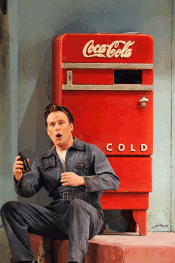 John Tessier as Nemorino
Into this rural eatery waltzed the confident proprietor, Adina. Sarah Tynan, sporting a peroxide bob, was perky and coquettish rather than a vamp. Her voice was as agile as her wiggling hips, and bright and warm; and she offered a lively, engaging performance, perfectly conveying the mannerisms of a 1950s blond bombshell. However, there was no sense of ’depth’ beneath the flighty surface and Tynan offered little to mitigate her cruel treatment of Nemorino.
Indeed, there was a disappointing lack of chemistry between the Adina and Nemorino, the latter presented here as a gauche garage hand. Canadian tenor John Tessier was a naïve and trusting yokel, but while his clear, true rendering was well-received, his voice is fairly light-weight and lacks an Italianate warmth and colour that hints at passionate depths beneath. Tessier’s ‘miraculous’ transformation from garage dunce to matinee idol was not entirely credible and too often he sang to the audience, rather than to the other characters on stage. However, the production did create a dramatic context for ‘Una furtive lagrima’, which for once did not seem like a convenient ‘add-on’.
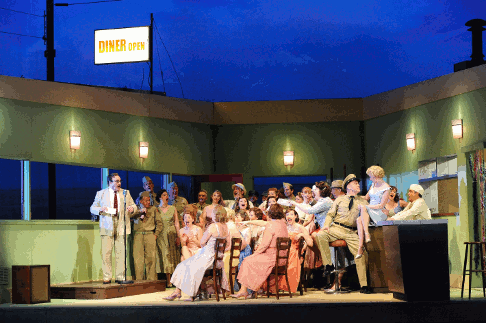 Andrew Shore as Dulcamara and company
The real star of the show was the experienced Andrew Shore, as the oleaginous quack doctor, Dulcamara. He slid in, seated in an ostentatious open-top Cadillac cabriolet (its shine a little sullied after a journey across the dusty plains), looking sharp but shifty in white suit, shades and brogues, panama hat perched rakishly on ill-fitting wig. Shore’s swindler was confident, assured, and crafty. [The automatic dispenser for Coca-Cola — that ‘pure refreshment’ that ‘revives and sustains’ — was cleverly positioned ...] Indeed, for Shore’s sparkling salesman’s pitch the surtitles disappeared — one assumes this was an intentional acknowledgement of Shore’s prowess rather than a technical hitch — but every word of Kelley Rourke’s clever libretto was crystal clear. Shore presented Rourke’s wittily rhymed medicinal claims — “You reek of halitosis/ Then take a couple of doses” — with consummate mastery, although (if one was being harsh) one might accuse him of trying a little too hard at the risk of straining the voice. The subsequent wedding celebrations were pure MGM gold. Impersonating Elvis, Shore’s line ‘I’ve got a little ditty’, drew the largest laugh of the night; and when Adina joined him ‘on-stage’ in the diner, there was considerably more knowing interaction between them than was apparent in her exchanges with the younger heart-throb Nemorino. Adina’s Marilyn drawl might have been a bit too self-knowing, but Tynan, and Miller, pulled it off, just staying short of overkill.
As a gum-chewing GI, David Kempster’s Belcore swaggered and boasted his way, temporarily to Adina’s heart. Julia Sporsén’s Gianetta was sparkling and full of life.
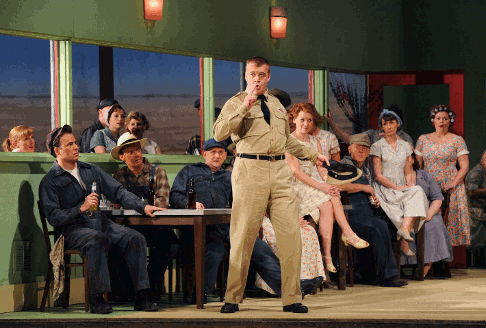 David Kempster as Belcore and company
Miller and Bywater had clearly, and effectively, thought hard about the realism of this production. But there was one incongruity: the inconsistency between the text and its delivery, with regard to accent. It was decided (so the programme told us) to use Americanisms (‘a knuckle sandwich’, ‘hello cupcake’), to pay homage to Porter and Sondheim (‘an elixir with a kick, sir’), and to attempt American accents throughout. The problem was that no one seemed to have told the chorus, and the principals frequently only remembered at the ends of phrases, which made Tessier’s native Canadian burr seem rather out of place.
Another problem was the over-enthusiasm of the conductor. Spaniard Pablo Heras-Casado, who enjoyed himself just a bit too much, encouraging the orchestra too excitedly and destroying the balance between stage and pit. Moreover, the tempi were often too slow: fine for the patter songs but fatal in the acts’ final choruses which should whip up a froth.
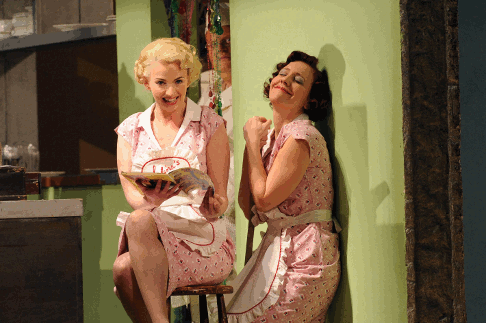 Sarah Tynan as Adina and Julia Sporsén as Gianetta
So, this was a charming, folksy show. Miller’s humour was of the gentle kind — Nemorino turning momentarily into a bass-baritone when swigging the elixir, the outside loo flushing incongruously as Gianetti announced Nemorino’s financial good fortune. Dulcamara’s slugging of his own elixir when he observed the ladies chasing after Nemorino drew an appreciative chuckle from the audience. However, despite its ‘silliness’, there are some shades of darkness in this work — innocence is threatened by deception, guileless by guilt, and love seems indissolubly linked to money; but such shadows were kept well under wraps in this affectionate, enjoyable show.
Claire Seymour