![Paulo Szot as Kovalyov [Photo by Ken Howard courtesy of The Metropolitan Opera]](http://www.operatoday.com/Szot_Nose_Met.png)
12 Mar 2010
The Nose, New York
When the orchestra re-tuned itself between the intermissionless acts of the Met premiere of The Nose last week, many in the audience were uncertain whether they were hearing practice or prelude.
English Touring Opera are delighted to announce a season of lyric monodramas to tour nationally from October to December. The season features music for solo singer and piano by Argento, Britten, Tippett and Shostakovich with a bold and inventive approach to making opera during social distancing.
This tenth of ten Live from London concerts was in fact a recorded live performance from California. It was no less enjoyable for that, and it was also uplifting to learn that this wasn’t in fact the ‘last’ LfL event that we will be able to enjoy, courtesy of VOCES8 and their fellow vocal ensembles (more below …).
Ever since Wigmore Hall announced their superb series of autumn concerts, all streamed live and available free of charge, I’d been looking forward to this song recital by Ian Bostridge and Imogen Cooper.
The Sixteen continues its exploration of Henry Purcell’s Welcome Songs for Charles II. As with Robert King’s pioneering Purcell series begun over thirty years ago for Hyperion, Harry Christophers is recording two Welcome Songs per disc.
Although Stile Antico’s programme article for their Live from London recital introduced their selection from the many treasures of the English Renaissance in the context of the theological debates and upheavals of the Tudor and Elizabethan years, their performance was more evocative of private chamber music than of public liturgy.
In February this year, Albanian soprano Ermonela Jaho made a highly lauded debut recital at Wigmore Hall - a concert which both celebrated Opera Rara’s 50th anniversary and honoured the career of the Italian soprano Rosina Storchio (1872-1945), the star of verismo who created the title roles in Leoncavallo’s La bohème and Zazà, Mascagni’s Lodoletta and Puccini’s Madama Butterfly.
Evidently, face masks don’t stifle appreciative “Bravo!”s. And, reducing audience numbers doesn’t lower the volume of such acclamations. For, the audience at Wigmore Hall gave soprano Elizabeth Llewellyn and pianist Simon Lepper a greatly deserved warm reception and hearty response following this lunchtime recital of late-Romantic song.
Collapsology. Or, perhaps we should use the French word ‘Collapsologie’ because this is a transdisciplinary idea pretty much advocated by a series of French theorists - and apparently, mostly French theorists. It in essence focuses on the imminent collapse of modern society and all its layers - a series of escalating crises on a global scale: environmental, economic, geopolitical, governmental; the list is extensive.
For this week’s Live from London vocal recital we moved from the home of VOCES8, St Anne and St Agnes in the City of London, to Kings Place, where The Sixteen - who have been associate artists at the venue for some time - presented a programme of music and words bound together by the theme of ‘reflection’.
'Such is your divine Disposation that both you excellently understand, and royally entertaine the Exercise of Musicke.’
Amongst an avalanche of new Mahler recordings appearing at the moment (Das Lied von der Erde seems to be the most favoured, with three) this 1991 Mahler Second from the 2nd Kassel MahlerFest is one of the more interesting releases.
‘And there was war in heaven: Michael and his angels fought against the dragon; and the dragon fought and his angels, And prevailed not; neither was their place found any more in heaven … that old serpent … Satan, which deceiveth the whole world: he was cast out into the earth, and his angels were cast out with him.’
If there is one myth, it seems believed by some people today, that probably needs shattering it is that post-war recordings or performances of Wagner operas were always of exceptional quality. This 1949 Hamburg Tristan und Isolde is one of those recordings - though quite who is to blame for its many problems takes quite some unearthing.
There was never any doubt that the fifth of the twelve Met Stars Live in Concert broadcasts was going to be a palpably intense and vivid event, as well as a musically stunning and theatrically enervating experience.
‘Love’ was the theme for this Live from London performance by Apollo5. Given the complexity and diversity of that human emotion, and Apollo5’s reputation for versatility and diverse repertoire, ranging from Renaissance choral music to jazz, from contemporary classical works to popular song, it was no surprise that their programme spanned 500 years and several musical styles.
The Academy of St Martin in the Fields have titled their autumn series of eight concerts - which are taking place at 5pm and 7.30pm on two Saturdays each month at their home venue in Trafalgar Square, and being filmed for streaming the following Thursday - ‘re:connect’.
The London Symphony Orchestra opened their Autumn 2020 season with a homage to Oliver Knussen, who died at the age of 66 in July 2018. The programme traced a national musical lineage through the twentieth century, from Britten to Knussen, on to Mark-Anthony Turnage, and entwining the LSO and Rattle too.
With the Live from London digital vocal festival entering the second half of the series, the festival’s host, VOCES8, returned to their home at St Annes and St Agnes in the City of London to present a sequence of ‘Choral Dances’ - vocal music inspired by dance, embracing diverse genres from the Renaissance madrigal to swing jazz.
Just a few unison string wriggles from the opening of Mozart’s overture to Le nozze di Figaro are enough to make any opera-lover perch on the edge of their seat, in excited anticipation of the drama in music to come, so there could be no other curtain-raiser for this Gala Concert at the Royal Opera House, the latest instalment from ‘their House’ to ‘our houses’.
"Before the ending of the day, creator of all things, we pray that, with your accustomed mercy, you may watch over us."
When the orchestra re-tuned itself between the intermissionless acts of the Met premiere of The Nose last week, many in the audience were uncertain whether they were hearing practice or prelude.
Should they talk or should they shush? Was it time to recharge the cell phone? Would that just sound like more of Shostakovich’s raucous, blurting score?
True, no one was singing at that moment but people hardly do sing in this opera, and the leading character — Kovalyov, a faceless bureaucrat who has just awakened to discover that he is noseless as well — performs much of his role in falsetto or in oaths and exclamations and excited jabber. Paulo Szot, who’s been singing Ezio Pinza’s role in South Pacific next door to great acclaim (with a microphone) might not be impressive as Don Giovanni in so huge a house as the Met, but he’s splendid in what is largely an acting part and in a staging that stints nothing on the acrobatic shenanigans it demands of all the performers. The actual title role — Kovalyov’s nose, portrayed by Gordon Gietz — runs about committing antics, getting into fights, picking up strange women, but hardly sings at all except when impersonating an officer.
When the opera premiered in 1930, Shostakovich had the happy advantage of being certain everyone in his audience — and every literate Russian — would know Gogol’s classic short story by heart, and therefore be able to follow the surreal twists and turns of a plot that echoed Gogol’s in detail. (Those planning to attend might want to read the story, too — it’s easy to find on the Internet.) Much of the opening night audience appeared to be Russian, but those who were not were often uncertain whether director/designer William Kentridge was making fun of them or just being silly. Madly inventive as his creations are, Kentridge was following Gogol (and Shostakovich) pretty closely in the storyline, though his sets seemed more inspired by the “Constructivist” epoch of early Soviet art during which Shostakovich wrote the opera.
You may or may not care for Shostakovich’s anti-lyrical — indeed, anti-operatic — score, which lacks the yearning, emotional center that endears his Lady Macbeth of the Mtsensk District, composed four years later, to audiences around the world. In any case, here we have an appropriate production for this strange, unoperatic opera. This isn’t the only way to present it, but it’s a way that takes the work seriously and deals with it in terms of contemporary stagecraft. The contrast to, say, the awkward, undramatic production of Verdi’s Attila that premiered at the Met a week earlier was striking: Though often handsome, nothing about that staging suited the opera being performed or helped make sense of it to a public who did not know it. The Met, it seems, will only suit the production to the work if that work is modern and alien to grand opera tradition.
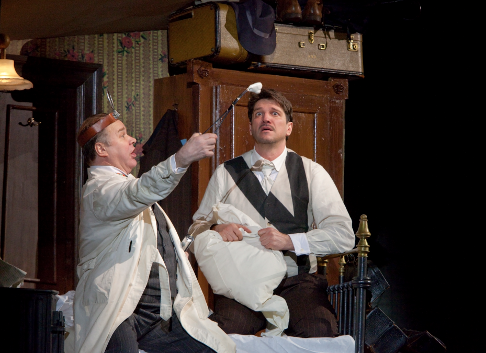 Paulo Szot as Kovalyov and Gennady Bezzubenkov as the Doctor
The set of The Nose is a wall of newsprint and graffiti, crisscrossed by bridges and inset with rooms, houses, offices, railway stations. The newsprint with its excitable but meaningless headlines seems to emphasize that the events of the opera are at once the very latest news and as insignificant as the filler of so much popular journalism. A man’s nose has run off — or been sliced off by a drunken barber (Vladimir Ognovenko, growling superbly) — and the hapless legal owner has pursued the runaway appendage to church and been snubbed in his polite request that it return to its place. The nose has not even admitted to working in the same bureaucratic department! And now our hero hardly dares approach the haughty lady whose daughter he was hoping to marry because — well, it’s plain as the nose on your face — he really can’t right now, can he? The authorities are unsympathetic and the newspapers will not print this story, even as a paid advertisement — he might be faking it, after all — and when the police do apprehend the runaway schnoz (attempting to leave town with a passport to Riga), poor Kovalyov has to bribe them in order to get it back. And then, at first, it won’t stay on!
Gogol’s depiction of the dullness and egocentricity of everyone in this world when faced with impossible events is precise and funny — and a forerunner of such writers as Kafka, Borges, Calvino and Barthelme. Shostakovich has set the tale with fiendish glee, in percussive explosions and astringent parody of popular song styles. The instruments often seem to sneeze or whine or fart as much as they play music. Pretty “vocalism” is a sure sign of hypocrisy — as in the case of the snobbish mother and daughter, sweetly sung by Barbara Dever and Erin Morley, or the police inspector serenely warbled by Andrei Popov — or of brainlessness, as in the charming serenade sung to balalaika by Sergei Skorokhodov as Kovalyov’s uncomprehending valet. Claudia Waite is both the barber’s shrewish wife and a bagel-seller raped by the police (a scene very like the rape of Aksinia in Lady Macbeth), Gennady Bezzubenkov is Kovalyov’s unsympathetic doctor, Adam Klein is Kovalyov’s sympathetic friend. There are twenty minor parts in the passing parade Kovalyov encounters — all too busy with their own problems to notice his — and all of them seemed to be sharing the high old time.
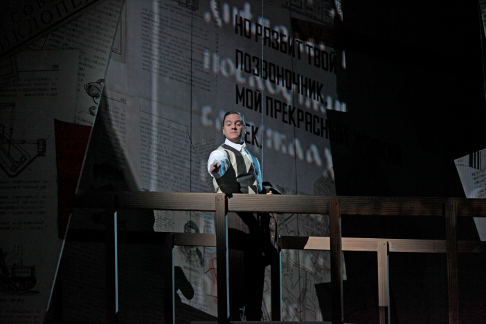 Gordon Gietz as the Nose
Yet, well before the end of the evening one tired of the shenanigans of both plot and score. Gogol’s story is short. So is the opera (less than two hours when played, as here, with no intermission), but I can’t say it flew by — it’s draining. One joke, since there is never an explanation for it, hardly sustains an entire evening.
All the singers and actors and dancers merited their applause, but the musical star was Valery Gergiev, who kept the joint jumping from start to finish with an energy that never seemed to wear out. It wore me out, but Gergiev could clearly have played a few Shostakovich symphonies as encores.
John Yohalem