Seated precariously atop the heap of ruin, resembling a large, destructive
boy who has been playing where he shouldn’t, is Ildar Abdrazakov with
what looks like a feathered teapot on his head. The chorus, in uniform gray,
sit on the floor at his feet and sing a hymn to Wodano (you know – Wotan
– the god of war) and to Attila the Hun – for it is he – who
has just destroyed the great Roman city of Aquileia. When I visited Aquileia in
2006 – admittedly 1554 years after Attila’d been and gone –
there wasn’t a rod of reinforced concrete in sight but there wasn’t
much ruined Roman cityscape either; just some glorious mosaics, a fine museum
and a peaceful tree-lined path beside the canal that was once a harbor for the
imperial fleet. Most of the city’s monumental stonework has been
“borrowed” over the centuries by nearby towns like Venice. (Venice
was founded by refugees from Attila – an event that opens the second
scene of Verdi’s opera.)
I’m not sure if singing from atop a heap of an elevated set undercuts
vocal production, but Abdrazakov’s Attila, though competent and musical
– and fearless on that rickety ledge – lacked the mighty depths
signifying monumental and barbaric emotion that Jerome Hines and Samuel Ramey
brought to the part. Abdrazakov was sturdy but never a force to be reckoned
with, much less the Scourge of God.
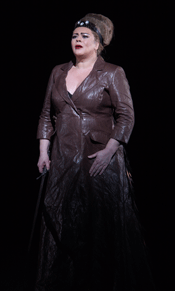 Violeta Urmana as Odabella
The contrast between a competent voice and a real one was clear the moment
Giovanni Meoni entered as Ezio, the Roman general, his baritone rolling out to
fill the room on the line: “Avrai tu l’universo, resti
l’Italia a me!” (Take the universe, but leave Italy to me), which
is the cry that made Attila a hit on its original appearance in
Austrian-occupied Italy. Meoni has a genuine Verdi baritone timbre and line,
makes a sturdy if stiff figure on stage in Miuccia Prada’s meter-long
leather fringe epaulets, and if he hadn’t run out of breath towards the
end of his Act II cabaletta, this would have been a headline occasion for him.
The world seems to have run short of Bastianinis and Merrills and Milneses, and
Verdi is hard to put over without them.
The sound of a real Verdi voice came, too, from the Attila of the previous
generation, Samuel Ramey, who walked on – the part is no more than that
– as “Leone, an ancient Roman,” in a crimson miter (for
censorship reasons, the librettist demoted this figure, who is actually Pope
Leo the Great) to forbid superstitious Attila from attacking Rome itself.
Ramey’s ugly wobble was in evidence, but also his
from-the-depths-of-the-earth authority, an echo of the true Verdi sound. Is it
a coincidence that he was singing on stage level, and not two stories up in the
air?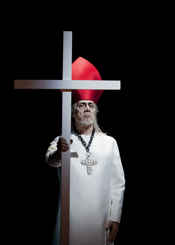
Samuel Ramey as Leone
Violeta Urmana, though she sang all the cascading notes of Odabella’s
famously hectic arias, seemed to lack a center, a depth of heart. Urmana has a
beautiful instrument and an assured technique – is there anyone else
nowadays who can sing Odabella without peeling paint? – and she
got all the intricacies beautifully, but she has never shown much dramatic
instinct for Italian music and this stern placidity was in evidence here. There
was none of the suppressed passion one felt in her Kundry at the Met some years
ago, or her Isolde broadcast in December from Vienna.
Odabella’s tenderer music never does seem credible, perhaps because
sopranos are hired to sing the role based on their ability to deal with the
fire-breathing coloratura of her sortita, “Santo di patria.”
Connoisseurs sometimes refer to Odabella’s “Sutherland aria”
(“Santo di patria”) and her “Caballé aria” (“Oh
nel fuggente nuvolo”), for the matchless recorded versions, but the
recording studio is one thing, the stage another – and neither of those
sensible ladies ever sang the role on stage. Voice lovers nonetheless come to
Attila irrationally expecting Sutherland’s blazing fioritura in
“Santo di patria,” Caballé’s luxuriant velvet in “Oh
nel fuggente nuvolo,” and they’re never going to get both, seldom
either one. Verdi composed them for Sofia Loewe, also the first Elvira in
Ernani – and for the same house, Venice’s La Fenice, which is
one-quarter the size of the Met.
Urmana sang all this music with impressive ease, ducking some high notes for
the honorable reason that she doesn’t have them, but never sounding less
than in command. As a technical exercise, her presence was very welcome and I
doubt anyone now singing could do it better – but there was little
feeling behind it. Too, she looked absurd in a Queen of Outer Space coiffure
(“They sacked my city, but I didn’t have a hair out of
place!”), but that’s not her fault.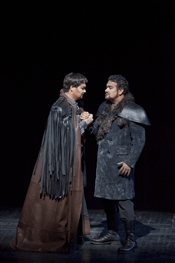
Giovanni Meoni as Ezio and Ramon Vargas as Foresto
That leaves Ramón Vargas in the role of Foresto, who is not a character at
all but a jumble of tenor “tropes” – soprano’s
suspicious lover, refugees’ heroic leader, incompetent conspirator. There
wasn’t much of Vargas’ youthful honey in his first scenes; his tone
was dry, his pitch all over the place. He didn’t warm up until his aria
in the last act, a lovely account full of melting phrases.
The musical stars of the evening were none of the named singers but the
orchestra and chorus, and Riccardo Muti, making his long-deferred house debut.
Attila, like nearly all of Verdi’s early operas, is a major
vehicle for chorus (not until Rigoletto and Traviata did he
seem to find individuals more interesting than nationalities), and here we have
rapacious Huns, pious monks, desperate refugees, unbowed Romans –
although since they are dressed pretty much the same at the Met, or are visible
only from the shoulder up, you might not know the chorus was playing any
characters at all on this occasion. Still, they sang with the vigor and
subtlety that has marked them ever since Donald Palumbo took over their
headship.
As for Muti, he brought the score a sense of swiftness, lightness, speed,
melodic arching, Rossini-esque brilliance that made me want to close my eyes
and just forget about what was going on on stage. The many touches that reveal
Verdi’s talent as an instrumental colorist beginning to achieve mastery
were all brought forth.
If an opera has been around so long, and the composer has been represented
in nearly every one of the 126 Met seasons (a few early all-German ones aside),
and the Met has never chosen to stage it, there are probably very good reasons
not to bother. All of them were apparent: The libretto is ungainly (director
Pierre Audi barely tried to stage it, contenting himself with posed attitudes),
the solo parts are difficult to cast, the dramatic effect of the work mediocre
at best. Attila is worthy of its obscurity – as are most early
Verdi operas, the thrilling Macbeth and the brooding Luisa
Miller being the great exceptions. The only good reasons to put the others
on are, first, to experience the master’s fascinating apprenticeship and,
second, if you have spectacular singers who can do wonders with great melodies.
Attila requires first-rate Verdi tenor, baritone and bass and a
superhuman soprano, and the Met does not have such singers in its stable.
Herzog & de Meuron, the architects who designed this production, appear
to have looked at the five-story-high Met stage and thought, “How can we
fill that?” Not: “How can we stage an exciting drama there?”
but “How can we fill it?” – as if they were designing a wall
hanging. They have filled it, to be sure, with an eye-popping vertical green
rain forest (turning a sere brown for the final act, and blood red when at last
Attila is slain) in which little cavernous hollows appear so that Attila can
have a nightmare and Ezio a change of heart. It’s very attractive but
highly unsuitable for stage action. In order to present the scenes Verdi asks
for (I’m sure Mr. Audi was very annoyed with him about it, but
couldn’t get his phone calls returned from the tomb), the set has to rise
in the air a story or so, and singers appear underneath it to
“emote” against bare backdrop. This undercuts Verdi’s
masterful scene-painting, dawn over the lagoons of Venice, sunset over
Attila’s tent, saints appearing in the heavens at the pope’s
command and so forth – all played magnificently by the Met orchestra
under Muti – because nothing on stage corresponds to the music we are
hearing. They might as well have given the whole thing in concert and saved a
lot of money.
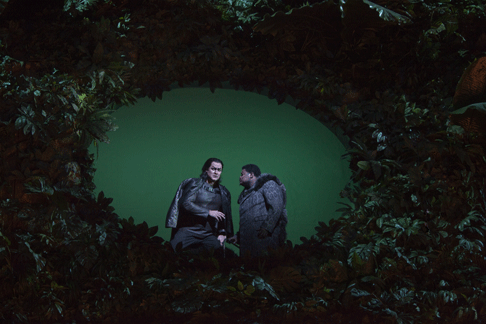 Ildar Abdrazakov as Attila and Russell Thomas as Uldino
There is a certain logic in pushing the singers to the stage apron –
the singers like that – they feel somewhat lost fifty feet back.
In front they think they can make more effect, more noise, and keep an eye on
the conductor as well. But it’s a waste of space and of playing room, and
it makes the action impossible to play.
Miuccia Prada’s costumes probably call for a special word: what the
well-dressed refugee is wearing, a runway with cavalry in hot pursuit. The
principals wear leather and fake fur and gold lame in improbably contemporary
styles (when did capes come back in fashion?), but the chorus of monks are
dressed in undistinguished shmattas so if we do not follow the titles
we’ll have no idea they’re supposed to be monks, and the refugees
in their fur vests who seek them out seem to be ladies out for an evening
stroll. There is no theatrical thrill to this unless all you want from an opera
is a fashion show.
John Yohalem
![Ildar Abdrazakov as Attila [Photo by Ken Howard/Metropolitan Opera]](http://www.operatoday.com/Attila_Met_01.gif)