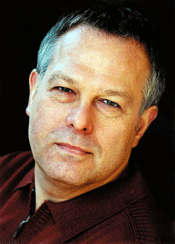
In the programme notes, Christoph Prégardien calls for a more realistic and
trusting attitude towards death: “Today death has been pushed out of our
life almost completely … this is the reason we have compiled our
programme: so that people become a little more aware that death is always in
our midst. That we cannot ignore it, but have to accept it.” If one
feared that this programme — comprising a striking variety of styles and
attitudes — ranging from the baroque certainties of Bach to the dark
dreaming of the Romantics, from the hinteryears’ resignation of Brahms
and Mahler to the existential Gothic terrors of Loewe and Weber — would
be a melancholy and bleak affair, such concerns were allayed by Prégardien and
his pianist, Michael Gees, for their commitment, consistency and composure
throughout this recital was in itself consoling and reassuring. Through this
meticulously constructed sequence of lyric songs, narrative ballads and
operatic melodramas which ensued, the performers (who have spent two years
selecting the songs which best portray man’s ‘quest for the
infinite’) offered a unified and supremely controlled exploration of
contrasting psychologies, situations and dramas of human existence.
Prégardien immediately established a mood of confident certainty in
Bach’s aforementioned aria; his total control of line and nuance,
complemented by a warm, secure tone, perfectly conveying the unshakeable
convictions of the baroque age. The veiled quality of the second verse,
delicately ornamented by the piano, suggested the composer’s awe and love
in the face of the majesty of heaven; indeed, one of Prégardien’s most
absorbing qualities is the gentle warmth of his pianissimo utterances
— in particular, his tender but tangible mezza voce—which never stray
into affectation or whimsy.
The Romantics had a very different relationship with death: and following
such certainty of salvation came spiritual transcendence, in the form of
Mahler’s ‘Urlicht’ (‘Primordial Light’) from
Des Knaben Wunderhorn, and symbolised by the quiet clarity of
Prégardien’s pianissimo floating octave arcs which suggest the
desire for heavenly rest, where God ‘will light my way to eternal blessed
life’.
For the wanderers who populate the songs of Schumann and Schubert, death is
often not a welcome meeting with one’s God, but rather a blessed release
from the unrequited torments of earthly love. Schubert’s
‘Schwanengesang’ (‘Swan Song’) allowed us to appreciate
the rich baritonal range of Prégardien’s voice, while
‘Auflösung’ (‘Dissolution’) offered Gees the
opportunity to explore turbulent realms in disturbing, deep arpeggio sweeps,
underpinning the earnest colourings in the vocal line with which the tenor
emphasised the ‘fires of rapture’ and bitter disappointment of the
protagonist. ‘Stirb, Lieb’ und Freud’!’ (‘Die,
love and joy!’) by Robert Schumann, tells of a young man’s anguish
as his loved one chooses the hand of Christ over his own mortal hand; here
Prégardien and Gees impressively inhabited the speaker’s spirit: the
flowing regularity of the accompaniment disrupted by surprising modulations;
the destruction of dreams conveyed by poignant contrasts between upper and
lower registers; rubatos and syncopations revealing the painful yearning and
despair of the speaker.
In contrast, Brahms’s ‘Feldeinsamkeit’ (‘Alone in
the Fields’) presents a more soothing acceptance of human mortality.
However, the same composer’s’ ‘Wie rafft ich mich auf in der
Nacht’ (‘How I leapt up in the night’) reminds us that such
tranquillity is the preserve of those who are unburdened by guilt — and
here the piano and voice were true partners in the drama, for although
Prégardien tenderly reassured us with a vision of the white clouds serenely
passing across the ‘deep blue, like lovely silent dreams’
(‘Durchs tiefe Blau, wie schöne stille Träume’), Gees’s
between-verse paraphrases powerfully conveyed the torment of the troubled soul.
The enlarged dramatic canvas in this song initiated a passionate sequence which
closed the first half, in which the sheer terror and ‘nothingness’
present in Loewe’s ‘Edward’ and Max’s recitative and
aria from Weber’s Der Freischütz, which followed on without a
breath, brutally swept aside the certitudes of salvation with which we had
begun. Gees relished the challenge of capturing the orchestral sound-scape,
producing a kaleidoscope of textures and timbres; and while Prégardien
powerfully conveyed the tense anger of the protagonists, the more focused
context, and his own intense concentrated delivery, prevented these Gothic
dramas from straying into melodrama or bombast.
In the second half of the recital the figure of Death itself stepped onto
the stage, summoned perhaps by the piano’s tolling invitation in the
introduction to Hugo Wolf’s ‘Denk es, I Seele!’ (‘O
soul, remember!). At first, all was calm and reassuring; Gees describes
Wolf’s setting of Goethe, ‘Anakreon’s Grab’
(‘Anacreon’s Grave’) as ‘the heavy made light, in the
simplicity of a serenade’ — and indeed, his gentle piano postlude
echoed the touching sweetness of Prégardien’s evocation of the
‘turtle-dove calls, where the cricket rejoices’. Similarly, in
‘Der Jüngling under der Tod’ (‘The youth and death’)
and ‘Das Tod und das Mädchen’ (‘Death and the Maiden’),
Schubert envisages Death as an authoritative but gentle presence; but here the
deep baritonal monotone of Prégardien’s enticement, ‘Give me your
hand, you lovely, tender creature’’ inferred the ominous gravity of
the invitation, and perhaps suggested the repressed violence which was abruptly
released in Loewe’s ‘Erlkönig’ (‘The Erlking’).
In Loewe’s dark, disturbing song, the performers enacted a truly Gothic
visitation by a malevolent force which snatches life from its powerless victim:
the final lines, describing the swift homeward journey of a bereaved father,
his child ‘dead in his arms’, were simultaneously emotively nuanced
in detail and chillingly dispassionate in stance.
Another dramatic triptych closed the second half. An impassioned rendering
of Lensky’s aria from Eugene Onegin was followed by
Schubert’s ‘Kreiger’s Ahnung’ (‘Warrior’s
foreboding’). The emotional tension of the latter was poignantly
revealed: for while the dead warrior yearns for the imagined comfort of his
lover’s arms—his earnest conviction ably conveyed by the deep
resonances of Prégardien’s lower range — Gees, hesitantly
manipulating the cadences, tellingly emphasising the final ponderous rhythms,
intimated the ambiguity which underlies the apparent certitudes of the
text’s conclusion. It was Mahler who was allotted the final word:
‘Revelge’ (‘Reveille’) from Des Knaben
Wunderhorn presents a desperate charge to an end which brings no
redemption, transcendence or consolation — in the words of Gees,
‘This is real death, when no one recognises you any more’.
Twenty-two visions of death might seem a dispiriting and emotionally
exhausting concept. But the masterful control of pace and mood, colour and
nuance exhibited here by Prégardien and Gees, made this an evening to rejoice
in human creativity and artistry, not to despair at its transience.
Claire Seymour