![Deborah Voigt as Senta [Photo by Cory Weaver courtesy of The Metropolitan Opera]](http://www.operatoday.com/Voigt_Senta.gif)
26 Apr 2010
Der Fliegende Holländer, New York
Pick the word: soupçon? snippet? tidbit? quark? to describe the infinitesimal bite of Wagner bestowed upon us by the Met this year — and we had to wait till the end of April, to boot!
English Touring Opera are delighted to announce a season of lyric monodramas to tour nationally from October to December. The season features music for solo singer and piano by Argento, Britten, Tippett and Shostakovich with a bold and inventive approach to making opera during social distancing.
This tenth of ten Live from London concerts was in fact a recorded live performance from California. It was no less enjoyable for that, and it was also uplifting to learn that this wasn’t in fact the ‘last’ LfL event that we will be able to enjoy, courtesy of VOCES8 and their fellow vocal ensembles (more below …).
Ever since Wigmore Hall announced their superb series of autumn concerts, all streamed live and available free of charge, I’d been looking forward to this song recital by Ian Bostridge and Imogen Cooper.
Although Stile Antico’s programme article for their Live from London recital introduced their selection from the many treasures of the English Renaissance in the context of the theological debates and upheavals of the Tudor and Elizabethan years, their performance was more evocative of private chamber music than of public liturgy.
Evidently, face masks don’t stifle appreciative “Bravo!”s. And, reducing audience numbers doesn’t lower the volume of such acclamations. For, the audience at Wigmore Hall gave soprano Elizabeth Llewellyn and pianist Simon Lepper a greatly deserved warm reception and hearty response following this lunchtime recital of late-Romantic song.
For this week’s Live from London vocal recital we moved from the home of VOCES8, St Anne and St Agnes in the City of London, to Kings Place, where The Sixteen - who have been associate artists at the venue for some time - presented a programme of music and words bound together by the theme of ‘reflection’.
'Such is your divine Disposation that both you excellently understand, and royally entertaine the Exercise of Musicke.’
‘And there was war in heaven: Michael and his angels fought against the dragon; and the dragon fought and his angels, And prevailed not; neither was their place found any more in heaven … that old serpent … Satan, which deceiveth the whole world: he was cast out into the earth, and his angels were cast out with him.’
There was never any doubt that the fifth of the twelve Met Stars Live in Concert broadcasts was going to be a palpably intense and vivid event, as well as a musically stunning and theatrically enervating experience.
‘Love’ was the theme for this Live from London performance by Apollo5. Given the complexity and diversity of that human emotion, and Apollo5’s reputation for versatility and diverse repertoire, ranging from Renaissance choral music to jazz, from contemporary classical works to popular song, it was no surprise that their programme spanned 500 years and several musical styles.
The Academy of St Martin in the Fields have titled their autumn series of eight concerts - which are taking place at 5pm and 7.30pm on two Saturdays each month at their home venue in Trafalgar Square, and being filmed for streaming the following Thursday - ‘re:connect’.
The London Symphony Orchestra opened their Autumn 2020 season with a homage to Oliver Knussen, who died at the age of 66 in July 2018. The programme traced a national musical lineage through the twentieth century, from Britten to Knussen, on to Mark-Anthony Turnage, and entwining the LSO and Rattle too.
With the Live from London digital vocal festival entering the second half of the series, the festival’s host, VOCES8, returned to their home at St Annes and St Agnes in the City of London to present a sequence of ‘Choral Dances’ - vocal music inspired by dance, embracing diverse genres from the Renaissance madrigal to swing jazz.
Just a few unison string wriggles from the opening of Mozart’s overture to Le nozze di Figaro are enough to make any opera-lover perch on the edge of their seat, in excited anticipation of the drama in music to come, so there could be no other curtain-raiser for this Gala Concert at the Royal Opera House, the latest instalment from ‘their House’ to ‘our houses’.
"Before the ending of the day, creator of all things, we pray that, with your accustomed mercy, you may watch over us."
The doors at The Metropolitan Opera will not open to live audiences until 2021 at the earliest, and the likelihood of normal operatic life resuming in cities around the world looks but a distant dream at present. But, while we may not be invited from our homes into the opera house for some time yet, with its free daily screenings of past productions and its pay-per-view Met Stars Live in Concert series, the Met continues to bring opera into our homes.
Music-making at this year’s Grange Festival Opera may have fallen silent in June and July, but the country house and extensive grounds of The Grange provided an ideal setting for a weekend of twelve specially conceived ‘promenade’ performances encompassing music and dance.
There’s a “slide of harmony” and “all the bones leave your body at that moment and you collapse to the floor, it’s so extraordinary.”
“Music for a while, shall all your cares beguile.”
The hum of bees rising from myriad scented blooms; gentle strains of birdsong; the cheerful chatter of picnickers beside a still lake; decorous thwacks of leather on willow; song and music floating through the warm evening air.
Pick the word: soupçon? snippet? tidbit? quark? to describe the infinitesimal bite of Wagner bestowed upon us by the Met this year — and we had to wait till the end of April, to boot!
We must be grateful for what we can scrounge, and Der Fliegende Holländer, Wagner’s Weber-like romantic fable of the vampire-like sea captain doomed to sail till he meets the woman faithful to death, in August Everding’s outsize production, provides some sumptuous music-making. Holländer, indeed, has grown sufficiently unfamiliar to New Yorkers that many members of the audience were outraged to find they were expected to sit still for two and a half hours without intermission (though you’d have to go back nearly forty years to find a Met production of the opera that did include intermissions), and several of them walked out during the second scene-changing entr’acte.
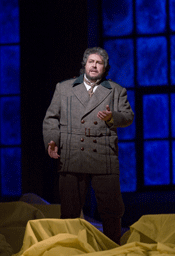 Stephen Gould as Erik
The vocal standard of the evening was impressively high. Finnish
bass-baritone Juha Uusitalo, who has been singing Wotan around Europe, gave us
a suave, passionate Dutchman with a smooth, even, grateful sound. A tall man
and a fine actor, he was got up to look pale, raven-haired, huge of eye and
lofty of brow, rather like Wagner’s friend, King Ludwig of Bavaria
— appropriately; the king drowned.
Uusitalo would have been the star of the evening had not Hans-Peter König been singing the bumptious Daland. König has one of those godlike basses (think Matti Salminen or Kurt Moll), clear and even from top to bottom, enormous but graciously so, never oppressive, never bellowed, as gently nuanced as if he were singing lieder. You will think: if there’s a God, he sounds like this. It was the A-list performance of the night.
Stephen Gould, an American tenor who has been singing Siegfried in Vienna to great acclaim, made his Met debut as Erik. An enormous figure on stage, Gould has a voice as sturdy as his linebacker build and a clarion delivery, but has a tendency to hurl it out brusquely when romantic gentility seems called for, especially in this dreamy role. His bark was not harsh but it was unfinished — which seems right for the half-savage Siegfried but not for Erik. When he sang, one pricked up one’s ears — but when Mr. König sang, pricking up of ears wasn’t necessary — the voice came out into the theater and seduced us. Russell Thomas provided an energetic Steersman, seeming a bit small-scale in such company.
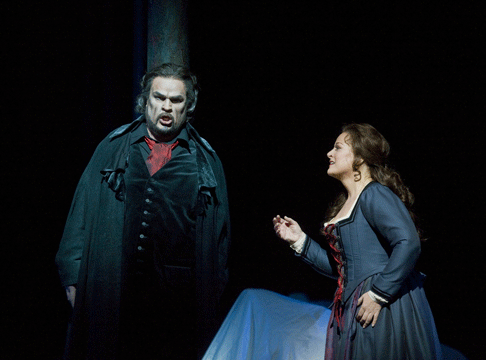 Deborah Voigt as Senta and Juha Uusitalo as the Dutchman
Deborah Voigt sang her first staged Senta. She looked good and hurled herself ardently about the room — at one point bringing the house to giggles, unintentionally one supposes: As Erik described his dream of the arrival of the Dutchman, she abruptly “assumed the position,” head back, legs spread, in anticipation. Her voice, though, was not in happy estate, stringy and unattractive for much of the night and occasionally flat. She nailed the “treu” on her final “treue als dem Tod,” but it was a bit late in the evening to rescue this heroic figure. Senta is a young girl with an earth mother coiled audibly within her, bursting out into thrilling cries. Senta — indeed Wagner — is not a good choice for Voigt’s instrument these days.
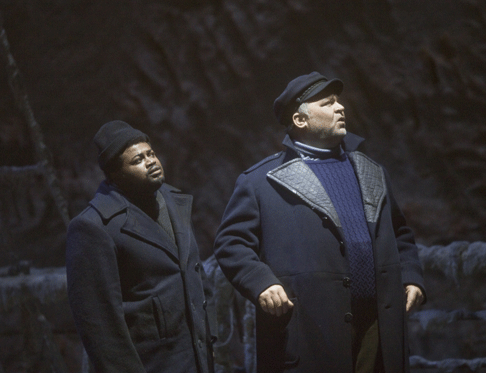 Hans-Peter König as Daland and Russell Thomas as the Steersman
In the pit, Kazushi Ono, undeterred by occasional intrusive applause and the departure of those unwilling to do without intermissions, kept the oceanic rhythms of this nautical ghost story in driving motion. The only sounds one regretted were not in his department at all — the squeak of the metal gangway as it descended to the stage in Act I. It has indeed been years since its last use (seven by the story, ten at the Met), and we had an undesired squealing obbligato. This however had been oiled away by the final scene — good catch, Met crew!
John Yohalem