![Simon Keenlyside as Hamlet [Photo by Brent Ness courtesy of The Metropolitan Opera]](http://www.operatoday.com/HAMLET_Keenlyside_in_title_role_1580.png)
03 Apr 2010
Hamlet, New York
Design is rotten in Denmark, evidently — and in every other grand opera locale. “Palace” has come to mean “high school basement,” or that’s what they look like. “Royal” is synonymous with sleazy men in suits.
English Touring Opera are delighted to announce a season of lyric monodramas to tour nationally from October to December. The season features music for solo singer and piano by Argento, Britten, Tippett and Shostakovich with a bold and inventive approach to making opera during social distancing.
This tenth of ten Live from London concerts was in fact a recorded live performance from California. It was no less enjoyable for that, and it was also uplifting to learn that this wasn’t in fact the ‘last’ LfL event that we will be able to enjoy, courtesy of VOCES8 and their fellow vocal ensembles (more below …).
Ever since Wigmore Hall announced their superb series of autumn concerts, all streamed live and available free of charge, I’d been looking forward to this song recital by Ian Bostridge and Imogen Cooper.
The Sixteen continues its exploration of Henry Purcell’s Welcome Songs for Charles II. As with Robert King’s pioneering Purcell series begun over thirty years ago for Hyperion, Harry Christophers is recording two Welcome Songs per disc.
Although Stile Antico’s programme article for their Live from London recital introduced their selection from the many treasures of the English Renaissance in the context of the theological debates and upheavals of the Tudor and Elizabethan years, their performance was more evocative of private chamber music than of public liturgy.
In February this year, Albanian soprano Ermonela Jaho made a highly lauded debut recital at Wigmore Hall - a concert which both celebrated Opera Rara’s 50th anniversary and honoured the career of the Italian soprano Rosina Storchio (1872-1945), the star of verismo who created the title roles in Leoncavallo’s La bohème and Zazà, Mascagni’s Lodoletta and Puccini’s Madama Butterfly.
Evidently, face masks don’t stifle appreciative “Bravo!”s. And, reducing audience numbers doesn’t lower the volume of such acclamations. For, the audience at Wigmore Hall gave soprano Elizabeth Llewellyn and pianist Simon Lepper a greatly deserved warm reception and hearty response following this lunchtime recital of late-Romantic song.
Collapsology. Or, perhaps we should use the French word ‘Collapsologie’ because this is a transdisciplinary idea pretty much advocated by a series of French theorists - and apparently, mostly French theorists. It in essence focuses on the imminent collapse of modern society and all its layers - a series of escalating crises on a global scale: environmental, economic, geopolitical, governmental; the list is extensive.
For this week’s Live from London vocal recital we moved from the home of VOCES8, St Anne and St Agnes in the City of London, to Kings Place, where The Sixteen - who have been associate artists at the venue for some time - presented a programme of music and words bound together by the theme of ‘reflection’.
'Such is your divine Disposation that both you excellently understand, and royally entertaine the Exercise of Musicke.’
Amongst an avalanche of new Mahler recordings appearing at the moment (Das Lied von der Erde seems to be the most favoured, with three) this 1991 Mahler Second from the 2nd Kassel MahlerFest is one of the more interesting releases.
‘And there was war in heaven: Michael and his angels fought against the dragon; and the dragon fought and his angels, And prevailed not; neither was their place found any more in heaven … that old serpent … Satan, which deceiveth the whole world: he was cast out into the earth, and his angels were cast out with him.’
If there is one myth, it seems believed by some people today, that probably needs shattering it is that post-war recordings or performances of Wagner operas were always of exceptional quality. This 1949 Hamburg Tristan und Isolde is one of those recordings - though quite who is to blame for its many problems takes quite some unearthing.
There was never any doubt that the fifth of the twelve Met Stars Live in Concert broadcasts was going to be a palpably intense and vivid event, as well as a musically stunning and theatrically enervating experience.
‘Love’ was the theme for this Live from London performance by Apollo5. Given the complexity and diversity of that human emotion, and Apollo5’s reputation for versatility and diverse repertoire, ranging from Renaissance choral music to jazz, from contemporary classical works to popular song, it was no surprise that their programme spanned 500 years and several musical styles.
The Academy of St Martin in the Fields have titled their autumn series of eight concerts - which are taking place at 5pm and 7.30pm on two Saturdays each month at their home venue in Trafalgar Square, and being filmed for streaming the following Thursday - ‘re:connect’.
The London Symphony Orchestra opened their Autumn 2020 season with a homage to Oliver Knussen, who died at the age of 66 in July 2018. The programme traced a national musical lineage through the twentieth century, from Britten to Knussen, on to Mark-Anthony Turnage, and entwining the LSO and Rattle too.
With the Live from London digital vocal festival entering the second half of the series, the festival’s host, VOCES8, returned to their home at St Annes and St Agnes in the City of London to present a sequence of ‘Choral Dances’ - vocal music inspired by dance, embracing diverse genres from the Renaissance madrigal to swing jazz.
Just a few unison string wriggles from the opening of Mozart’s overture to Le nozze di Figaro are enough to make any opera-lover perch on the edge of their seat, in excited anticipation of the drama in music to come, so there could be no other curtain-raiser for this Gala Concert at the Royal Opera House, the latest instalment from ‘their House’ to ‘our houses’.
"Before the ending of the day, creator of all things, we pray that, with your accustomed mercy, you may watch over us."
Design is rotten in Denmark, evidently — and in every other grand opera locale. “Palace” has come to mean “high school basement,” or that’s what they look like. “Royal” is synonymous with sleazy men in suits.
Has it something to do with the coming to power of irresponsible corporate executives? The trend doesn’t make the works seem more immediate, more real to me — just tiresome to look at.
If you haven’t given a certain opera in 113 years, wouldn’t you
want to sell the piece? Make it attractive to lure new audiences? I
never want to see the Met’s production of Thomas’s Hamlet
ever again, not if Melba returned in tip-top form to put it over — though
in general, just say “obscure, once-popular overblown nineteenth-century
vocal farrago” and I’m, like, totally there. (Robert le
Diable anyone? But no — we can guess what modern directors would do
with the ballet of Satanic nuns. Probably drag, and not even good
drag.)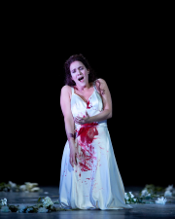 Marlis Petersen as Ophélie
But Hamlet is supposed to take place in the Renaissance grandeur of Elsinore — and what do we get? Basement rooms in stained plaster, barf-green doors, bare brick pilasters, the ugliest battlements this side of the Brooklyn Navy Yard. I don’t know where the designers went to school, but I’d be ashamed to put a sock hop in here, never mind the festivities of a new-married king. Hamlet’s self-dramatizing misbehavior doesn’t stick out in such digs — he’s no stranger than everything else, and Claudius and Gertrude are sordid in good company. The production is by some guys named Caurier and Leiser, borrowed from Geneva, whom we hope have outstayed their work visa and been deported. The dreadful sets are by Christian Fenouillat, the uncomfortable and unattractive costumes by Agostino Cavalca — well, at least they are better than Miuccia Prada’s swishing Attila shmattas.
The designers of the Met’s Trovatore and Tosca and Lucia — and Don Giovanni, for that matter — were similarly glamour challenged. The last truly elegant and appropriate set I can recall in a Met production was that for Gounod’s Roméo et Juliette. And I don’t much like Roméo et Juliette, and no one who appears in that set ever seems to sing anything there but Gounod. It is very tiresome.
In Hamlet, we finally get an attractive stage picture in Act IV (yes!): Ophélie crouches in a grand upholstered sofa near a (lowered) crystal chandelier (representing a frozen fountain?), but as the scene calls for a pond in which she can drown herself, this, too, is puzzling. She spends the scene slashing her wrists and breasts with a knife and the chandelier rises to the ceiling, symbolizing her unlikely — isn’t suicide a mortal sin? — ascent to heaven. I’m not making this up, you know.
By 1868, the phenomenon of French grand opera was winding down, at least in terms of Paris premiers — though Verdi’s Aida, which topped them all, was still to come, and the grandest opera composed by a Frenchman, Berlioz’s Les Troyens, would not reach L’Opéra till well into the twentieth century. It was in 1868 that Ambroise Thomas, fresh from the triumph of his Goethe-based opéra-comique, Mignon, which would hold the stage for a hundred years, produced Hamlet, a late but at the time entirely successful gasp of grand opera.
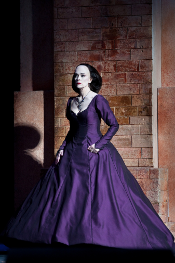 Jennifer Larmore as Gertrude
Hamlet has all the grand opera trappings: big star parts, big solo
display pieces (well, at least one — Ophélie’s famous mad scene),
unusual orchestrations, spectacular effects, small but effective minor roles
(Thomas pounced on Shakespeare’s merry Gravediggers), and a ballet
— omitted at the Met. Just as well: It’s a long evening, and with
only one intermission in five acts, it feels even longer.
Hamlet was a great hit in Paris and elsewhere, but it has always had problems in the English-speaking world. We know Hamlet and we’re not sympathetic to changes in the plot that undercut the familiar story. The same attitude kept Verdi’s Macbeth a rarity hereabouts until the mid-twentieth century — Othello and Romeo and Juliet worked as operas for us because the stories were Italian melodramas to begin with and suited to operatic treatment. Too, Verdi had Boito for his Otello and Falstaff, and Boito knew his Shakespeare.
Thomas’s librettists, Carré and Barbier, who had already done the musical number on so many classics, retained the Ghost and the Gravediggers and the most famous soliloquy — they, and Thomas, knew enough to set “To be or not to be” as declamation and not make a verse chanson out of it — but they omit Hamlet’s wilder feats of mayhem, the murder of Polonius, the trip to England, the duel with poisoned swords. Laertes has been shredded and Polonius all but eliminated — Ophélie goes mad not because her lover has slain her father but merely for love — which Shakespeare might not think credible but is business-as-usual in opera. Then, in building up the soprano and mezzo roles to grand opera stature, the focus on Hamlet’s own dilemma has been watered down. Gertrude’s guilt is not, as in Shakespeare, ambiguous — here she states it, is obsessed with it. And the Ghost won’t stay dead — like a figure in an American horror flick, he keeps popping up, is even responsible for the slaying of his brother. So who needs Hamlet the prince?
A soprano vehicle back in the day — no one but Ophélie gets a major scena — Hamlet is not entirely without interest, and might even be a hit with attractive sets and if cast to strength, which it has not been. You can’t do grand opera on two stars and two fadeouts. It needs better than that. These are virtuoso roles, so designed. We’ve had such sleepwalking Aida casts over the years that we’ve forgotten how singer-driven grand opera used to be — and, at the Met, Aida at least has gaudy sets!
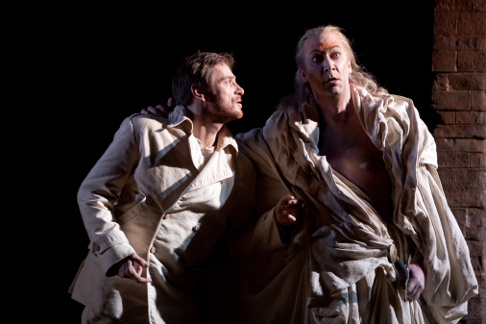 David Pittsinger as the Ghost of Hamlet’s Father and Simon Keenlyside as Hamlet
The finest singing of the night came, unquestionably, from the most unexpected player, Marlis Petersen, replacing an indisposed Natalie Dessay as Ophélie. Dessay was a prime mover and motivation to bring the opera here — no one else would have thought of doing it, and it has always been a soprano vehicle at the Met, for Sembrich and Melba in the old days. (The last time New York saw it, at the City Opera some years ago, it was a vehicle for Sherill Milnes, who performed the title role splendidly, a Shakespearean Trifecta with his Iago and Macbeth.)
Dessay’s abrupt withdrawal from a role she was planning to drop from her repertoire in any case turned out to be a happy occasion. Marlis Petersen has one of the most beautiful and accurate coloratura sopranos now before the public, a cool, clear, easy sound like a rippling stream. One or two top notes seemed forced, but in such a way — and at such a point, on both the broadcast and in the house three days later — as to suggest these were a characterization choice, meant to imply her gathering hysteria. Her trill is imperfect but her runs are ravishing; nothing is tossed away with that “I can’t be bothered to sing each note, I’m acting” shrug so common in this repertory. I would love to hear her in Lucia, Puritani, Sonnambula, Lakme — but, alas, she seems herself to prefer more modern music requiring far more precise musicianship, such as Lulu (which she will sing here in May) and contemporary operas by Reimann, Henze and Trojahn.
In the play, Queen Gertrude’s remarks tend to be brief and on target — her only poetic flights come in describing Ophelia’s death, of which speech she is robbed in the opera in order to turn it into the soprano’s mad scene. Nonetheless, a secure dramatic mezzo can make quite an effective thing of the queen here, and that Jennifer Larmore, still handsome and dressed to kill, did not do so must be attributed to a dullness, a tunelessness, that afflicted her in every register. There was nothing musical, nothing attractive, nothing precisely on the note in the notes she produced; she gave no pleasure. The old plummy Larmore sound was never in evidence.
James Morris, who has been singing at the Met for forty years, starting with Mozart, passing through Bellini and Verdi to Wagnerian triumphs, now suffers from an occasional wobble and a pervading dryness of timbre, but he still cuts an imposing figure, visually and vocally — when he sings, we know he’s there and we know he’s the king. Still, when David Pittsinger sang the Ghost’s music, I wished the brothers might exchange roles as they had exchanged crown and queen. Toby Spence was rather wasted on the small remains — a trio and a duel-duet — of Laërte, and glum Richard Bernstein and lyrical Mark Schowalter made their scene as the Gravediggers seemed far too brief.
In default of the regularly scheduled prima donna, Simon Keenlyside was the headliner of his Hamlet — as he deserves to be. Keenlyside’s voice can seem light and gracious in lieder recitals, then turn so dark and shadowy that the radio listener wonders if it is he or James Morris. We have not had him nearly as often in New York as we might like, but the raves that have met his Billy Budd, Prince Andrei and Rodrigo di Posa in London and on the continent may puzzle Met listeners. His voice, I fear, is not big enough for the house — his acting is too subtle for its spaces. He is never casual for a moment, each word and gesture are considered, and we are often riveted (when he is terrified of the Ghost) or unnerved (when he capers unpredictably before the king and queen), but the beauty of his singing in other roles was given short shrift here. The rumbustious drinking song with which he celebrates the king’s reaction to his strategic play-within-the-play did not ring out. It might be more interesting to hear his sound from upstairs, if one could do that while studying his fascinating portrayal of the character from closer up. I’d go to another performance of the opera if I could endure those awful sets again.
Louis Langrée, who leads the Mostly Mozart forces in his summer job, understands the machine that is grand opera: tight rhythms, driving power when the chorus is to be loosed upon us, and the supportive playing of a variety of tone colors by a variety of instruments required by the showpiece arias that give a work like Hamlet its texture and distinction.
John Yohalem