![Aleksandra Kurzak as Fiorilla and Ildebrando D’Arcangelo as Selim [Photo by Clive Barda courtesy of The Royal Opera]](http://www.operatoday.com/TURCO-100331_0410-KURZAK%20AS%20FIORILLA%26D%27ARCANGELO%20AS%20SELIM-%28C%29BARDA.png)
05 Apr 2010
Il Turco in Londra
It may be possible that there is no more effervescent entertainment on stage in London now than the tirelessly clever revival of Il Turco in Italia now playing at the Royal Opera House.
English Touring Opera are delighted to announce a season of lyric monodramas to tour nationally from October to December. The season features music for solo singer and piano by Argento, Britten, Tippett and Shostakovich with a bold and inventive approach to making opera during social distancing.
This tenth of ten Live from London concerts was in fact a recorded live performance from California. It was no less enjoyable for that, and it was also uplifting to learn that this wasn’t in fact the ‘last’ LfL event that we will be able to enjoy, courtesy of VOCES8 and their fellow vocal ensembles (more below …).
Ever since Wigmore Hall announced their superb series of autumn concerts, all streamed live and available free of charge, I’d been looking forward to this song recital by Ian Bostridge and Imogen Cooper.
Although Stile Antico’s programme article for their Live from London recital introduced their selection from the many treasures of the English Renaissance in the context of the theological debates and upheavals of the Tudor and Elizabethan years, their performance was more evocative of private chamber music than of public liturgy.
Evidently, face masks don’t stifle appreciative “Bravo!”s. And, reducing audience numbers doesn’t lower the volume of such acclamations. For, the audience at Wigmore Hall gave soprano Elizabeth Llewellyn and pianist Simon Lepper a greatly deserved warm reception and hearty response following this lunchtime recital of late-Romantic song.
For this week’s Live from London vocal recital we moved from the home of VOCES8, St Anne and St Agnes in the City of London, to Kings Place, where The Sixteen - who have been associate artists at the venue for some time - presented a programme of music and words bound together by the theme of ‘reflection’.
'Such is your divine Disposation that both you excellently understand, and royally entertaine the Exercise of Musicke.’
‘And there was war in heaven: Michael and his angels fought against the dragon; and the dragon fought and his angels, And prevailed not; neither was their place found any more in heaven … that old serpent … Satan, which deceiveth the whole world: he was cast out into the earth, and his angels were cast out with him.’
There was never any doubt that the fifth of the twelve Met Stars Live in Concert broadcasts was going to be a palpably intense and vivid event, as well as a musically stunning and theatrically enervating experience.
‘Love’ was the theme for this Live from London performance by Apollo5. Given the complexity and diversity of that human emotion, and Apollo5’s reputation for versatility and diverse repertoire, ranging from Renaissance choral music to jazz, from contemporary classical works to popular song, it was no surprise that their programme spanned 500 years and several musical styles.
The Academy of St Martin in the Fields have titled their autumn series of eight concerts - which are taking place at 5pm and 7.30pm on two Saturdays each month at their home venue in Trafalgar Square, and being filmed for streaming the following Thursday - ‘re:connect’.
The London Symphony Orchestra opened their Autumn 2020 season with a homage to Oliver Knussen, who died at the age of 66 in July 2018. The programme traced a national musical lineage through the twentieth century, from Britten to Knussen, on to Mark-Anthony Turnage, and entwining the LSO and Rattle too.
With the Live from London digital vocal festival entering the second half of the series, the festival’s host, VOCES8, returned to their home at St Annes and St Agnes in the City of London to present a sequence of ‘Choral Dances’ - vocal music inspired by dance, embracing diverse genres from the Renaissance madrigal to swing jazz.
Just a few unison string wriggles from the opening of Mozart’s overture to Le nozze di Figaro are enough to make any opera-lover perch on the edge of their seat, in excited anticipation of the drama in music to come, so there could be no other curtain-raiser for this Gala Concert at the Royal Opera House, the latest instalment from ‘their House’ to ‘our houses’.
"Before the ending of the day, creator of all things, we pray that, with your accustomed mercy, you may watch over us."
The doors at The Metropolitan Opera will not open to live audiences until 2021 at the earliest, and the likelihood of normal operatic life resuming in cities around the world looks but a distant dream at present. But, while we may not be invited from our homes into the opera house for some time yet, with its free daily screenings of past productions and its pay-per-view Met Stars Live in Concert series, the Met continues to bring opera into our homes.
Music-making at this year’s Grange Festival Opera may have fallen silent in June and July, but the country house and extensive grounds of The Grange provided an ideal setting for a weekend of twelve specially conceived ‘promenade’ performances encompassing music and dance.
There’s a “slide of harmony” and “all the bones leave your body at that moment and you collapse to the floor, it’s so extraordinary.”
“Music for a while, shall all your cares beguile.”
The hum of bees rising from myriad scented blooms; gentle strains of birdsong; the cheerful chatter of picnickers beside a still lake; decorous thwacks of leather on willow; song and music floating through the warm evening air.
It may be possible that there is no more effervescent entertainment on stage in London now than the tirelessly clever revival of Il Turco in Italia now playing at the Royal Opera House.
As imagined by the directorial team of Moshe Leiser and Patrice Caurier, Turco recalls the heyday of 60’s Italian cinema, with images unashamedly evocative of La Dolce Vita, 8-1/2 et al, and comedy rendered in the vein of a rather ribald sitcom; I Love Lucy with a fully functioning queen size bed, instead of those two maddening twins, if you will. (Where was Little Ricky conceived in that chaste boudoir?)
Mssrs. Leiser and Caurier waste no time in jump-starting the action with
(mostly) meaningful busy-ness that is (mostly) cleanly executed by the
well-tutored ROH chorus under the direction of Renato Balsadonna. Amid much
amassed rushing on- and off-stage, and much laying on of (mostly) primary
colors on gliding flats, the all-important Pirandellian narrator Prosdocimo is
dynamically introduced, and he immediately engages the audience directly in his
quest to write the very opera we are viewing.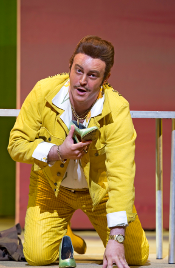 Colin Lee as Narciso
The inventiveness never flags, and it is to the directors’ credit that they manage to (mostly) avoid upstaging stars and story with distracting business. And when they score (which is often), they score big. Can there have been a more spectacular star entrance than that devised for the white-clad Selim, back to us, atop the massive prow of a yacht that tracks into view upstage, complete with pop-up Turkish flag? As the bass turns around to let us size him up visually just before he sings, it completes a perfectly judged dramatic moment. The preening Narciso rides in on a motor bike, another telling character introduction. Would that Fiorilla’s rather weak entrance have had the same cheeky punch. Still, the lady gets to roll around on the afore-mentioned bed in a passionately madcap sex show with her horny Turk, that is, until Don Geronio lurches through the door effecting a highly comical ‘show-itus interruptus.’
Principals arrive for the meeting on the beach on all mode of transport, snazzy sedan, cheap compact, and the tenor-topped Vespa; and Selim’s subsequent making out with Zaida in the back seat was a goof that resonated with 60’s park-and-snog atmosphere. The cast was exceptionally well blocked and the whole evening was crafted with well-defined character relationships as evidenced by meaningful, varied stage business.
That said, there was an occasional mis-step. Or minced step. When the chorus does those supposed-to-be-funny-pattering-feet-run-abouts, well, we are drawn out of an otherwise honest evening by the falesehood of the movement. This Turco is so overwhelmingly funny and delightful because of its honest trust in the material, that such insincere applications matter. I would urge the team to re-look the staging to eliminate those few fleeting distractions. And an inherent problem in today’s’ opera world remains that the (clever) surtitles sometimes get the laugh in lieu of, or in advance of the singer/director. Maybe delaying the punchline projection would give the performer the advantage?
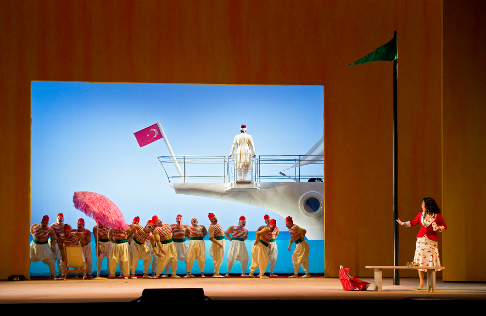 Scene from Il turco in Italia
The directorial duo was given stellar support in their efforts starting with an eye-popping, riotously colorful set design by Christian Fenouillat. The pleasing clutter and motion of flats at the top of One filled the space with a volatile, multi-layered geometric design, with floating blocks of color reminiscent of, say, Mark Rothko. While the texturing of the set pieces seemed a little rudimentary on occasion, there is no doubt that it functioned beautifully, constantly morphing into such surprises as the fold out bed room (complete with a painting of an erupting Vesuvius over the head board), and a 60’s Kitsch disco complete with mirror ball for the party scene.
Of equal quality were the well-gauged costumes by Agostino Cavalca. Fiorilla was got-up as a Gina Lollobrigida stand-in and her glamor knew no bounds. Va-va-voom. Narciso’s yellow Elvis-meets-the Pillsbury-Dough-boy pop-rocker jumpsuit was giddily prankish. And the manly, well-tailored costumes for the title character managed to make him look handsomely exotic rather than stock-issue-silly. Indeed, the entire ensemble of performers was clothed in character-specific attire in a well-calculated color palette. Christophe Forey’s spot-on (pun intended) lighting was a critical component in the over-all triumph of design.
As Selim, Ildebrando d’Arcangelo swept all before him with a commanding presence, good comic sensibilities, amorous abandon, and oh, yes, an imposing world class bass voice with the suavity and richness of a dark Godiva chocolate sauce. He must own this role right now, so definitive was his performance.
Young Aleksandra Kurzak had much to recommend her as Fiorilla: a secure, silvery lyric soprano with excellent agilty; a lovely physical appearance; a supremely confident stage demeanor; superior acting skills. This was a beautifully sung account, cleanly and effortlessly delivered, save for a bit of sraight-toned stridency that crept into the very loudest notes above the staff. However, unlike her other successful repertoire (Adina, Susanna, Norina), Fiorilla asks for that extra measure of Divadom that is not yet hers to command. This is a vehicle that cries out for the unique fire-power and charismatic gifts of a Callas, a Sills, a Bartoli. If only Ms. Kurzak could go the the Evita shop and buy a “little touch of star quality,” for she decidedly has all the other goods and then some. Ah well, she is young and gifted. My bet is that time and experience will find her growing ever further into this role assumption
If his securely sung and impersonated Prosdocimo is any evidence Thomas Allen’s illustrious career remains an evergreen joy. The buffo Alessandro Corbelli acquitted himself exceptionally well as the weary Geronio, missing nary a nuance as the demoralized spouse. Leah-Marian Jones was a lovely, and lively Zaida, her plummy vocalizing a wonderful complement to Aleksandra’s limpid soprano. Collin Lee’s light-voiced tenor had all the pleasing notes in place as Narciso, although there was occasional gear-shifting around the passaggio that made for a handful of clumsy musical phrasings. Jette Parker Young Artist Steven Ebel made an assured impression as Albazar.
On this occasion, the pit seemed off form initially with Maurizio Benini leading a rather scrappy overture. There was little fire or presence at the downbeat, and the horn solo was not only a hair under pitch but also sounded like it was well off-stage. It wasn’t until the jaunty string figure re-appeared that the band seemed to settle into a more inspired comic frame of mind. There were also some rhythmic mis-connects with the chorus getting ahead, then Geronio in his patter, then the chorus again, then Narciso, that are atypical of Covent Garden’s high standard. However, by a third of the way into Act One the musical ensemble settled down, and the whole thing began to sparkle. No doubt future performances will have righted these minor imperfections.
All told, London’s Il Turco in Italia is an engaging evening of witty stagecraft, rife with winning portrayals, and featuring secure singing from some of the day’s top artists. In short, ROH has served up a veritable Turkish Delight.
James Sohre