![Linda Watson (Brunnhilde) [Photo by Monika Rittershaus courtesy of Los Angeles Opera]](http://www.operatoday.com/gott_312.png)
06 Apr 2010
LA Opera finishes formidable Ring
The boo’s were boisterous when director/designer Achim Freyer came on stage at the end of Götterdämmerung in Los Angeles’ Dorothy Chandler Pavilion on April 3.
English Touring Opera are delighted to announce a season of lyric monodramas to tour nationally from October to December. The season features music for solo singer and piano by Argento, Britten, Tippett and Shostakovich with a bold and inventive approach to making opera during social distancing.
This tenth of ten Live from London concerts was in fact a recorded live performance from California. It was no less enjoyable for that, and it was also uplifting to learn that this wasn’t in fact the ‘last’ LfL event that we will be able to enjoy, courtesy of VOCES8 and their fellow vocal ensembles (more below …).
Ever since Wigmore Hall announced their superb series of autumn concerts, all streamed live and available free of charge, I’d been looking forward to this song recital by Ian Bostridge and Imogen Cooper.
Although Stile Antico’s programme article for their Live from London recital introduced their selection from the many treasures of the English Renaissance in the context of the theological debates and upheavals of the Tudor and Elizabethan years, their performance was more evocative of private chamber music than of public liturgy.
Evidently, face masks don’t stifle appreciative “Bravo!”s. And, reducing audience numbers doesn’t lower the volume of such acclamations. For, the audience at Wigmore Hall gave soprano Elizabeth Llewellyn and pianist Simon Lepper a greatly deserved warm reception and hearty response following this lunchtime recital of late-Romantic song.
For this week’s Live from London vocal recital we moved from the home of VOCES8, St Anne and St Agnes in the City of London, to Kings Place, where The Sixteen - who have been associate artists at the venue for some time - presented a programme of music and words bound together by the theme of ‘reflection’.
'Such is your divine Disposation that both you excellently understand, and royally entertaine the Exercise of Musicke.’
‘And there was war in heaven: Michael and his angels fought against the dragon; and the dragon fought and his angels, And prevailed not; neither was their place found any more in heaven … that old serpent … Satan, which deceiveth the whole world: he was cast out into the earth, and his angels were cast out with him.’
There was never any doubt that the fifth of the twelve Met Stars Live in Concert broadcasts was going to be a palpably intense and vivid event, as well as a musically stunning and theatrically enervating experience.
‘Love’ was the theme for this Live from London performance by Apollo5. Given the complexity and diversity of that human emotion, and Apollo5’s reputation for versatility and diverse repertoire, ranging from Renaissance choral music to jazz, from contemporary classical works to popular song, it was no surprise that their programme spanned 500 years and several musical styles.
The Academy of St Martin in the Fields have titled their autumn series of eight concerts - which are taking place at 5pm and 7.30pm on two Saturdays each month at their home venue in Trafalgar Square, and being filmed for streaming the following Thursday - ‘re:connect’.
The London Symphony Orchestra opened their Autumn 2020 season with a homage to Oliver Knussen, who died at the age of 66 in July 2018. The programme traced a national musical lineage through the twentieth century, from Britten to Knussen, on to Mark-Anthony Turnage, and entwining the LSO and Rattle too.
With the Live from London digital vocal festival entering the second half of the series, the festival’s host, VOCES8, returned to their home at St Annes and St Agnes in the City of London to present a sequence of ‘Choral Dances’ - vocal music inspired by dance, embracing diverse genres from the Renaissance madrigal to swing jazz.
Just a few unison string wriggles from the opening of Mozart’s overture to Le nozze di Figaro are enough to make any opera-lover perch on the edge of their seat, in excited anticipation of the drama in music to come, so there could be no other curtain-raiser for this Gala Concert at the Royal Opera House, the latest instalment from ‘their House’ to ‘our houses’.
"Before the ending of the day, creator of all things, we pray that, with your accustomed mercy, you may watch over us."
The doors at The Metropolitan Opera will not open to live audiences until 2021 at the earliest, and the likelihood of normal operatic life resuming in cities around the world looks but a distant dream at present. But, while we may not be invited from our homes into the opera house for some time yet, with its free daily screenings of past productions and its pay-per-view Met Stars Live in Concert series, the Met continues to bring opera into our homes.
Music-making at this year’s Grange Festival Opera may have fallen silent in June and July, but the country house and extensive grounds of The Grange provided an ideal setting for a weekend of twelve specially conceived ‘promenade’ performances encompassing music and dance.
There’s a “slide of harmony” and “all the bones leave your body at that moment and you collapse to the floor, it’s so extraordinary.”
“Music for a while, shall all your cares beguile.”
The hum of bees rising from myriad scented blooms; gentle strains of birdsong; the cheerful chatter of picnickers beside a still lake; decorous thwacks of leather on willow; song and music floating through the warm evening air.
The boo’s were boisterous when director/designer Achim Freyer came on stage at the end of Götterdämmerung in Los Angeles’ Dorothy Chandler Pavilion on April 3.
However, the bravo’s — more sedately stated — were in the majority, and their enthusiasm declared the success of this first production of Wagner’s Ring des Nibelungen in the company’s 25-year history. (Price tag: $32 million.)
This does not imply, of course, total agreement even among Freyer’s fans. Indeed, intermission conversation was rich in questions on the director’s intentions and on the wealth of images that made his stage a continually shifting panorama often with little obvious reference to events in the libretto — questions that will continue to perplex the audience as the production now moves into three complete cycles set for May and June.
Yet this Ring, no matter how it is judged, is a landmark — especially for the United States where it is the first experience of radical Wagnerian Regieoper yet encountered. And even those who prefer traditional Wagner could not withhold their praise for an exemplary cast that under the director of veteran Wagnerian James Conlon who made this a memorable Ring from its beginning a season ago to its conclusion on the Easter weekend.
It’s clear that Conlon cares and that he was out to give Los Angeles — and the United States — a Ring to remember. The production is not only a singular triumph for Los Angeles Opera, it is further a milestone in the staging of Wagner in America.
The opening scene of Götterdämmerung with the Three Norns trying in vain to weave the fabric that guaranteed some kind of future for Walhalla and its now despondent residents brought few surprises to those who had seen the first three installments of the Freyer Ring. Wotan’s missing eye remained in evidence, and the Tarnhelm — a gilded top hat — was suspended above the stage. Lighted tubes in various colors remain Freyer’s top toy.
There was thus little in the director’s immense bag of tricks that the audience had not already seen, and the question was now how successfully Freyer might bring the cycle to a meaningful and satisfactory conclusion. Freyer reduced the Gibichungs to near-comic-book figures, singing for the most part behind huge cut-outs. The incestuous relationship between siblings Gunther (Alan Held) and Gutrune (Jennifer Wilson), now a given in most Ring productions, was hardly noticeable as attention focused on Hagen, now the master of evil in Götterdämmerung.
Of Hagen, deliciously sung by veteran bass Eric Halfvarson, Freyer made a paraplegic dwarf who rarely left his seat at stage right, where he operated something of a remote to cause things to happen on stage. Unable to stab Siegfried in the usual manner in Act Three he allowed a bar of yellow light to fall and bring down the hero. Hagen’s equally evil men, on stage throughout Act Two, framed Brünnhilde’s cry for revenge and made this the finest hour of the entire cycle.
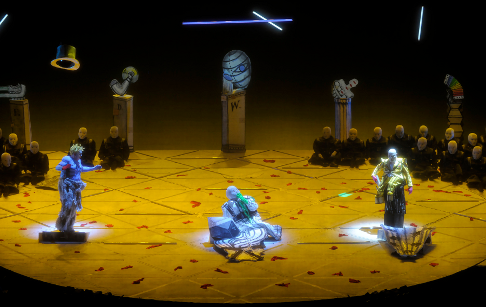 John Treleaven (Siegfried), Alan Held (Gunther), Eric Halfvarson (Hagen)
Linda Watson, a major Brünnhilde of the past decade, brought unusual anguish to the frustrating helplessness of a woman now bereft of divine powers. (And one wonders why Siegfried makes such limited use of the magic that he had acquired through Ring and Tarnhelm, which he had used only to win Brünnhilde for weakling Gunther.) As the wrongly wronged woman Watson was at her dramatic — and tragic — best in achieving the dramatic intensity that made this act breathtakingly engaging.
No procession carried the dead Siegfried from the stage. The mortally wounded John Treleaven walked rather from sight, while a black-clad figure — his soul? — collapsed at Watson’s feet. The Funeral March, although played with epic sweep by Conlon, was thus without its usual focus. Moreover the powerful Immolation, in which Brünnhilde puts the entire story of the Ring together, suffered from Freyer’s inability to control excess.
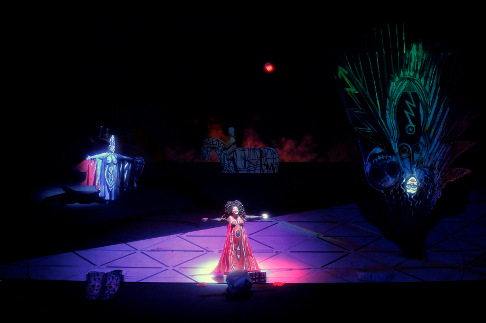 Back: Michelle deYoung (Waltraute), Front: Linda Watson (Brunnhilde)
Flames, a horse rising at the rear of the stage and immense ravens flying across the scrim were more competition than Watson — and Wagner — could counter. Although the soprano’s delivery was belabored, Conlon evoked an exuberance from his spectacular orchestra that ended the performance with the metaphysical consolation that Nietzsche called the essence of Greek tragedy. Once one adjusted to the Harpo Marx curls that Treleaven had sported in Siegfried, he sang the ill-fated hero with stamina and lyric loveliness as the drink that had destroyed his memory wore off and he recalled the promise with which he had set out on his venture.
Highest vocal marks, however, went to Michelle DeYoung for her expression of Waltraute’s sisterly concern in her attempt to avoid impending tragedy. One of the great Wagner and Mahler interpreters of today, DeYoung also sang the Third Norn, joined in the opening scene by Jill Grove and Melissa Citro. Richard Paul Fink was a definitive Alberich.
Beginning with Wolfgang Wagner’s revolutionary Ring that re-opened the Bayreuth Festival in 1952 directors have attempted to de-mythologize the work, to make clear that these are not gods and giants, but confused humans like the rest of us. Achim Freyer has rather made a daring effort to re-mythologize the Ring — to elevate it beyond the every-day to a new level of metaphysical significance. His may not be a Ring for everyone, but it is not to be written off as missing the Wagnerian mark.
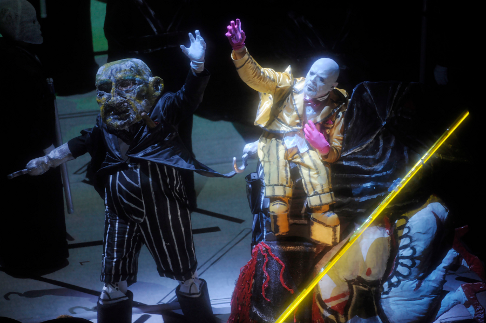 Alberich (Richard Paul Fink), Eric Halfvarson (Hagen)
While in Germany it is Wagner’s Parsifal that dominates the Easter weekend, it was significant — if coincidental — that Los Angeles paired Götterdämmerung at the Opera with a stirring performance of Gustav Mahler’s Fifth Symphony across First Street at the Los Angeles Philharmonic in Disney Hall. The two works, heard in tandem on April 3, made for an impressive weekend. Given the hype surrounding the appointment of Gustavo Dudamel as music director of the Philharmonic, it was important to hear the orchestra under another conductor — in this case guest Semyon Bychkov.
Soviet-born and -trained Bychkov, now at home with Germany’s WDR Orchestra in Cologne, is an elegant and able conductor who took, however, a largely understated view of Mahler’s 1904 score. This was classic Mahler, if one will, contrasting sharply with the Romantic — and often bombastic — view of the composer commonly encountered today.
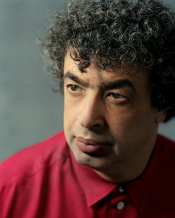 Semyon Bychkov [Photo courtesy of Van Walsum Management]
Fascinating was the manner, in which Bychkov kept one aware of that undercurrent of gnawing contradiction that is so much a part of Mahler — that saying “Now, this isn’t as overwhelmingly lush as it seems” that is the mark of a Mahler master. Bychkov was especially convincing in the delicate transparency that he brought to the brief Adagietto, a movement often reduced to near-trivia through its over-popularity. (It was the major theme of Lucino Visconti’s undoing of Thomas Mann’s Death in Venice.)
Trumpeter James Wilt set the tone for the performance with the solo that opens the score, and — happily — Bychkov moved horn William Lane to the front of the orchestra for his seminal role in the sometimes rustic Scherzo.
It was, however, the Philharmonic itself that was the glory of the Mahler heard on April 3. This is obviously one of the world’s top orchestras, due in no small measure to the devotion brought to it from 1992 to 2009 by music director Esa-Pekka Salonen. It is hoped that Dudamel realizes the challenge in Salonen’s legacy and keeps the Philharmonic at its current level of excellence.
The Los Angeles Opera stages three complete cycles of Achin Freyer’s production of Wagner’s Ring des Nibelungen between May 29 and June 28, 2010. For information and tickets,1972-8001 or visit its web site.
Wes Blomster