The program for Götterdämmerung omitted a credit for the role of Alberich (sung ably by Richard Paul Fink), requiring the inclusion of a slip of paper to amend the error. A larger inserted sheet advertised the upcoming three cycles of the Freyer production of Der Ring des Nibelungen, but the calendar of dates cited no month — time means little in the mythical world of Wagner’s masterpiece, one might propose.
Freyer is not an artist averse to rough edges, so these managerial slips would probably just amuse him. After all, as Brünnhilde sent the ravens off to Valhalla to tell Wotan of the end of his world, on Freyer’s set the raven cut-outs, located at either end of the stage lip, rose up to reveal two prompters, chest-high, backs to the audience but scores before them. Not long before that, a computer malfunction left the projected backdrop strewn with line after line of computer gibberish, but since one line of that was a time clock running down, perhaps it was part of Freyer’s design all along.
If Freyer’s climax disappointed (which it did), it wasn’t because of these intentional or inadvertent glitches, but because his invention did not match the boldness and incision seen in the earlier parts of this long, long show (and most of his other stagings of the Ring operas). Gibichungs on wires tumbling through the air behind a scrim of flames came off as more Cirque du Soleil than riotous or avant-garde. To the vociferous critics of Freyer’s work, it must be said that the mythic ponderousness seen in most stagings of Wagner’s work — a quality that those critics would insist is embedded in the libretto — holds little interest for Freyer. His vision is centered on identity, the no-man’s-land distance between what each character thinks of him or herself and what events reveal the truth to be. Thus, Freyer created the painted cardboard facades that characters carried before them, right from Das Rheingold until the end of Götterdämmerung. At that end, Linda Watson’s Brünnhilde couldn’t take the subterfuge anymore, and knocked not only her own flat representation to the ground, but those of the other characters then on stage. She had truly learned contempt for the ring, and the limitless avarice and ambition it inspired.
Surely Freyer’s sense of humor traumatized those most offended by his staging, especially the portrayal of Siegfried, a muscle-bound doofus who, nonetheless, came off as the only genuine, likable figure in the world. John Treleavan continued to make some of the more unpleasant sounds a tenor can make and still manage to create an appealing characterization that excused most, if not all, the barking and yelping. Most of the first two acts Watson seemed to holding back on the best part of her voice, its sheer formidable size, as if keeping a reserve for her monumental closing scene. In the event, her full power did not reveal itself even then, another factor that made the last 15 minutes of this five-hour extravaganza the least impressive section.
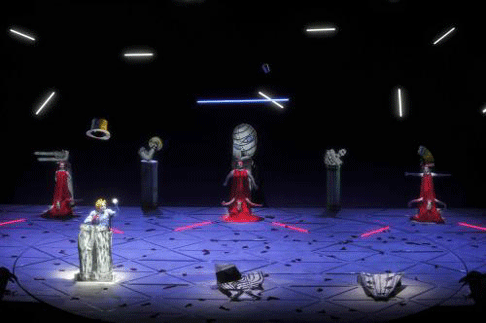 Front: John Treleaven (Siegfried), Back: Stacey Tappan (Woglinde), Ronnita Miller (Flosshilde), Lauren McNeese (Wellgunde) [Photo by Monika Rittershaus courtesy of the Los Angeles Opera]
Eric Halfvarson triumphed as Hagen, his gruff, imposing bass as frightening as his portrayal. Freyer’s work here (with costumes designed by himself and his daughter Amanda) is emblematic of the Freyer approach. Hagen wore a bright yellow jacket, and around Halfvarson’s waist were two limp, yellow-clad dwarf legs, while the singer’s lower half was a pair of black trousers with white chalk streaks (matching some of other design elements). When Hagen stood behind his facade, he could drape the legs over the front, making him look truly troll-ish. At other times, though, Freyer had no hesitance about having the singer stride the stage, the dwarf-legs dangling feebly at his waist. This sort of staging element drove some attendees crazy, as Freyer quite obviously had no interest in naturalistic representation. For those accepting of this theatrical compromise, nothing distracted from the complete portrayal of Hagen as detailed in Wagner’s libretto — ugly, scheming, manipulative, and ultimately doomed.
Alan Held as Gunther and Jennifer Wilson as Gutrune both sang impressively from behind their blank, infantile Gibichung masks — masks that were able to make Siegfried’s deception when he kidnapped Brünnhilde plausibly staged, for once. Michelle DeYoung joined Jill Grove and Melissa Citro as the three Norns, and Ms. DeYoung also made for a fine Waltraute.
The pit reconfiguration did dampen the sound a bit too much as James Conlon continued to lead the Los Angeles Opera orchestra with finesse and power. The horns in particular had a great, great day on Sunday. There were a small number of departures from the audience after the first act, but most stayed, and then lingered to stand through the final ovations, which rose to a peak of volume when Conlon appeared. The conductor is truly becoming the heart and soul of Los Angeles Opera, which may save it come the day that Placido Domingo no longer leads — ostensibly — the company.
Not to say that Conlon is perfect. He managed to find the funding for his Recovered Voices series, which undoubtedly has brought some exposure to some interesting work — that of composers whose careers were crushed by the Nazis. However, opera being the expensive enterprise that it is, your reviewer can’t help but wonder if compromised stagings of these rare (for a reason, too often) operas really fits the managerial profile of a company that operates out of the Dorothy Chandler, a 3000+ seat hall. The last performance of Shreker’s Die Gezeichneten on a Thursday night saw a house with decent attendance but far from a sell-out. Conlon’s devotion to this music is evident in the power and beauty of the orchestra’s performance. Schreker’s score, however, sounded like a never-ending striving for sensual effects, with no solid lyrical themes as a foundation. The harmonic language tended to the sort of overripe modalities of the score to a Cecil B. De Mille Biblical extravaganza. Schreker’s libretto is even more hopeless, an incomprehensible mish-mash of perversion and political intrigue, mostly told through interminable dialogues with next to no action actually seen on stage.
Director Ian Judge had to work around the revolving platform built for Freyer’s production, and Judge found clever ways to exploit his limited resources, including some tasteful projection effects (designed by Wendall K. Harrington). An interesting cast tried their best, with Robert Brubaker outstanding as Alviana Salvago, the hump-backed dwarf who searches hopelessly for love while finding ample opportunities for sexual degradation. Anja Kampe sounded great as Carlotta Nardi, Salvago’s obsession. A huge cast of other able singers strode on and off but your reviewer could not make sense of their motivations and stopped caring by the end of the second act. Even an orgy in an island grotto couldn’t make him linger.
At least partly due to the cost of the Freyer Ring, next season there will only be six main stage opera productions, and the Recovered Voices series will take a hiatus. Perhaps future ventures in the series should be staged in some alternative, more intimate home, where those who share Conlon’s passion for this niche can settle in comfortably for their dose of early 20th century Viennese perversity and pretentiousness.
Chris Mullins
![Martin Gantner (Count Tamare), Anja Kampe (Carlotta) in The Stigmatized [Photo by Robert Millard courtesy of the Los Angeles Opera]](http://www.operatoday.com/Stigmatized_LAO.gif)