For after the quivering soldier-as-executioner drops the axe in fright (at the moment the music tells us the head, not the axe, falls to the ground), a determined Herodias strides up to the kneeling prophet, switchblade in hand, and gruffly slits his throat with a spray of blood on the Plexiglas walls of the central cubicle-cum-wrestling-ring. That whole pesky “cistern” thing? Fuggedaboudit. Or anything remotely resembling the Oscar Wilde-Richard Strauss creation.
The entire design and directorial conceit seemed to hang upon a unit set which approximated, what, a circus ring? Amphitheatre? Upscale medical classroom? Downscale cruising bar? The performers sauntered on before the houselights dimmed and took their places remaining onstage until a) the opera ended, or b) they died, whichever came first. The semi-circle of steps and platforms also served as a wall on which Herodias relentlessly paced for what seemed like the first third of the piece, and frequently thereafter. Betchya didn’t know this was all about Herodias, now didja?
When Narraboth sings “wie schoen ist die Prinzessin Salome” we don’t really know who or where she is. We do see Lady H promenading prominently in the focal point looking oddly like Miss Manners, in a black, partially sequined gown that might be seen at a SoHo gallery opening. After praying that this (nonetheless handsomely mature) woman was not our heroine, all I could think was “wie alt is die Prinzessin Salome heute Nacht.” That fear was allayed — sort of — when we come to realize that indeed our young princess was someone else, and cozying up to daddy on a stair stage left. Our Salome looked like a Mall-rat, got up in black leg warmers, teal high-heeled boots to mid-calf and — well, what might have passed for a First Communion dress. Except, whoa, we hadn’t lived that part of history yet.
This box, this …this…’thing’ center stage “must have been about something.” Except I don’t know what. Nor did my well-read colleague who was seated next to me. Nor, in fact, did one of the principle singers in the production. No one knew what this rotating square platform with plexiglass walls actually was. In Euro-trash-circles, that can only mean one thing: it was gasp “important.”
All sorts of foolishness went on in this space. Salome and John squared off in as un-erotic a duet staging as I hope to never encounter again. Salome’s lascivious dance consisted of her dumping several buckets of sand in the middle of the square. Then she and Herod played in it like two demented pre-schoolers. They giggled, they built mounds of sand, they scattered the other’s creations, and then by golly, Our Gal Sal starting jumping up and down in it. Well, daddy was having none of that, so he packed sand around her feet so she Could. Not. Move. That showed her, by golly. There she was, dance music throbbing sensuously, cemented in place by three inches of sand. In fairness, she did break loose and came up with a veil. Okay, okay it was a triangle of cloth with which she blindfolded Herod, who wore what appeared to be a paper crown throughout, a look that was a cross between a Burger King hat and Bart Simpson’s hair-do.
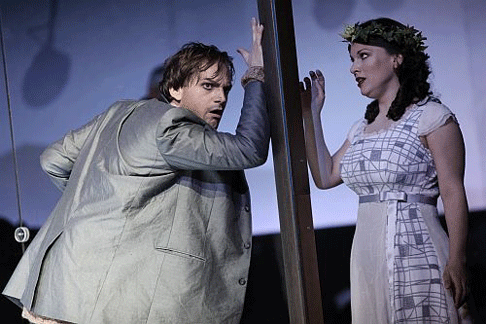 Peter Felix Bauer as Jochanaan and Justine Viani as Salome
There was no end to the inventions. In lieu of Jokanaan’s voice booming from a cistern, he sang through a bullhorn, often from a fetal position tucked under a step. The Page is attired in a cocktail dress as a woman throughout, ditto the Slave Girl who, got up as the household’s maid, gets strangled by Herod. Guess she left one too many Windex streaks on the Plexiglas. Dead bodies were dispatched through a door in one of the stairs, not unlike the window seat in Arsenic and Old Lace (and twice as funny). How Narraboth dies is anyone’s guess. He was far upstage and seemed to smear something on his hand which he then stuck in…what…a socket? There was a little spark and then he fell down. I honestly thought the effect must have mis-fired, but while I was assured it hadn’t…it did. At least his means of death didn’t cause that pesky blood-flow that Herod complains about in the text. Oh, wait. Oh, damn. There was no blood. What was that Krazy King talkin’ ‘bout?
The throat-slitting leaves Salome without a head of her own, of course, so she plays with the one that is still attached to the dead body. And ooh, she gets nasty with it. By the time she actually straddles Jokanaan…what the heck? He comes back to life! And they roll around in a lip lock, groping and stroking. Ah, but this is all in her head, you see. (I think.) And when Herod orders someone to kill her, well, no one does.
For the record I should tell you that Aurelia Eggers directed this mess, and never has someone succeeded in making so little out of so much. I used to think Salome was so powerful it was fool-proof, but then I had failed to reckon with the foolishness of Ms. Eggers. Stephan Mannteufel’s set design at least had the benefit of cleanly professional execution. Andreas Rehfeld’s lighting missed nearly every opportunity inherent in the piece. Where was the sudden sliver of moonlight that reveals the debauched princess prompting her father to command her death? How could so little attention be paid to such things? The costumes from Veronika Lindner were all over the place, and while they were not overtly offensive, they were also not in any way helpful to the characterizations.
Happily the musical side of the evening was considerably more rewarding. From the very first phrase, Emilio Pons as Narraboth revealed a robust lyric tenor that was beautifully deployed throughout his vocal appearance. This was an especially commanding interpretation from this wonderful artist and it should open doors to major houses. Peter Felix Bauer is already a very fine Jokanaan, with a secure, buzzing baritone voice of ample size that speaks over the orchestra throughout the range. It is understandable that this young singer is still feeling his way through the mechanics of a phrase here, an interval there, but his is an exciting future in this role as his voice matures and he gets more experience in the part.
Winfrid Minkus also had a very good night as Herod, singing (and never once shouting) with clarity and good dramatic understanding. The goofiness of the staging held him back somewhat, but he offered good insights and a commanding presence. Ditto the powerhouse Herodias from company member Carolyn Frank. This was my first encounter with Ms. Frank but if ever there was a perfect match of vocal prowess and role, this was it. Her hurled declarations of “Meine Tocher hat recht getan” were bone chilling.
Sebastian Geyer’s light-voiced baritone was enjoyable as the Second Nazarene, but Wilfried Staber’s richly projected First Nazarene stole that scene and was a real highlight. I usually find the hectoring segment with the Five Jews something to be endured until we can get on with the story, but here it was very well sung by Young Kyoung Wan, Dagang Zhang, Sang Hoon Lee, Michale Zahn and, especially Tokuichi Toyota. Riveting stuff.
I would like to report that with title role debutante Justine Viani we had discovered another Birgit. But for all of her hard work, and considerable talent, I am truly sorry I cannot. For I liked her. I admired her pluck, and her concentration, and her stage presence, and her quite lovely soprano instrument. There was much that she sang that was sensitively phrased, and potentially affecting. But her unidiomatic German early on, and her lack of steely richness in the lower middle, robbed her performance of the impact that is needed in those long parlando exposition passages. By the time of the great final scene, she was not only pronouncing it well, but her voice was living vibrantly in the more grateful upper stretches of the writing. Despite the quite rapturous reception from the first-nighters, I don’t think Ms.Viani’s current gifts are an optimal match for this cruelly difficult part.
Conductor Cornelius Meister led a well-judged reading, cleanly executed by a beautifully rehearsed ensemble of musicians who were in top form. In a monster-piece like this, virtuoso playing is de rigeur and the Heidelberg pit did themselves proud. Maestro Meister is young, and surely time and experience will deepen his feeling for the piece. Like his Dutchman in Munich last spring, I felt that he conducts with consummate skill and control, but he does not yet get the orchestra to partner and support the drama. They need to be living it with the singers. He is supremely gifted. He has a bright future. And the opera world needs him. I would caution him that when he is in a continual spotlight, he should resist smiling proudly as the orchestra has played something to his liking — a boyishly grinning conductor does not quite mesh with lurid acts of necrophilia on stage.
Ja, ja, at the end of the night I felt numbed by the staging, but honestly buoyed by the high musical quality. The Publikum responded in kind with resounding approval for the soloists, conductor. and musicians, and well, they couldn’t even work up the energy to disapprove of the production with the usual hissing and booing. This tepid indifference is perhaps the best response. I mean, sure they turned Salome on its, um, head. But why bother losing ours over it?
James Sohre
![Justine Viani (Salome) [Photo by Markus Kaesler courtesy of Theater der Stadt Heidelberg]](http://www.operatoday.com/Salome_002.gif)