Subscribe to
Opera Today

Receive articles and news via RSS feeds or email subscription.


twitter_logo[1].gif


UCP_9780226043425.gif

Recently in Performances

Wozzeck at ENO

“Man is an abyss. It makes one dizzy to look into it.” So utters Georg Büchner’s Woyzeck, repeating what was also a recurring motif in the playwright’s own letters.

Mulhouse: Rare Britten Well Done

National Opera Company of the Rhine has marked this year’s Benjamin Britten celebration with a remarkably compelling, often gripping new production of the seldom-seen Owen Wingrave.

Frankfurt's Intriguing Idomeneo

Once upon a time, Frankfurt Opera had the baddest ass reputation in Germany as “the” cutting edge producer of must-see opera.

Rigoletto at Lyric Opera of Chicago

Productions of Giuseppe Verdi’s Rigoletto can serve as a vehicle for individual singers to make a strong impression and become afterward associated with specific roles in the opera.

Britten Sinfonia with Ian Bostridge

Just in case we were not aware that the evening’s programme was ‘themed’, the Britten Sinfonia designed a visual accompaniment to their musical exploration of night, sleep and dreams.

Aida, Manitoba Opera

Poor Aida! She never seems to have anything go her way.

Superlative singing: Don Carlo, Royal Opera House

Is it possible to upstage Jonas Kaufmann? Kaufmann was brilliant in this Verdi Don Carlo at the Royal Opera House, London, but the rest of the cast was so good that he was but first among equals. Don Carlo is a vehicle for stars, but this time the stars were everyone on stage and in the pit. Even the solo arias, glorious as they are, grow organically out of perfect ensemble. This was a performance that brought out the true beauty of Verdi's music.

Sarah Connolly: French Song at Wigmore Hall

The big names were absent: Duparc, D’Indy, Debussy, Ravel … and while Fauré, Chausson, Roussel and several members of Les Six put in an appearance, in less than familiar guises, this survey of French song of the early 20th century and interwar years deliberately took us on a journey through infrequently travelled terrain.

Rare restoration: Handel’s Esther 1720

Composed between 1718 and 1720, Handel’s Esther is sometimes described as the ‘first English Oratorio’, but is in fact a hybrid form, mixing elements of oratorio, masque, pastoral and opera.

The Damnation of Faust, London

Hector Berlioz's légende dramatique, La Damnation de Faust, exists somewhere between cantata and opera. Berlioz's flexible attitude to dramatic form made the piece unworkable on the stages of early 19th century Paris and his music is so vivid that you wonder whether the piece needs staging at all.

Elizabeth Connell Memorial Concert, St John's Smith Square

St. John’s Smith Square was the site of Elizabeth Connell’s final London concert, intended as a farewell to London on her moving to Australia. It was rendered ultimately final by her unexpected death.

Aida with all the Trimmings, Even a Blue Silk Elephant!

With the building of the Suez Canal, Egypt became more interesting to Western Europeans. Khedive Ismail Pasha wanted a hymn by Verdi for the opening of a new opera house in Cairo, but the composer said he did not write occasional pieces.

Die Zauberflöte, Royal Opera

Back for its fourth revival, David McVicar’s 2003 production of Mozart’s Die Zauberflöte has much charm, beauty and artistry.

The Marriage of Figaro Ends Season at Arizona Opera

Wolfgang Amadeus Mozart's opera The Marriage of Figaro has a libretto by Lorenzo daPonte based on the French play La folle journée, ou le Mariage de Figaro (The Crazy Day or the Marriage of Figaro) by Pierre Caron de Beaumarchais (1732-1799).

Baden’s Flute Goes Barefoot in the Park

For its world class Easter Festival, Baden-Baden mounted a Die Zauberflöte that owed more to the grey penitential doldrums of Lent than to the unbridled jubilance of re-birth.

Bonjour M. Gauguin in Berkeley

Once Berkeley Opera, renamed West Edge Opera, this enterprising company offers the Bay Area’s only serious alternative to corporate opera, to wit Bonjour M. Gauguin.

Mahler Lieder, Wigmore Hall

In the first of pianist Julius Drake’s three-part series, ‘Perspectives’, our gaze was directed at Gustav Mahler’s eclectic musical responses to human experiences: from the trauma and distress of anguished love to the sweet contentment of true friendship, from the agonised introspection of the artist to the diverse dramas of human interaction.

Cinderella Goes to the Opera

The Los Angeles opera company marketed its spring production of Rossini's La Cenerentola as Cinderella though there is no opera by that name. The libretto of La Cenerentola is not the Cinderella story we know.

Die Walküre, Paris

The Paris Opéra has not staged a full Ring Cycle since 1957, but its current season will conclude with a correction of this grand operatic gap.

Manon Lescaut, Washington National Opera

Washington National’s 2012-2013 season continues this spring with a production of Giacomo Puccini’s first successful opera.

OPERA TODAY ARCHIVES »

Performances

Moby-Dick [Photo by Karen Almond courtesy of Dallas Opera]
10 May 2010

Heggie’s Moby-Dick a whale of an opera

It’s glorious and it’s gripping; it’s grand — and it’s good! Indeed, Jake Heggie’s Moby Dick, premiered by Dallas Opera in its handsome new Winspear Opera House on April 30, is a work that restores meaning to basic vocabulary made banal by overuse through the decades.

Jake Heggie: Moby Dick. Librettist: Gene Scheer

Captain Ahab: Ben Heppner; Greenhorn: Stephen Costello; Starbuck: Morgan Smith; Queequeg: Jonathan Lemalu; Flask: Matthew O'Neill; Stubb: Robert Orth; Pip: Talise Trevigne. Conductor: Patrick Summers. Stage Director: Leonard Foglia. Set Designer: Robert Brill. Projection Designer: Elaine J. McCarthy. Costume Designer: Jane Greenwood.

All photos Karen Almond courtesy of Dallas Opera.


Heggie — assisted by his seasoned librettist Gene Scheer — has achieved something with Moby Dick that American opera has not experienced in a long time: they have created a work of quality that should garner itself an immediate place in the repertory of opera houses around the world.

Announcement of the commission — Dallas Opera’s first for the Wiinspear — raised eyebrows, for few could imagine a less operatic novel than Hermann Melville’s 1851 detailed account of sailing and whaling. Running 500 to 700 pages in standard editions, the book is often dark and diffuse — everything that an opera cannot be, if it is to reach an audience with its story. In a sense, of course, Melville made it easy for Sheer, for the many exegesis on whaling were easily excised as the librettist laid bare the soul of the novel in his focus on its characters.

As told in the opera Moby Dick is now a story that explores the raw basic forces of life, underscoring the darkness that drives men and sends them to perdition. The Great White Whale is only a means to that end. Indeed, Sheer’s Ahab, the man who has lost a leg to the animal upon whom he seeks revenge, is yet another Faust out to defy the less-than-benevolent god embodied in the whale.

It is this confrontation with “the basics,” the unembellished dark drives that send men on impossible adventures, that the audience feels first-hand in this three-hour opera. “Feels,” one emphasizes, for Heggie has written music — always accessible — that requires no major act of mediation through performers. The score speaks always with telling directness. There is never “time out” to be mere opera. It is visceral music; now and then one puts up one’s hand in defense. That’s why one is wrung out at the end of Moby Dick, for one has been through it all with the many sailors on the Pequod. The opera keeps attention riveted on the stage; the mind is not allowed to wander. Most amazing aspect of the opera is that there is no feeling of condensation or that anything has been left out. Heggie more than compensates in mesmerizing music for the liberties taken with Melville’s text.

Heggie’s progress as a composer is documented throughout the score, which is largely through-composed with arias and ensembles seamlessly woven into it. The orchestral interludes are destined to take their place next to the Sea Interludes from Benjamin’s Peter Grimes.

Moby Dick is a Dallas co-commission with San Francisco, San Diego and Calgary Operas and State Opera of South Australia, and one can only hope that the other companies have the high-tech facilities that enabled the Winspear to take full advantage of an awesome world of effects — photos, projections and sets — that added so much to this initial staging.
Moby_21.gif

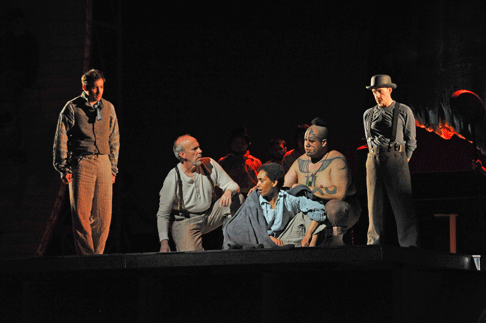
Director Leonard Foglia worked with the hand of a sorcerer to blend projection designs by Elaine McCarthy into an overpowering and effective whole with designs by Robert Brill and lighting by Donald Holder. Never did these visual aspects threaten the primacy of Heggie’s score, in which there is not one superfluous note.

Scheer achieved dramatic concentration by pairing Ahab — sung to perfection by veteran Ben Heppner - with first mate Starbuck — stunningly portrayed by Morgan Smith, a baritone at home in top German opera houses. They interlock with a second pairing: native and noble Queequeg, engrossingly portrayed by New Zealand Samoan Jonathan Lemalu, and Greenhorn, the young man out — Parsifal-like — to learn fear — so touchingly sung by young American tenor Stephen Costello.

Only in the final minutes of the work does Costello reveal that he is the man called Ishmael who opens the novel. He is of special interest as the one character who — in confronting fear — develops. The other three of this basic quartet remain what they were when the curtain rose.

Sole female in the cast was Talise Trevigne, whose touching incarnation of Cabin Boy Pip offered little hint of the successful Violetta, Lucia and Pamina that have made her famous in Europe.

Moby Dick is rich in powerful choruses — the major show-stoppers of the debut performance — admirable prepared by Alexander Rom.

Patrick Summers, Heggie perennial collaborator, evoked magnificent playing from the Dallas Opera Orchestra in giving birth to what is obviously a modern masterpiece of music theater.

(The opera will enlighten a young generation by revealing the source of the name Starbuck — even if it fails to explain the coffee company’s aversion to apostrophes.)

Wes Blomster

Send to a friend

Send a link to this article to a friend with an optional message.

Friend's Email Address: (required)

Your Email Address: (required)

Message (optional):