![Jacques Imbrailo as Billy Budd [Photo by Alastair Muir]](http://www.operatoday.com/BB_Glyndebourne01.png)
22 May 2010
Imbrailo stars as Billy Budd in Glyndebourne
Star born through stutter? It’s immediately obvious that Jacques Imbrailo’s Billy Budd at Glyndebourne is an extraordinary portrayal. His stammer is more expressive than speech.
English Touring Opera are delighted to announce a season of lyric monodramas to tour nationally from October to December. The season features music for solo singer and piano by Argento, Britten, Tippett and Shostakovich with a bold and inventive approach to making opera during social distancing.
This tenth of ten Live from London concerts was in fact a recorded live performance from California. It was no less enjoyable for that, and it was also uplifting to learn that this wasn’t in fact the ‘last’ LfL event that we will be able to enjoy, courtesy of VOCES8 and their fellow vocal ensembles (more below …).
Ever since Wigmore Hall announced their superb series of autumn concerts, all streamed live and available free of charge, I’d been looking forward to this song recital by Ian Bostridge and Imogen Cooper.
Although Stile Antico’s programme article for their Live from London recital introduced their selection from the many treasures of the English Renaissance in the context of the theological debates and upheavals of the Tudor and Elizabethan years, their performance was more evocative of private chamber music than of public liturgy.
Evidently, face masks don’t stifle appreciative “Bravo!”s. And, reducing audience numbers doesn’t lower the volume of such acclamations. For, the audience at Wigmore Hall gave soprano Elizabeth Llewellyn and pianist Simon Lepper a greatly deserved warm reception and hearty response following this lunchtime recital of late-Romantic song.
For this week’s Live from London vocal recital we moved from the home of VOCES8, St Anne and St Agnes in the City of London, to Kings Place, where The Sixteen - who have been associate artists at the venue for some time - presented a programme of music and words bound together by the theme of ‘reflection’.
'Such is your divine Disposation that both you excellently understand, and royally entertaine the Exercise of Musicke.’
‘And there was war in heaven: Michael and his angels fought against the dragon; and the dragon fought and his angels, And prevailed not; neither was their place found any more in heaven … that old serpent … Satan, which deceiveth the whole world: he was cast out into the earth, and his angels were cast out with him.’
There was never any doubt that the fifth of the twelve Met Stars Live in Concert broadcasts was going to be a palpably intense and vivid event, as well as a musically stunning and theatrically enervating experience.
‘Love’ was the theme for this Live from London performance by Apollo5. Given the complexity and diversity of that human emotion, and Apollo5’s reputation for versatility and diverse repertoire, ranging from Renaissance choral music to jazz, from contemporary classical works to popular song, it was no surprise that their programme spanned 500 years and several musical styles.
The Academy of St Martin in the Fields have titled their autumn series of eight concerts - which are taking place at 5pm and 7.30pm on two Saturdays each month at their home venue in Trafalgar Square, and being filmed for streaming the following Thursday - ‘re:connect’.
The London Symphony Orchestra opened their Autumn 2020 season with a homage to Oliver Knussen, who died at the age of 66 in July 2018. The programme traced a national musical lineage through the twentieth century, from Britten to Knussen, on to Mark-Anthony Turnage, and entwining the LSO and Rattle too.
With the Live from London digital vocal festival entering the second half of the series, the festival’s host, VOCES8, returned to their home at St Annes and St Agnes in the City of London to present a sequence of ‘Choral Dances’ - vocal music inspired by dance, embracing diverse genres from the Renaissance madrigal to swing jazz.
Just a few unison string wriggles from the opening of Mozart’s overture to Le nozze di Figaro are enough to make any opera-lover perch on the edge of their seat, in excited anticipation of the drama in music to come, so there could be no other curtain-raiser for this Gala Concert at the Royal Opera House, the latest instalment from ‘their House’ to ‘our houses’.
"Before the ending of the day, creator of all things, we pray that, with your accustomed mercy, you may watch over us."
The doors at The Metropolitan Opera will not open to live audiences until 2021 at the earliest, and the likelihood of normal operatic life resuming in cities around the world looks but a distant dream at present. But, while we may not be invited from our homes into the opera house for some time yet, with its free daily screenings of past productions and its pay-per-view Met Stars Live in Concert series, the Met continues to bring opera into our homes.
Music-making at this year’s Grange Festival Opera may have fallen silent in June and July, but the country house and extensive grounds of The Grange provided an ideal setting for a weekend of twelve specially conceived ‘promenade’ performances encompassing music and dance.
There’s a “slide of harmony” and “all the bones leave your body at that moment and you collapse to the floor, it’s so extraordinary.”
“Music for a while, shall all your cares beguile.”
The hum of bees rising from myriad scented blooms; gentle strains of birdsong; the cheerful chatter of picnickers beside a still lake; decorous thwacks of leather on willow; song and music floating through the warm evening air.
Star born through stutter? It’s immediately obvious that Jacques Imbrailo’s Billy Budd at Glyndebourne is an extraordinary portrayal. His stammer is more expressive than speech.
The cannons don’t get to shoot the Frenchies, Vere cannot resolve his conflicts, but inarticulate Billy overcomes huge obstacles and gets things done. He pays the price for inadvertently killing Claggart, but no-one intervenes. Captain Vere’s paralyzed by conscience, trapped in the fogs of scruple. Billy, though, is instinctive, physical, direct. Imbrailo lives the part in his body. No makeup can turn his face red so quickly, no costume can create the tense, twisted coil of his frame.
Imbrailo’s Billy is musically astute, as stammer is integral to Britten’s music. The mutiny, in Billy Budd, is in the music. So echoes of Billy’s stammer burst out in recurrent staccato in the orchestra, disruptive protests against the rigidity of naval life. The sailors don’t mutiny, but Billy’s stammer comes to affect the rhythms in other voices, even Claggart’s. Like Billy, Britten expresses himself in abstract sound, rather than relying on words alone. Orchestration as protagonist. In Billy Budd, Britten shows why he didn’t need to write symphonies.
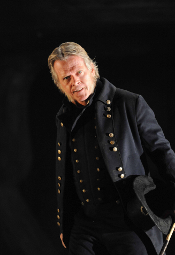 Phillip Ens as Claggart
Significantly, in this new production directed by Michael Grandage, what
stands out most in Billy’s star aria, “Through the port comes moonshine astray” isn’t the usual lyrical magic but the phrase “I’m strong, and I know it, and
I’ll stay strong!” Imbrailo’s “Beauty” isn’t a passive “Baby” but an assertive
force of life.
Yet central to the whole opera is Captain Vere’s dilemma. He’s spent a lifetime trying to understand what Billy meant. What is “the love that passes understanding”? In this production, Vere recedes almost into the background. No “Starry Vere” here, fixed on a more rarefied intellectual plane, thinking of Scylla and Charybdis.Vere is tormented because he is a man who thinks.
Instead, this Vere is one of the boys. He doesn’t even wear a hat when he’s with the other officers. In the scene where Billy is hanged, he’s seen as an old man in a dressing gown, as still as a statue among the teeming crowd of sailors. Grandage is making a valid point, but this neuters Vere’s position. In this scene, Vere is still Captain, still capable of action, hamstrung as he is by his quandary. John Mark Ainsley sings beautifully, as he always does, but this production doesn’t make full use of his potential.
If Vere’s pivotal role is underplayed, Claggart, in this production, is developed unusually well. Philip Ens makes Claggart twitch with sexual tension. Like the mists that trap the ship, and the haze that shrouds the stage, this Claggart oozes poison so pervasive that just hearing Ens makes one feel unclean — he’s a great actor, and his voice twists and elides in a sinister way. How did this Claggart come to be who he is? This portrait of warped sexuality is almost too awful to contemplate.
This is an extremely dark production, in all ways. Definitely not a cheery sailor story! Christopher Oram’s set is claustrophobic. We’re inside the bowels of the ship, not on deck, and certainly not in the foretop, where Billy feels free. You can almost smell the fetid air, and feel the cramped, damp chaos. Psychologically, this is astute, but becomes oppressive in itself.
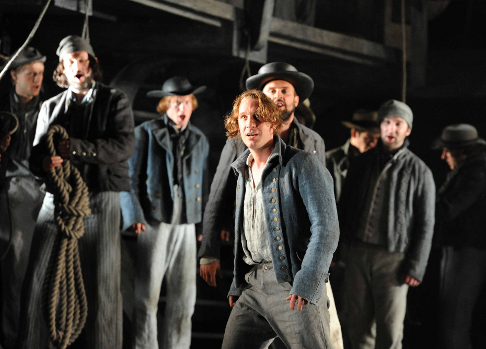 Jacques Imbrailo as Billy Budd (foreground centre).
The transfer scene, where Billy sings “Farewell to the Rights of Man” might have sounded more poignant if we’d “seen” the bright hope of the other ship in some way. Later, soldiers in brilliant red and white uniforms appear. They’re a delight to the eyes, but distract from the grimness of what’s happening. The real brightness in this opera is Billy, and his transfiguration. The set is also not flexible, despite intelligent use of lighting (Paule Constable), and works less well after the First Act. Also, the protracted tying of the noose within sight of the condemned man seemed excessive. The music at this point is so amazing, that we should be listening, not watching.
This was Mark Elder’s first Billy Budd. He conducted the London Philharmonic Orchestra so the strong undercurrents of Britten’s music flowed well. In a production as dark as this, though, more sharpness of attack would have captured the edginess in the music, but Elder understood the recurrent “stammers” well. Dulled, pounding thrusts, as instinctive and direct as Billy’s stutter.
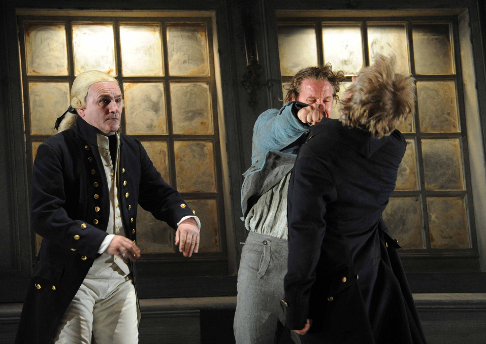 John Mark Ainsley as Captain Vere, Jacques Imbrailo as Billy Budd and Phillip Ens as Claggart
“Rum, sodomy and the lash” don’t really fit in with Glyndebourne’s elegant, summertime ambiance, so it is no surprise that it’s taken 60 years to become part of the Festival. But it’s a measure of Glyndebourne’s artistic integrity that this particularly brutal production is done at all. This Billy Budd will be revived many times. The theatre at Glyndebourne is small, but the Festival reaches out all over the world, to a much bigger audience through broadcasts and DVD releases. Relatively few may attend in person, but the potential is huge, for Glyndebourne’s artistic standards are extremely high.
Hopefully, if they film this Billy Budd, they’ll do it with Jacques Imbrailo, who is so good that his star is very definitely in the ascendant.
Anne Ozorio