![Natalie Dessay as Marie and Juan Diego Flórez As Tonio [Photo by The Royal Opera / Bill Cooper]](http://www.operatoday.com/LA-FILLE-BC20100514078-FLOR.gif)
20 May 2010
La Fille du régiment, Royal Opera
Expectations were running high for the opening night of Elaine Kidd’s revival of Laurent Pelly’s production of Donizetti’s mad-cap romp, La Fille du regiment — almost as high as Tonio’s infamous top Cs.
English Touring Opera are delighted to announce a season of lyric monodramas to tour nationally from October to December. The season features music for solo singer and piano by Argento, Britten, Tippett and Shostakovich with a bold and inventive approach to making opera during social distancing.
This tenth of ten Live from London concerts was in fact a recorded live performance from California. It was no less enjoyable for that, and it was also uplifting to learn that this wasn’t in fact the ‘last’ LfL event that we will be able to enjoy, courtesy of VOCES8 and their fellow vocal ensembles (more below …).
Ever since Wigmore Hall announced their superb series of autumn concerts, all streamed live and available free of charge, I’d been looking forward to this song recital by Ian Bostridge and Imogen Cooper.
Although Stile Antico’s programme article for their Live from London recital introduced their selection from the many treasures of the English Renaissance in the context of the theological debates and upheavals of the Tudor and Elizabethan years, their performance was more evocative of private chamber music than of public liturgy.
Evidently, face masks don’t stifle appreciative “Bravo!”s. And, reducing audience numbers doesn’t lower the volume of such acclamations. For, the audience at Wigmore Hall gave soprano Elizabeth Llewellyn and pianist Simon Lepper a greatly deserved warm reception and hearty response following this lunchtime recital of late-Romantic song.
For this week’s Live from London vocal recital we moved from the home of VOCES8, St Anne and St Agnes in the City of London, to Kings Place, where The Sixteen - who have been associate artists at the venue for some time - presented a programme of music and words bound together by the theme of ‘reflection’.
'Such is your divine Disposation that both you excellently understand, and royally entertaine the Exercise of Musicke.’
‘And there was war in heaven: Michael and his angels fought against the dragon; and the dragon fought and his angels, And prevailed not; neither was their place found any more in heaven … that old serpent … Satan, which deceiveth the whole world: he was cast out into the earth, and his angels were cast out with him.’
There was never any doubt that the fifth of the twelve Met Stars Live in Concert broadcasts was going to be a palpably intense and vivid event, as well as a musically stunning and theatrically enervating experience.
‘Love’ was the theme for this Live from London performance by Apollo5. Given the complexity and diversity of that human emotion, and Apollo5’s reputation for versatility and diverse repertoire, ranging from Renaissance choral music to jazz, from contemporary classical works to popular song, it was no surprise that their programme spanned 500 years and several musical styles.
The Academy of St Martin in the Fields have titled their autumn series of eight concerts - which are taking place at 5pm and 7.30pm on two Saturdays each month at their home venue in Trafalgar Square, and being filmed for streaming the following Thursday - ‘re:connect’.
The London Symphony Orchestra opened their Autumn 2020 season with a homage to Oliver Knussen, who died at the age of 66 in July 2018. The programme traced a national musical lineage through the twentieth century, from Britten to Knussen, on to Mark-Anthony Turnage, and entwining the LSO and Rattle too.
With the Live from London digital vocal festival entering the second half of the series, the festival’s host, VOCES8, returned to their home at St Annes and St Agnes in the City of London to present a sequence of ‘Choral Dances’ - vocal music inspired by dance, embracing diverse genres from the Renaissance madrigal to swing jazz.
Just a few unison string wriggles from the opening of Mozart’s overture to Le nozze di Figaro are enough to make any opera-lover perch on the edge of their seat, in excited anticipation of the drama in music to come, so there could be no other curtain-raiser for this Gala Concert at the Royal Opera House, the latest instalment from ‘their House’ to ‘our houses’.
"Before the ending of the day, creator of all things, we pray that, with your accustomed mercy, you may watch over us."
The doors at The Metropolitan Opera will not open to live audiences until 2021 at the earliest, and the likelihood of normal operatic life resuming in cities around the world looks but a distant dream at present. But, while we may not be invited from our homes into the opera house for some time yet, with its free daily screenings of past productions and its pay-per-view Met Stars Live in Concert series, the Met continues to bring opera into our homes.
Music-making at this year’s Grange Festival Opera may have fallen silent in June and July, but the country house and extensive grounds of The Grange provided an ideal setting for a weekend of twelve specially conceived ‘promenade’ performances encompassing music and dance.
There’s a “slide of harmony” and “all the bones leave your body at that moment and you collapse to the floor, it’s so extraordinary.”
“Music for a while, shall all your cares beguile.”
The hum of bees rising from myriad scented blooms; gentle strains of birdsong; the cheerful chatter of picnickers beside a still lake; decorous thwacks of leather on willow; song and music floating through the warm evening air.
Expectations were running high for the opening night of Elaine Kidd’s revival of Laurent Pelly’s production of Donizetti’s mad-cap romp, La Fille du regiment — almost as high as Tonio’s infamous top Cs.
First staged to glorious reviews in 2007, in fact this co-production with the Vienna State Opera and the Metropolitan Opera, New York, has seldom been ‘out-of-production’ during the last two years; but Covent Garden has reassembled almost all the members of the original stellar cast, re-uniting French soprano, Natalie Dessay, as the gamine, gambolling Marie, with Juan Diego Flórez’ charming, heart-winning Tonio.
Even by the standards of 1840s opéra comique, the libretto is wildly implausible. But Pelly relishes the improbabilities and excesses, envisaging Donizetti’s trifle as a Gilbert & Sullivanesque caper; his staging abounds with visual gags which inject much energy humour into the text, which is itself enlivened by some smart one-liners (‘It’s raining soldiers’) and a co-mingling of English and French which neatly complements the franglais accents on stage. Certainly, the manic visual stimuli — lines of dancing long-johns, balletic dusting routines, a coup de théâtre tank - deftly keep at bay any potential dramatic languors; but, while satire is undoubtedly a vital element of the genre there is perhaps a danger that Pelly’s farce indulges in just a touch too much self-ridicule — surely Donizetti is sincere in his flippancy and frivolity?
As the regiment’s adopted daughter/skivvy, Natalie Dessay is certainly committed: from her first entrance — stumbling beneath a toppling mound of regimental laundry — she flounces and flops, stamps and strops, wildly throwing herself around the stage in a ceaseless comic routine à la Chaplin. Not afraid to squawk and screech, she savours the dialogue, spitting out Gallic ‘Merde!’s a-plenty, and confirms her reputation as one of the finest actors currently on the operatic stage. This is fast becoming a signature role — and indeed it is hard to imagine this production without Dessay — but there some alarming signs of dramatic and vocal wear-and-tear. Her comic timing may be exemplary, with coloratura pinging perfectly to a twang of the braces; and the top Ds and Es may ring true and clear even as she is tossed and twirled by her military ‘daddies’; but the price to pay for such a breath-taking performance may literally be the taking of Dessay’s breath. On more than one occasion she seemed exhausted by her own exuberance and, worryingly, in quieter moments her voice became rather pale, on occasion fading completely. Punching out the regimental song as she darted up and down the map-inscribed mountains of Chantal Thomas’s Act 1 set, Dessay effectively captured the drive and ambition of the military milieu, but if familiarity breeds excess and exaggeration, there is a danger that her performance could become a caricature of itself.
If Dessay never quite attained a true bel canto lyricism, Juan Diego Flórez’ light, high tenor is perfect for this part. Nonchalant leaps to the 9 successive high Cs in ‘Ah, mes amis’ were more than matched, even outshone, by a moving, tender declaration of love in his Act 2 aria, ‘Pour me rapprocher de Marie’. Although the voice is a little unyielding, the homogenous, even beauty of tone is astonishing, and it was hard to believe that the sweet, tenderness of the daringly hushed closing phrase could fail to touch the heart of the daughter-denying Marquise de Berkenfeld.
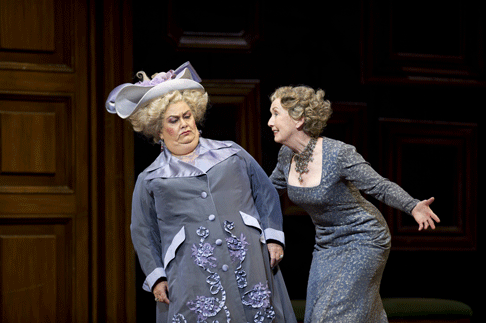 Dawn French as La Duchesse De Crackentorp and Ann Murray as La Marquise De Berkenfeld
For all Pelly’s attention to dramatic detail, there was however a disappointing absence of genuine ‘chemistry’ between the star pair. Fortunately, Ann Murray’s self-important Marquise and Alessandro Corbelli’s soft-hearted Sulpice more than made up for this lack of erotic spark, with masterly embodiments of haughty elegance and paternal indulgence respectively. Her voice may lack some of its former sheen, but Murray knows how to command a stage and her entrance aria, 'Pour une femme de mon nom', was instantly engaging and convincing. Amusingly accompanying Dessay at the piano during the singing-lesson scene, she more than matched the master Corbelli for comic timing.
Queen of TV comedy, Dawn French, in the speaking role of the Duchess de Crackentorp, reprised her Vicar of Dibley trademarks, eliciting laughs by the mere raising of the eyebrow and stopping just a whisker short of overkill. Donald Maxwell as Hortensius completed the ‘dream cast’. They were complemented by a superb male chorus, although their female counterparts, admittedly less busy, were not quite up to the rest of the regiment’s mark.
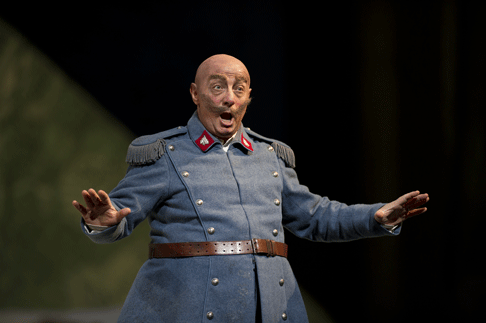 Alessandro Corbelli as Sulpice Pingot
Bruno Campanella conducted a rather scruffy performance from the Royal Opera House orchestra: although the pit-stage balance was excellent, the tempi were a bit ragged, and cast and band were occasionally out-of-step. However, things tightened up in the second Act, and a stunning solo ’cello introduced Dessay’s ‘C’en est donc fait’.
Florez’ light elegance shows no signs of waning, but Dessay can surely not reprise this role indefinitely. Although her Marie is at times less hyperactive tomboy and more hysterical Lucia, this is not a show to miss. Grab a ticket — even if you have to mount a military campaign to hunt one down.
Claire Seymour