![Yvette Bonner (Sarah), Roderick Williams (Aiden) [Photo by Hans van den Bogaard courtesy of De Nederlandse Opera]](http://www.operatoday.com/AfterLife01.gif)
17 May 2010
Michel van der Aa : After Life at the Barbican, London
“If you could take any one memory with you to eternity, which one would you choose?” In Michel van der Aa’s After Life several people meet in a waiting room.
English Touring Opera are delighted to announce a season of lyric monodramas to tour nationally from October to December. The season features music for solo singer and piano by Argento, Britten, Tippett and Shostakovich with a bold and inventive approach to making opera during social distancing.
This tenth of ten Live from London concerts was in fact a recorded live performance from California. It was no less enjoyable for that, and it was also uplifting to learn that this wasn’t in fact the ‘last’ LfL event that we will be able to enjoy, courtesy of VOCES8 and their fellow vocal ensembles (more below …).
Ever since Wigmore Hall announced their superb series of autumn concerts, all streamed live and available free of charge, I’d been looking forward to this song recital by Ian Bostridge and Imogen Cooper.
Although Stile Antico’s programme article for their Live from London recital introduced their selection from the many treasures of the English Renaissance in the context of the theological debates and upheavals of the Tudor and Elizabethan years, their performance was more evocative of private chamber music than of public liturgy.
Evidently, face masks don’t stifle appreciative “Bravo!”s. And, reducing audience numbers doesn’t lower the volume of such acclamations. For, the audience at Wigmore Hall gave soprano Elizabeth Llewellyn and pianist Simon Lepper a greatly deserved warm reception and hearty response following this lunchtime recital of late-Romantic song.
For this week’s Live from London vocal recital we moved from the home of VOCES8, St Anne and St Agnes in the City of London, to Kings Place, where The Sixteen - who have been associate artists at the venue for some time - presented a programme of music and words bound together by the theme of ‘reflection’.
'Such is your divine Disposation that both you excellently understand, and royally entertaine the Exercise of Musicke.’
‘And there was war in heaven: Michael and his angels fought against the dragon; and the dragon fought and his angels, And prevailed not; neither was their place found any more in heaven … that old serpent … Satan, which deceiveth the whole world: he was cast out into the earth, and his angels were cast out with him.’
There was never any doubt that the fifth of the twelve Met Stars Live in Concert broadcasts was going to be a palpably intense and vivid event, as well as a musically stunning and theatrically enervating experience.
‘Love’ was the theme for this Live from London performance by Apollo5. Given the complexity and diversity of that human emotion, and Apollo5’s reputation for versatility and diverse repertoire, ranging from Renaissance choral music to jazz, from contemporary classical works to popular song, it was no surprise that their programme spanned 500 years and several musical styles.
The Academy of St Martin in the Fields have titled their autumn series of eight concerts - which are taking place at 5pm and 7.30pm on two Saturdays each month at their home venue in Trafalgar Square, and being filmed for streaming the following Thursday - ‘re:connect’.
The London Symphony Orchestra opened their Autumn 2020 season with a homage to Oliver Knussen, who died at the age of 66 in July 2018. The programme traced a national musical lineage through the twentieth century, from Britten to Knussen, on to Mark-Anthony Turnage, and entwining the LSO and Rattle too.
With the Live from London digital vocal festival entering the second half of the series, the festival’s host, VOCES8, returned to their home at St Annes and St Agnes in the City of London to present a sequence of ‘Choral Dances’ - vocal music inspired by dance, embracing diverse genres from the Renaissance madrigal to swing jazz.
Just a few unison string wriggles from the opening of Mozart’s overture to Le nozze di Figaro are enough to make any opera-lover perch on the edge of their seat, in excited anticipation of the drama in music to come, so there could be no other curtain-raiser for this Gala Concert at the Royal Opera House, the latest instalment from ‘their House’ to ‘our houses’.
"Before the ending of the day, creator of all things, we pray that, with your accustomed mercy, you may watch over us."
The doors at The Metropolitan Opera will not open to live audiences until 2021 at the earliest, and the likelihood of normal operatic life resuming in cities around the world looks but a distant dream at present. But, while we may not be invited from our homes into the opera house for some time yet, with its free daily screenings of past productions and its pay-per-view Met Stars Live in Concert series, the Met continues to bring opera into our homes.
Music-making at this year’s Grange Festival Opera may have fallen silent in June and July, but the country house and extensive grounds of The Grange provided an ideal setting for a weekend of twelve specially conceived ‘promenade’ performances encompassing music and dance.
There’s a “slide of harmony” and “all the bones leave your body at that moment and you collapse to the floor, it’s so extraordinary.”
“Music for a while, shall all your cares beguile.”
The hum of bees rising from myriad scented blooms; gentle strains of birdsong; the cheerful chatter of picnickers beside a still lake; decorous thwacks of leather on willow; song and music floating through the warm evening air.
“If you could take any one memory with you to eternity, which one would you choose?” In Michel van der Aa’s After Life several people meet in a waiting room.
They’ve just died, but they must examine their lives, and pick one memory to take with them before they can journey on. One memory to summarize a whole lifetime? It’s not easy. Effectively, they’re pondering what their lives might have meant. It’s a powerful psychological concept, strikingly adapted as theatre.
At the premiere in 2006, Shirley Apthorp in the Financial Times described the opera as “The Gesammstkunstwerk of the Future”. Michel van der Aa mixes live orchestra with electronica, live performers with ordinary people captured on film. That’s not specially innovative in itself, but van der Aa takes the concept further, blending art and reality. Singers and musicians perform a score, while ordinary people speak spontaneously. Van der Aa abandoned the idea of script altogether: people simply turned up at his studio, and talked spontaneously. Ordinary people, but extraordinary lives.
Perhaps that’s part of After Life’s message too. More emotionally articulate people have more insight into what makes them what they are, but even the most mundane life has meaning.. What of those who are blocked in some way ? Mr Walter ( Richard Suart) looks back on a “so-so job, a so-so marriage”, where nothing seems to have mattered either way. Ilana (Margreit van Reisen) has had such a horrible life she doesn’t want to remember anything. But in the Afterlife, you can’t move on unless you can deal with your past.
That’s why the staff in the “waiting room” help people reconstruct their lives and memories. Sometimes it isn’t the grand gestures that create the best memories, but simple things. like hugging a loved pet, or sitting on a park bench and feeling you belong. Aiden (Roderick Williams) reveals that the staff themselves are people who are blocked and can’t proceed until they, too, learn the meaning of their lives. Aiden helps Walter, but by helping Walter, he finds his own release. In this strange Limbo, the authority figure, The Chief (Claron McFadden) may in fact be the person most trapped. Maybe the secret to passage isn’t what memory you carry with you, but how much excess baggage you’re prepared to leave behind.
Michel van der Aa’s music may be avant garde, and extended by electronic effects, but it communicates well. Van der Aa wrote one of the study pieces for After Life for the famous Freiburg Baroque Orchestra, hence the harpsichord-led purity of line. As he says, the music “has two layers, a direct, physically dramatic layer and another with more depth, that is more conceptual”. The opera deals with very unusual ideas, so this interplay between clarity and mystery is fundamental.
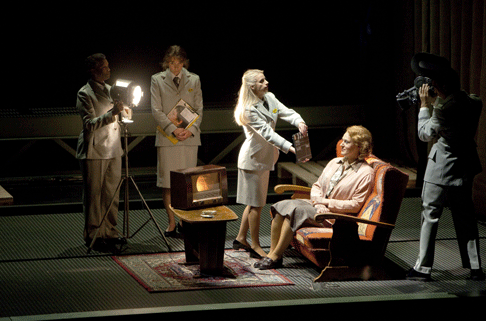 Claron McFadden (Chief), Margriet van Reisen (Ilana), Yvette Bonner (Sarah), Helena Rasker (Bryna Pullman), Roderick Williams (Aiden)
The vocal lines sweep up and down the scale, even within phrases, but don’t sound unnatural. McFadden, who has few equals in modern music, and has created the wildest Harpies, sounds soft and lyrical, actually quite sweet. Williams proves why he’s one of the most sought after character baritones in his generation. He’s a wonderful, expressive actor who moves as well as he sings. Yvette Bonner as Sarah, the other member of staff, has good potential.
Michel van der Aa worked with Louis Andriessen (Writing to Vermeer) who promoted the idea of anti-orchestra back in the 1960’s. The idea of multi-media, conceptual theatre is fairly well established in Europe. The Queen of the Netherlands attended After Life at the highly prestigious Holland Festival. Holland’s famous for its liberal, open-minded attitudes, but After Life is so good that it can export, even to more buttoned down. British psyche. After all, every one of us will one day make that journey, whatever may be on the other side.
Congratulations to the Barbican for bringing it to London, just months after the recent revival (with revisions) . I was impressed by the way the Barbican marketed this opera, which might have been a hard sell, given that it’s so modern. They set up a mini website, inviting readers to send in their own ideas of what memory they’d take into the unknown. After Life is about ordinary people, so it’s a good idea that “ordinary people” participate. While it emphasizes “ordinary” life, this opera poses questions about life, identity and emotional dexterity that make it a challenge. What you get from it reflects what you put in. A bit like life itself.
Anne Ozorio