02 May 2010
No Elephants — Aida at the Royal Opera House, London
It’s time Verdi got attention in Aida, not elephants.
English Touring Opera are delighted to announce a season of lyric monodramas to tour nationally from October to December. The season features music for solo singer and piano by Argento, Britten, Tippett and Shostakovich with a bold and inventive approach to making opera during social distancing.
This tenth of ten Live from London concerts was in fact a recorded live performance from California. It was no less enjoyable for that, and it was also uplifting to learn that this wasn’t in fact the ‘last’ LfL event that we will be able to enjoy, courtesy of VOCES8 and their fellow vocal ensembles (more below …).
Ever since Wigmore Hall announced their superb series of autumn concerts, all streamed live and available free of charge, I’d been looking forward to this song recital by Ian Bostridge and Imogen Cooper.
Although Stile Antico’s programme article for their Live from London recital introduced their selection from the many treasures of the English Renaissance in the context of the theological debates and upheavals of the Tudor and Elizabethan years, their performance was more evocative of private chamber music than of public liturgy.
Evidently, face masks don’t stifle appreciative “Bravo!”s. And, reducing audience numbers doesn’t lower the volume of such acclamations. For, the audience at Wigmore Hall gave soprano Elizabeth Llewellyn and pianist Simon Lepper a greatly deserved warm reception and hearty response following this lunchtime recital of late-Romantic song.
For this week’s Live from London vocal recital we moved from the home of VOCES8, St Anne and St Agnes in the City of London, to Kings Place, where The Sixteen - who have been associate artists at the venue for some time - presented a programme of music and words bound together by the theme of ‘reflection’.
'Such is your divine Disposation that both you excellently understand, and royally entertaine the Exercise of Musicke.’
‘And there was war in heaven: Michael and his angels fought against the dragon; and the dragon fought and his angels, And prevailed not; neither was their place found any more in heaven … that old serpent … Satan, which deceiveth the whole world: he was cast out into the earth, and his angels were cast out with him.’
There was never any doubt that the fifth of the twelve Met Stars Live in Concert broadcasts was going to be a palpably intense and vivid event, as well as a musically stunning and theatrically enervating experience.
‘Love’ was the theme for this Live from London performance by Apollo5. Given the complexity and diversity of that human emotion, and Apollo5’s reputation for versatility and diverse repertoire, ranging from Renaissance choral music to jazz, from contemporary classical works to popular song, it was no surprise that their programme spanned 500 years and several musical styles.
The Academy of St Martin in the Fields have titled their autumn series of eight concerts - which are taking place at 5pm and 7.30pm on two Saturdays each month at their home venue in Trafalgar Square, and being filmed for streaming the following Thursday - ‘re:connect’.
The London Symphony Orchestra opened their Autumn 2020 season with a homage to Oliver Knussen, who died at the age of 66 in July 2018. The programme traced a national musical lineage through the twentieth century, from Britten to Knussen, on to Mark-Anthony Turnage, and entwining the LSO and Rattle too.
With the Live from London digital vocal festival entering the second half of the series, the festival’s host, VOCES8, returned to their home at St Annes and St Agnes in the City of London to present a sequence of ‘Choral Dances’ - vocal music inspired by dance, embracing diverse genres from the Renaissance madrigal to swing jazz.
Just a few unison string wriggles from the opening of Mozart’s overture to Le nozze di Figaro are enough to make any opera-lover perch on the edge of their seat, in excited anticipation of the drama in music to come, so there could be no other curtain-raiser for this Gala Concert at the Royal Opera House, the latest instalment from ‘their House’ to ‘our houses’.
"Before the ending of the day, creator of all things, we pray that, with your accustomed mercy, you may watch over us."
The doors at The Metropolitan Opera will not open to live audiences until 2021 at the earliest, and the likelihood of normal operatic life resuming in cities around the world looks but a distant dream at present. But, while we may not be invited from our homes into the opera house for some time yet, with its free daily screenings of past productions and its pay-per-view Met Stars Live in Concert series, the Met continues to bring opera into our homes.
Music-making at this year’s Grange Festival Opera may have fallen silent in June and July, but the country house and extensive grounds of The Grange provided an ideal setting for a weekend of twelve specially conceived ‘promenade’ performances encompassing music and dance.
There’s a “slide of harmony” and “all the bones leave your body at that moment and you collapse to the floor, it’s so extraordinary.”
“Music for a while, shall all your cares beguile.”
The hum of bees rising from myriad scented blooms; gentle strains of birdsong; the cheerful chatter of picnickers beside a still lake; decorous thwacks of leather on willow; song and music floating through the warm evening air.
It’s time Verdi got attention in Aida, not elephants.
The blue elephant in Graham Vick’sTamerlano almost stole the show, but elephants were pointedly banned from this new production of Aida at the Royal Opera House, London. Instead, Verdi’s music takes pride of place, revealed in full glory.
Pre-performance publicity indicated that this would not be a stereotype production, but minimalist it certainly was not. Abstraction in many ways suits Aida, an opera of secrets and mysteries.
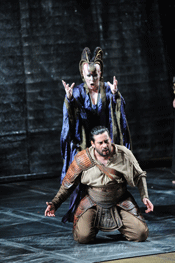 Marcelo Álvarez as Radames and Marianne Cornetti as Amneris
Large structures loom over the cast, for this is a drama where individuals are pitted against overwhelming forces. The simple, strong lines also permit a new kind of staging, created from light and colour.
No elephants, no circus. Instead the focus shifts onto Verdi’s music itself, revealing its magnificence without distraction. How glorious it is, heard as music! Indeed, it’s because Aida is so vivid orchestrally that we’ve become accustomed to associating it with grand panoramas. But music is in itself abstract. This time, the orchestral colours can be seen as well as heard. Shades of rose and ochre, scarab and peacock, amethyst and sand, glow iridescently, transforming as the music develops. Synaesthetes may overload, but this abstraction is surprisingly expressive, given the connection between visual image and music.
Nicola Luisotti conducted with flair..Tempi were on the fast side, but better that than too slow. Freed from the restraints of cumbersome staging, the orchestra’s pace matched the nervous energy in the drama. Violent moods, violent music. In the scene at the Temple of Vulcan, the Egyptians are working themselves up to a frenzy. Heightened emotion in the orchestra but less so in the dancing. The Rite of Spring style choreography would not have been out of place, but perhaps too much to expect. Strange, distorted shapes hang from the sky, like the corpses of the dead. When the prisoners shuffle in, they look like they’ve been in battle. As Aida (Micaela Carosi) reminds us, the Triumphal March may be triumph for some, but defeat for others.
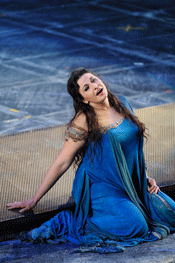
In the third act, when Aida sings “Qui Radamès verrà,|” Carosi stands before a black and white panel, as stark as the dilemma before her. But when Micaela Carosi sings, the lusciousness of her music translates into washes of blue and green, evoking the dark, swift Nile and “cieli azzurri” above, her Egyptian present and memories of her native land. Carosi is a very experienced Aida. Her middle voice is secure, so the extremes in the part feel natural, rather than over-coloured. Aida is constrained, all around, by secrecy and the need for stealth, so she is a strong personality, and alert.
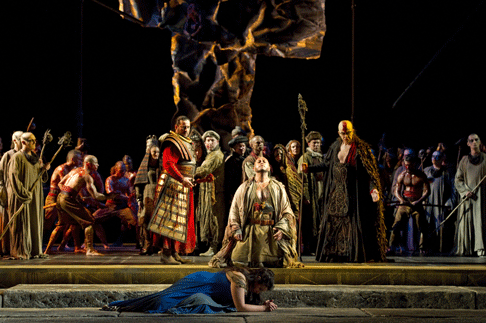
Marcelo Álvarez as Radames is a more conventional portrayal. He hectors, but then, Radames is a headstrong hero, eager for battle, but ennobled by the grace of love. His finest moment comes as he and Aida face death, when his voice softens and takes on a gentler tone. Marianne Cornetti was a forceful, forthright Amneris, and Marco Vratogna’s Amonasro suitably subdued.
Jennifer Tipton deserves much credit for designing the magnificent light show. David McVicar proves that abstraction does not mean minimal, and is just as valid musically as circus gimmicks.
Anne Ozorio