Armida, in her turn, is torn between sincere passion for Rinaldo and lust for
vengeance when he returns to his quest — as he must, since he’s one
of the mythic founders of the House of Este, and his distant descendant, the
Duke of Ferrara, will be the patron of the poet Torquato Tasso, who invented
both Rinaldo and Armida in his epic Gerusalemme Liberata.
Love or Duty? In Rossini’s day every literate Italian knew the poem
and half the leading opera composers set the story. It has reached the Met
previously as Gluck’s Armide (Enrico Caruso sang Renaud) and,
more recently, as Handel’s Rinaldo (in which Carol
Vaness’s Armida failed to bewitch Marilyn Horne in the title role, with
Samuel Ramey making his debut as Armida’s wicked uncle). This is a
magical story, and any production should dazzle. Fireworks (as in the
Met’s Central Park presentation of Rinaldo with Horne) are
called for.
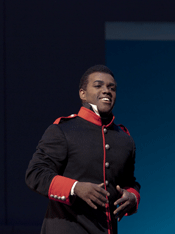 Lawrence Brownlee as Rinaldo
Rossini’s version, which only reached the Met this April, is one of
the nine operas he devised as principal composer for the San Carlo in Naples,
then (and now) the only opera house in the peninsula that seriously challenged
La Scala for size and grandeur. Rossini was expected to write appropriate
vehicles for the local prima donna, Isabella Colbran, a spectacular mezzo
soprano who eventually became his wife, and for several coloratura tenors under
contract at once. In consequence, all these operas are tenor-heavy, and the
writing is of an elaboration until recently long out of fashion; therefore none
of these operas are terribly well known but many have had successful revivals
lately: Beverly Sills made her Met debut in Le Siete de Corinto and
Barry Banks has appeared at the City Opera in both Ermione and La
Donna del Lago. Armida features a trio for coloratura tenors
— surely the first time such a thing has ever been heard at the Met
— and boasts six tenor roles in all. Some of these are short enough to
permit doubling up in case of illness, which happened on this occasion —
Mr. Banks sang his own role in Act III while gallantly replacing a colleague in
Act I.
The Met’s production of Armida is by Mary Zimmerman. If she
does not take the story quite seriously, well, who could believe in Rossini as
a composer of sinister enchantments? The magical elements in this score
(diabolic forest, orgiastic palace, ecstatic garden, transformations,
bewilderments) are more Halloween parade than Pandemonium. In fact, these
elements — including the changeable enchantress and the naïve invading
soldiers who flirt with the ladies and carry a magical spear — seem to
belong rather to Wagner’s Parsifal. Had Wagner read Tasso?
Surely — Wagner read everything, and he adored Italy. Is his desperate
Kundry an incarnation of Armida as well as Herodias? It seems likely enough.
But Wagner’s music has a gift for the neurotic and despairing soul that
Rossini never attempts — indeed, what Italian would have dared to depict
such emotions in 1817? He’d have been lucky to escape with a lynching or
a year in the galleys. Parsifal is also a fable — but a dark
one. Armida is epic lite.
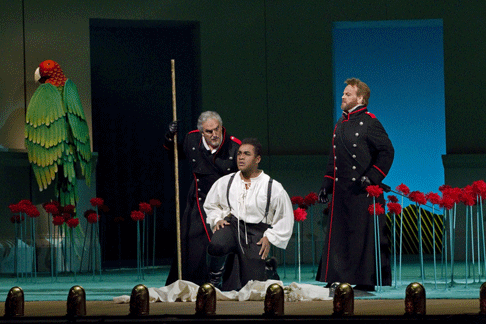 Kobie van Rensburg as Ubaldo, Lawrence Brownlee as Rinaldo, and Barry Banks as Carlo
In Zimmerman’s entirely charming staging, wicked Armida’s garden
of love is a nineteenth-century concert hall in which she declaims her great
aria, “D’Amore al dolce impero” from an ornamental music
stand, rather like a schoolmarm preaching intemperance. Her magic wand is a
conductor’s baton. The enormously lengthy ballet of sinister delights is
deliciously choreographed by Graciela Daniele as a send-up of an Orientalist
orgy, with houris tempting Rinaldo with apples, enormous rat demons in
ballet-skirted drag, and the entire Met women’s chorus in bellydance
pantaloons. Richard Hudson’s set is a semicircular arena with many
doorways revealing the Dome of the Rock in the first scene, a demonic forest at
other times, and presiding deities (Love, Vengeance) a-spy over the top. This
is the happiest, most enjoyable new production the Met has given us all year,
winsome and welcome and attractive, suitable to the work, the interpretation
and the audience.
The singing, alas, was not at quite so high a level, and the applause
reflected this. Ovations at the conclusion were perfunctory; I did not join
them. There were many thrilling moments, and it’s extraordinary that the
Met or any opera house can present the work acceptably at all, but there were
no individual performances to leave one dazzled and gasping — as there
certainly were twenty-five years ago, when Handel’s Rinaldo reached the
house.
Armida was presented in particular to suit the talents of Renée
Fleming, who has sung the piece in concert with Opera Orchestra of New York.
Fleming, gifted with one of the treasurable voices of her generation, has
proved a controversial, often irritating, deployer of her gifts. In German,
Russian and French works she seems to focus harder on giving us what the
composer asks for, but in Italian roles she follows no compass but her own. Her
first aria, her sortita, was typical of her recent style in bel canto: runs
were casual and uneven, with no attention to individual notes, no grace, no
focus on the melodic line, and diction as bad as Sutherland’s worst
— but Sutherland sang the notes, with the evenness and point bel canto
asks for. “D’Amore al dolce impero” found her more cautious,
rhythmically and dramatically, lacking the fire of the famous Callas version of
the aria and the precision and wit of Joyce Di Donato. In her duets she hewed
tighter to the notes, meeting her partner (usually Lawrence Brownlee) on common
ground, but when Armida’s despairs took center stage, notes seemed to
come from — and be tossed out to — any old where. There was no
logic to her ornaments. The style was not Rossini’s; it was
Fleming’s. Admirers of the lady may be thrilled; admirers of the composer
will have doubts.
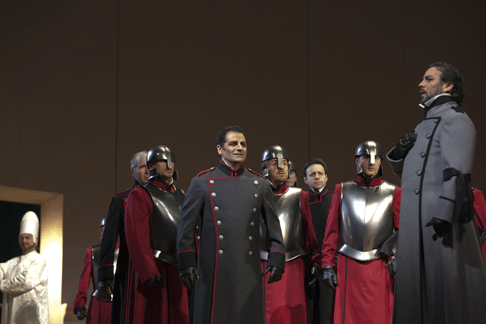 Yeghishe Manucharyan as Eustazio (center, grey jacket) and John Osborn as Goffredo (far right)
It is unfortunate that Ms. Fleming (or the management) has insisted that she
sing all the many performances of Armida given this spring and also
next year — I’d love to hear how the opera would work with Di
Donato or Diana Damrau or Ruth Ann Swenson, all brilliant coloratura
technicians who tend to honor the composer rather than their own jazzy whim.
Among the six — on this occasion five — tenors demanded by an
uncut performance of Armida (and at four hours, including two intermissions,
you have to suppose that most of it was here), most were very good, none were
over-the-top spectacular. John Osborn (Goffredo) and Yegishe Manucharyan
(Eustazio) made little impression. Kobie van Rensburg, who specializes in
florid music, brought a rather gravelly sound to the soldier Ubaldo, which made
a pleasing contrast to the more lyric voices of Mr. Banks (Carlo) in their
duets, and with Mr. Brownlee (Rinaldo) in the notorious trio.
Barry Banks was right to take on the suddenly vacated part of Gernando in
Act I — he thrives on angry coloratura (as Oreste in Ermione at
the City Opera, for example), and his singing had exciting force if lacking
beauty. As the very different Carlo, he produced a more sensuous tone and he is
an excellent actor.
Lawrence Brownlee has become an able actor, as was not originally the case,
and handled Rinaldo’s transformations convincingly — he must fight
a duel with rapiers, fall convincingly in love, suffer visible torments of his
divided soul, and at last throw aside his pleading lover with visible regret.
His voice is well produced and gifted with luscious high notes, but he lacks
the great bel canto desideratum of evenness — runs that cross the octaves
seem to be produced by different voices, from different parts of his body. The
effect is impressive but not graceful or stylish. His best singing — like
Ms. Fleming’s — came when he sang in duet or trio with others,
holding him back from awkward individual flights. Bel canto was all
about individual (as well as parallel) vocal flights — but that was back
when singers could be expected to do it with proper taste.
A friend objects that Armida is a second-rate opera. True. But if
second-rate operas did not permit, nay encourage, first-rate singing, opera
would have died out centuries ago and small loss. Some of the greatest singing
ever heard has come in second-rate operas, but not on the present occasion.
Riccardo Frizza accomplished the great task of getting through the endless
and witty ballet without producing tedium — rhythms that depicted
marching soldiers or languishing lovers or general mayhem were individually
colorful, and Ms. Daniele’s hilarious dances had the solid ground of Mr.
Frizza as their launching pad. In the opera proper, number succeeded number
with an impeccable musical logic and impulsion that was not always clear in the
libretto, and the Met orchestra sounded as if it was having fun with
Rossini’s exquisitely varied effects. (Terrific otherworldly harp moment
there.) The chorus sang that way, too — especially the men, soldiers in
Act I and demons at other times. The ladies sang well but might let themselves
go a bit when portraying Middle Eastern dance, even if Rossini’s rhythms
are not appropriate to the stuff.
John Yohalem
![Renée Fleming as Armida [Photo by Ken Howard courtesy of The Metropolitan Opera]](http://www.operatoday.com/ARMIDA_Fleming_in_title_rol.gif)