Subscribe to
Opera Today

Receive articles and news via RSS feeds or email subscription.


twitter_logo[1].gif


UCP_9780226043425.gif

Recently in Reviews

Wozzeck at ENO

“Man is an abyss. It makes one dizzy to look into it.” So utters Georg Büchner’s Woyzeck, repeating what was also a recurring motif in the playwright’s own letters.

Mulhouse: Rare Britten Well Done

National Opera Company of the Rhine has marked this year’s Benjamin Britten celebration with a remarkably compelling, often gripping new production of the seldom-seen Owen Wingrave.

Frankfurt's Intriguing Idomeneo

Once upon a time, Frankfurt Opera had the baddest ass reputation in Germany as “the” cutting edge producer of must-see opera.

Rigoletto at Lyric Opera of Chicago

Productions of Giuseppe Verdi’s Rigoletto can serve as a vehicle for individual singers to make a strong impression and become afterward associated with specific roles in the opera.

Britten Sinfonia with Ian Bostridge

Just in case we were not aware that the evening’s programme was ‘themed’, the Britten Sinfonia designed a visual accompaniment to their musical exploration of night, sleep and dreams.

Aida, Manitoba Opera

Poor Aida! She never seems to have anything go her way.

Superlative singing: Don Carlo, Royal Opera House

Is it possible to upstage Jonas Kaufmann? Kaufmann was brilliant in this Verdi Don Carlo at the Royal Opera House, London, but the rest of the cast was so good that he was but first among equals. Don Carlo is a vehicle for stars, but this time the stars were everyone on stage and in the pit. Even the solo arias, glorious as they are, grow organically out of perfect ensemble. This was a performance that brought out the true beauty of Verdi's music.

Sarah Connolly: French Song at Wigmore Hall

The big names were absent: Duparc, D’Indy, Debussy, Ravel … and while Fauré, Chausson, Roussel and several members of Les Six put in an appearance, in less than familiar guises, this survey of French song of the early 20th century and interwar years deliberately took us on a journey through infrequently travelled terrain.

Rare restoration: Handel’s Esther 1720

Composed between 1718 and 1720, Handel’s Esther is sometimes described as the ‘first English Oratorio’, but is in fact a hybrid form, mixing elements of oratorio, masque, pastoral and opera.

The Damnation of Faust, London

Hector Berlioz's légende dramatique, La Damnation de Faust, exists somewhere between cantata and opera. Berlioz's flexible attitude to dramatic form made the piece unworkable on the stages of early 19th century Paris and his music is so vivid that you wonder whether the piece needs staging at all.

Elizabeth Connell Memorial Concert, St John's Smith Square

St. John’s Smith Square was the site of Elizabeth Connell’s final London concert, intended as a farewell to London on her moving to Australia. It was rendered ultimately final by her unexpected death.

Aida with all the Trimmings, Even a Blue Silk Elephant!

With the building of the Suez Canal, Egypt became more interesting to Western Europeans. Khedive Ismail Pasha wanted a hymn by Verdi for the opening of a new opera house in Cairo, but the composer said he did not write occasional pieces.

Die Zauberflöte, Royal Opera

Back for its fourth revival, David McVicar’s 2003 production of Mozart’s Die Zauberflöte has much charm, beauty and artistry.

Kaufmann Wagner

The economics of the recording companies dictate much that is not ideal. Wagner’s operas were not composed as they were in order to permit the extraction of bleeding chunks, even on those occasions when strophic song forms do occur.

The Marriage of Figaro Ends Season at Arizona Opera

Wolfgang Amadeus Mozart's opera The Marriage of Figaro has a libretto by Lorenzo daPonte based on the French play La folle journée, ou le Mariage de Figaro (The Crazy Day or the Marriage of Figaro) by Pierre Caron de Beaumarchais (1732-1799).

Baden’s Flute Goes Barefoot in the Park

For its world class Easter Festival, Baden-Baden mounted a Die Zauberflöte that owed more to the grey penitential doldrums of Lent than to the unbridled jubilance of re-birth.

Bonjour M. Gauguin in Berkeley

Once Berkeley Opera, renamed West Edge Opera, this enterprising company offers the Bay Area’s only serious alternative to corporate opera, to wit Bonjour M. Gauguin.

Mahler Lieder, Wigmore Hall

In the first of pianist Julius Drake’s three-part series, ‘Perspectives’, our gaze was directed at Gustav Mahler’s eclectic musical responses to human experiences: from the trauma and distress of anguished love to the sweet contentment of true friendship, from the agonised introspection of the artist to the diverse dramas of human interaction.

Cinderella Goes to the Opera

The Los Angeles opera company marketed its spring production of Rossini's La Cenerentola as Cinderella though there is no opera by that name. The libretto of La Cenerentola is not the Cinderella story we know.

Die Walküre, Paris

The Paris Opéra has not staged a full Ring Cycle since 1957, but its current season will conclude with a correction of this grand operatic gap.

OPERA TODAY ARCHIVES »

Reviews

Mark Delavan (Wotan) and Nina Stemme (Brünnhilde) [Photo by Cory Weaver courtesy of San Francisco Opera]
28 Jun 2010

Die Walküre in San Francisco

Ring fever rages on. San Francisco has just unveiled its Walküre the completed cycle to take place next June. Gratefully the price of the SFO effort has not become a topic of conversation, as has the cost of the just completed L.A. Ring

Richard Wagner: Die Walküre

Brünnhilde: Nina Stemme; Wotan: Mark Delavan; Sieglinde: Eva-Maria Westbroek; Siegmund: Christopher Ventris; Fricka: Janina Baechle; Hunding: Raymond Aceto; Ortlinde: Molly Fillmore; Schwertleite: Suzanne Hendrix; Waltraute: Daveda Karanas; Gerhilde: Wendy Bryn Harmer; Helmwige: Tamara Wapinsky; Siegrune: Maya Lahyani; Grimgerde: Pamela Dillard; Rossweise: Priti Gandhi. Conductor: Donald Runnicles. Director: Francesca Zambello. Set Designer: Michael Yeargan. Costume Designer: Catherine Zuber. Lighting Designer: Mark McCullough. Projection Designer: Jan Hartley. Choreographer: Lawrence Pech.

Above: Mark Delavan as Wotan and Nina Stemme as Brünnhilde

All photos by Cory Weaver courtesy of San Francisco Opera


Whispers about the price tag of the upcoming Met Ring suggest the proportions of a foreign war.

Gratefully as well the SFO Rheingold and Walküre have looked like opera, and not like crazed imitations of Star Wars, so they are easier to talk about. Though not necessarily a more or less compelling take on Wagner’s mega opera, this plain SFO Ring is unfolding as conceptually direct and wonderfully human.

Two years ago Rheingold got the San Francisco Ring off to a rocky start with its light weight cast and unfocused staging. Still it was a promising beginning with lots of ideas, some of which did not work all that well (the Nibelheim special effects as example). But lots of fun came out of its director Francesca Zambello who imposed a light touch on the divine machinations that initiate this long saga of greed and love, affectionately capturing the naivete, optimism and entrepreneurial fun that built our cities.

Conductor Donald Runnicles got right to the point in Walküre, not even allowing the applause that greeted him to die before attacking the complications motivated by Wotan’s insecurities. The War Memorial Opera House is particularly kind to Wagner, allowing the transparency within his massive orchestral sound to project the depth of his mountainous landscapes, and as well the myriad of musical motivations to coexist amongst themselves and within this cosmic nature. Mo. Runnicles exploited the Walküre score to its utmost, a remarkably rich reading.
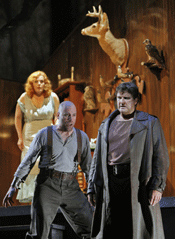
_MG_6214.gifEva-Maria Westbroek as Sieglinde, Raymond Aceto as Hunding and Christopher Ventris as Siegmund

Die Walküre is no place for lightweights (as in fact Rheingold is not either), and San Francisco Opera rose to the occasion with a nearly stellar cast. The Siegmund of English tenor Christopher Ventris captured the youth of a young hero, his voice beating with energy, the Sieglinde of Dutch soprano Eva-Maria Westbroek soared vocally over the maelstrom with the unborn hero in her womb. But it was Swedish sopranto Nina Stemme’s Brünnhilde whose voice rose over all else as the energy and psychic spirit of Wotan, her creator and the world’s master builder.

This is an American Ring (the mountains are surely our California Sierras, though there is no defining land or river-scape). Hunding’s cabin is an American primitive wood facade with a screen door that can be found no where else in the world other than in middle America. American bass Raymond Aceto in a long sleeved winter undershirt with suspenders was a medium voiced Hunding, his strut and menace hiding this character’s predestined impotence. Paired with his unhappy, beaten and defeated wife, Sieglinde in a ill fitting, sad pale blue dress Hunding, strangely, evoked sympathy.

Costumer Catherine Zuber dressed German mezzo Janina Baechle as Wotan’s wife Fricka in a sort of purple beaux arts long gown in which she stolidly prevailed as a wet-blanket moral conscience. Meanwhile Wotan, American bass Mark Delavan from the Rheingold cast, muttered and spat effectively as some sort of railroad tycoon, but was vocally pallid even before running out of voice (June 22).
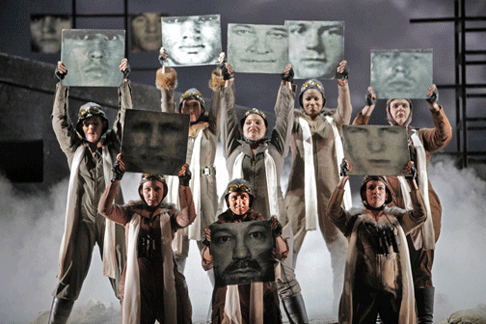
_MG_7033.gifWendy Bryn Harmer as Gerhilde, Suzanne Hendrix as Schwerleite, Tamara Wapinsky as Helmwige, Pamela Dillard as Grimgerde, Daveda Karanas as Waltraute, Maya Lahyani as Siegrune, Priti Gandhi as Rossweise and Molly Fillmore as Ortlinde

Wotan’s Valhalla is seen through the window of a massive high rise. It was not specifically San Francisco but a high rise city profile that is specifically American, with echoes of Fritz Lang’s Metropolis. Set design for this American Ring is by Michael Yeargan who, with Mme. Zambello is working in a determined post-modern vocabulary, Wotan’s desk a huge table with four huge wooden claws as legs, the following scene moving onto the contemporary detritus under an abandoned elevated freeway, and finally an abstract space for the Valkyries and the Wotan farewell to Brünnhilde.

Beautiful, detailed lighting by Mark McCullough subtly caught a real life wolf-dog and his cub racing across the stage as Wotan was about to kill his son, connecting the innocence of real nature to the tragedies of cosmic destiny. McCullough magically captured the steel gray folds of Wotan’s coat covering the sleeping Brünnhilde as a ring of real fire began to encircle the stage, this real fire somehow making the fairytale ending of the Ring’s second installment humanly real, and unusually moving.

Everything in this Ring was ordinary, and that was its triumph. Rarely has operatic acting achieved this level of realism delicately sitting on the verge of expressionism. This accomplishment signals heroic efforts of stage direction plus determined commitment from singers. Miraculously this staging melted effortlessly into the Runnicles reading of the score, the abstract musical motivations from the pit rendered on the stage in movement that effortlessly and truly portrayed complex dramatic motivations. Gesamtkunstwerk indeed!

It was a good night at San Francisco Opera.

Michael Milenski

Send to a friend

Send a link to this article to a friend with an optional message.

Friend's Email Address: (required)

Your Email Address: (required)

Message (optional):