Subscribe to
Opera Today

Receive articles and news via RSS feeds or email subscription.


twitter_logo[1].gif


UCP_9780226043425.gif

Recently in Performances

Wozzeck at ENO

“Man is an abyss. It makes one dizzy to look into it.” So utters Georg Büchner’s Woyzeck, repeating what was also a recurring motif in the playwright’s own letters.

Mulhouse: Rare Britten Well Done

National Opera Company of the Rhine has marked this year’s Benjamin Britten celebration with a remarkably compelling, often gripping new production of the seldom-seen Owen Wingrave.

Frankfurt's Intriguing Idomeneo

Once upon a time, Frankfurt Opera had the baddest ass reputation in Germany as “the” cutting edge producer of must-see opera.

Rigoletto at Lyric Opera of Chicago

Productions of Giuseppe Verdi’s Rigoletto can serve as a vehicle for individual singers to make a strong impression and become afterward associated with specific roles in the opera.

Britten Sinfonia with Ian Bostridge

Just in case we were not aware that the evening’s programme was ‘themed’, the Britten Sinfonia designed a visual accompaniment to their musical exploration of night, sleep and dreams.

Aida, Manitoba Opera

Poor Aida! She never seems to have anything go her way.

Superlative singing: Don Carlo, Royal Opera House

Is it possible to upstage Jonas Kaufmann? Kaufmann was brilliant in this Verdi Don Carlo at the Royal Opera House, London, but the rest of the cast was so good that he was but first among equals. Don Carlo is a vehicle for stars, but this time the stars were everyone on stage and in the pit. Even the solo arias, glorious as they are, grow organically out of perfect ensemble. This was a performance that brought out the true beauty of Verdi's music.

Sarah Connolly: French Song at Wigmore Hall

The big names were absent: Duparc, D’Indy, Debussy, Ravel … and while Fauré, Chausson, Roussel and several members of Les Six put in an appearance, in less than familiar guises, this survey of French song of the early 20th century and interwar years deliberately took us on a journey through infrequently travelled terrain.

Rare restoration: Handel’s Esther 1720

Composed between 1718 and 1720, Handel’s Esther is sometimes described as the ‘first English Oratorio’, but is in fact a hybrid form, mixing elements of oratorio, masque, pastoral and opera.

The Damnation of Faust, London

Hector Berlioz's légende dramatique, La Damnation de Faust, exists somewhere between cantata and opera. Berlioz's flexible attitude to dramatic form made the piece unworkable on the stages of early 19th century Paris and his music is so vivid that you wonder whether the piece needs staging at all.

Elizabeth Connell Memorial Concert, St John's Smith Square

St. John’s Smith Square was the site of Elizabeth Connell’s final London concert, intended as a farewell to London on her moving to Australia. It was rendered ultimately final by her unexpected death.

Aida with all the Trimmings, Even a Blue Silk Elephant!

With the building of the Suez Canal, Egypt became more interesting to Western Europeans. Khedive Ismail Pasha wanted a hymn by Verdi for the opening of a new opera house in Cairo, but the composer said he did not write occasional pieces.

Die Zauberflöte, Royal Opera

Back for its fourth revival, David McVicar’s 2003 production of Mozart’s Die Zauberflöte has much charm, beauty and artistry.

The Marriage of Figaro Ends Season at Arizona Opera

Wolfgang Amadeus Mozart's opera The Marriage of Figaro has a libretto by Lorenzo daPonte based on the French play La folle journée, ou le Mariage de Figaro (The Crazy Day or the Marriage of Figaro) by Pierre Caron de Beaumarchais (1732-1799).

Baden’s Flute Goes Barefoot in the Park

For its world class Easter Festival, Baden-Baden mounted a Die Zauberflöte that owed more to the grey penitential doldrums of Lent than to the unbridled jubilance of re-birth.

Bonjour M. Gauguin in Berkeley

Once Berkeley Opera, renamed West Edge Opera, this enterprising company offers the Bay Area’s only serious alternative to corporate opera, to wit Bonjour M. Gauguin.

Mahler Lieder, Wigmore Hall

In the first of pianist Julius Drake’s three-part series, ‘Perspectives’, our gaze was directed at Gustav Mahler’s eclectic musical responses to human experiences: from the trauma and distress of anguished love to the sweet contentment of true friendship, from the agonised introspection of the artist to the diverse dramas of human interaction.

Cinderella Goes to the Opera

The Los Angeles opera company marketed its spring production of Rossini's La Cenerentola as Cinderella though there is no opera by that name. The libretto of La Cenerentola is not the Cinderella story we know.

Die Walküre, Paris

The Paris Opéra has not staged a full Ring Cycle since 1957, but its current season will conclude with a correction of this grand operatic gap.

Manon Lescaut, Washington National Opera

Washington National’s 2012-2013 season continues this spring with a production of Giacomo Puccini’s first successful opera.

OPERA TODAY ARCHIVES »

Performances

Masada
08 Jun 2010

Nabucco at Masada

Israel Opera Nabucco includes three Va pensiero’s It’s apocrypha, of course, but legend has it that since its 1843 premiere at La Scala audiences have wanted an encore of the chorus Va pensiero when Verdi’s Nabucco is on stage.

Giuseppe Verdi: Nabucco

Zaccaria: Paata Burchuladze; Fenena: Tiziana Carraro; Ismaele: Nazzareno Antinori; Agigaille: Dmitra Theodossiou; Nabucco: Alberto Gazale. Conductor: Daniel Oren. Director: Joseph Rochlitz. Costumes: Alberto Spiazzi. Sets: Nitzan Refaeli. Lighting: Avi Yona Bueno. Sound: Bryan Grant.

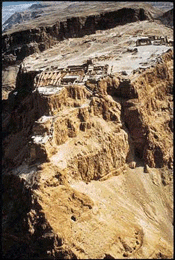
Above: Masada


In the opera house encores are out the question — except at youthful Israel Opera, where on June 3 the audience got to hear it three times — and they loved it. This was only one feature of this production in the new, 6500-seat outdoor theater at the foot of Mt. Masada that made this Nabucco fresh and exciting.
Oren, music director of Opera Israel, knows his Verdi. He understands the composer’s style. He knows Verdi was not a subtle musician and — unlike others — he makes no effort to make something of him that he is not. Oren unashamedly relishes the oom-paah of the score, and for him the confused identities of the plot are unhackneyed. For Oren it’s all fun — and that’s what this 25th-anniversary staging that launched a new international summer opera festival was.

But back — to make this case — to Va pensiero. Having performed the chorus and given it again as an encore, Oren then made it a community sing — but not before turning to the audience to tell them that they must not applaud until he brought down his hand at the end of the final note.

The capacity crowd — all five performances of Navucco were sold out — followed his instructions, and then went wild. It was a hoot, and it’s safe to say that Opera Israel at Masada is here to stay. To underscore the prestige of this production IO assembled a cast as committed as it was impressive.

Sterling senior Paata Burchuladze, who came West long ago from Soviet Georgia, sang a majestic Hebrew high priest Zuccaria. (In 1995 Burchuladze sang the title role in the production of Boris Godunov that opened Israel Opera’s new home in Tel Aviv. Since then he has appeared regularly with the company.) Italian baritone Alberto Gazala, who made his IO debut in the title role in this production, went straight to the heart of the troubled Babylonian emperor and portrayed his breakdown and recovery with great dramatic skill. As Abigaille, Greek soprano Dmitra Theodosssiou handled the shifting vocal demands that Verdi makes on the central female figure in the cast with amazing ease, while Italy’s Tiziana Carraro was appropriately gentle and loving as Fenena. (In the alternate cast Mongolian-born Baysa Dashnyam sang Abigaille and Italians Eugenia Tufano, Fenena and David Cecconi, Nabucco.)

The exuberance that Oren brought to the production was an obvious inspiration to everyone on stage and to members of the Israel Symphony Orchestra Rishon Le Zion, pit band of the company back home in Tel Aviv. It carried over to the audience as well, leaving them in a state of animated excitement when the performance ended at 1 a.m.
Behind the joyous success of Nabucco at Masada lay much more than the selection of a work and the assembly of a cast and production crew. We had to create the entire infrastructure for this project, said Opera Israel general director Hanna Munitz at a press conference before the June 3 performance of Nabucco. We had no example to follow; we had to figure it all out ourselves.

This meant not only building a modern theater in the middle of the dessert, but also arranging transportation from Israel’s major cities, organizing packages with the many hotels at the Dead Sea and providing shuttle service from them to the theater. It’s a dream that began four years ago, Munitz said. In the last four months it’s involved up to 600 people all working at one time. Of special importance was the choice of Britain’s Bryan Grant as sound designer for Nabucco. A totally natural sound prevailed throughout the performance.
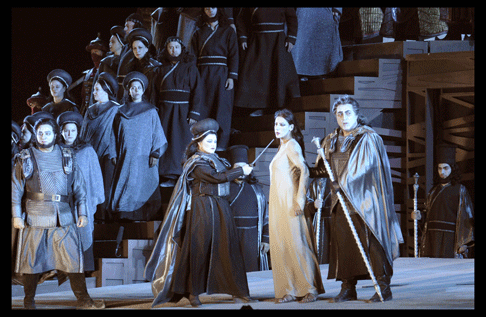
Nabuko_Israel_308.gifPhoto by Yossi Zwecker courtesy of Israeli Opera

The stage at Masada is 35 by 64 meters — three times as large as in OI’s home theater in Tel Aviv. Director Joseph Rochlitz worked largely without props, distributing the chorus and extras over the broad staircases at either side of the stage and in the area above it. Sets were by Nitzsan Refaeli; costumes by Alberto Spiazzi and lighting by Avi Yoni Bueno.

Munitz announced plans for the staging of Verdi’s Aida in 2011 and mentioned Samson et Dalila by Saint-Saens as a probable future choice for the festival. Nabucco, however, was the obvious opera to launch the festival. And that does in no way imply that Verdi thought of the story that plays following the destruction of the first temple down the road in Jerusalem as a Jewish Opera.

For the composer it was rather a veil for his concern about the state of his native Italy in the mid-19th-century. Be that as it may, you cannot hear Va pensiero — at least not in Israel — without hearing it as an anthem of the Diaspora. It is thus not surprising that the gala concert that celebrated the opening of Israel Opera’s new home in Tel Aviv ended with Va pensiero.

Green opera

Israel Opera at Masada is further a cultural endeavor committed to an environmental cause: it is supporting a drive to see the Dead Sea named one of the seven new Wonders of the World. The level of water in the Sea is currently falling one meter per year. If this continues, it will be the end of the many hotels there and the tourism that they encourage.

Among projects under consideration is the building of a canal from the Mediterranean — a project envisioned by father of Zionism Theodor Herzl in his 1902 New Land, his Utopian vision of the Jewish state. Among sites under consideration for the new Seven Wonders list are the Amazon River, the Grand Canyon and the Great Barrier Reef. Nabucco — for those who might not know it — is short for Nebuchadnezzar.

Wes Blomster
Send to a friend

Send a link to this article to a friend with an optional message.

Friend's Email Address: (required)

Your Email Address: (required)

Message (optional):