Subscribe to
Opera Today

Receive articles and news via RSS feeds or email subscription.


twitter_logo[1].gif


UCP_9780226043425.gif

Recently in Reviews

Wozzeck at ENO

“Man is an abyss. It makes one dizzy to look into it.” So utters Georg Büchner’s Woyzeck, repeating what was also a recurring motif in the playwright’s own letters.

Mulhouse: Rare Britten Well Done

National Opera Company of the Rhine has marked this year’s Benjamin Britten celebration with a remarkably compelling, often gripping new production of the seldom-seen Owen Wingrave.

Frankfurt's Intriguing Idomeneo

Once upon a time, Frankfurt Opera had the baddest ass reputation in Germany as “the” cutting edge producer of must-see opera.

Rigoletto at Lyric Opera of Chicago

Productions of Giuseppe Verdi’s Rigoletto can serve as a vehicle for individual singers to make a strong impression and become afterward associated with specific roles in the opera.

Britten Sinfonia with Ian Bostridge

Just in case we were not aware that the evening’s programme was ‘themed’, the Britten Sinfonia designed a visual accompaniment to their musical exploration of night, sleep and dreams.

Aida, Manitoba Opera

Poor Aida! She never seems to have anything go her way.

Superlative singing: Don Carlo, Royal Opera House

Is it possible to upstage Jonas Kaufmann? Kaufmann was brilliant in this Verdi Don Carlo at the Royal Opera House, London, but the rest of the cast was so good that he was but first among equals. Don Carlo is a vehicle for stars, but this time the stars were everyone on stage and in the pit. Even the solo arias, glorious as they are, grow organically out of perfect ensemble. This was a performance that brought out the true beauty of Verdi's music.

Sarah Connolly: French Song at Wigmore Hall

The big names were absent: Duparc, D’Indy, Debussy, Ravel … and while Fauré, Chausson, Roussel and several members of Les Six put in an appearance, in less than familiar guises, this survey of French song of the early 20th century and interwar years deliberately took us on a journey through infrequently travelled terrain.

Rare restoration: Handel’s Esther 1720

Composed between 1718 and 1720, Handel’s Esther is sometimes described as the ‘first English Oratorio’, but is in fact a hybrid form, mixing elements of oratorio, masque, pastoral and opera.

The Damnation of Faust, London

Hector Berlioz's légende dramatique, La Damnation de Faust, exists somewhere between cantata and opera. Berlioz's flexible attitude to dramatic form made the piece unworkable on the stages of early 19th century Paris and his music is so vivid that you wonder whether the piece needs staging at all.

Elizabeth Connell Memorial Concert, St John's Smith Square

St. John’s Smith Square was the site of Elizabeth Connell’s final London concert, intended as a farewell to London on her moving to Australia. It was rendered ultimately final by her unexpected death.

Aida with all the Trimmings, Even a Blue Silk Elephant!

With the building of the Suez Canal, Egypt became more interesting to Western Europeans. Khedive Ismail Pasha wanted a hymn by Verdi for the opening of a new opera house in Cairo, but the composer said he did not write occasional pieces.

Die Zauberflöte, Royal Opera

Back for its fourth revival, David McVicar’s 2003 production of Mozart’s Die Zauberflöte has much charm, beauty and artistry.

Kaufmann Wagner

The economics of the recording companies dictate much that is not ideal. Wagner’s operas were not composed as they were in order to permit the extraction of bleeding chunks, even on those occasions when strophic song forms do occur.

The Marriage of Figaro Ends Season at Arizona Opera

Wolfgang Amadeus Mozart's opera The Marriage of Figaro has a libretto by Lorenzo daPonte based on the French play La folle journée, ou le Mariage de Figaro (The Crazy Day or the Marriage of Figaro) by Pierre Caron de Beaumarchais (1732-1799).

Baden’s Flute Goes Barefoot in the Park

For its world class Easter Festival, Baden-Baden mounted a Die Zauberflöte that owed more to the grey penitential doldrums of Lent than to the unbridled jubilance of re-birth.

Bonjour M. Gauguin in Berkeley

Once Berkeley Opera, renamed West Edge Opera, this enterprising company offers the Bay Area’s only serious alternative to corporate opera, to wit Bonjour M. Gauguin.

Mahler Lieder, Wigmore Hall

In the first of pianist Julius Drake’s three-part series, ‘Perspectives’, our gaze was directed at Gustav Mahler’s eclectic musical responses to human experiences: from the trauma and distress of anguished love to the sweet contentment of true friendship, from the agonised introspection of the artist to the diverse dramas of human interaction.

Cinderella Goes to the Opera

The Los Angeles opera company marketed its spring production of Rossini's La Cenerentola as Cinderella though there is no opera by that name. The libretto of La Cenerentola is not the Cinderella story we know.

Die Walküre, Paris

The Paris Opéra has not staged a full Ring Cycle since 1957, but its current season will conclude with a correction of this grand operatic gap.

OPERA TODAY ARCHIVES »

Reviews

Deborah Voigt as Minnie [Photo by Cory Weaver courtesy of San Francisco Opera]
22 Jun 2010

La fanciulla del West in San Francisco

A bizarre rock cliff attributed in the program booklet to one Antonio Nigro was the sole background for San Francisco Opera’s production of Puccini’s version of a play named The Girl of the Golden West by San Francisco born David Belasco (1853-1931).

Giacomo Puccini: La fanciulla del West

Minnie: Deborah Voigt; Dick Johnson: Salvatore Licitra; Jack Rance: Roberto Frontali; Nick: Steven Cole; Sonora: Timothy Mix; Ashby: Kevin Langan; Joe: Brian Jagde; Harry: David Lomelí; Trin: Matthew O’Neill; Handsome: Austin Kness; Sid: Kenneth Overton; Jake Wallace: Trevor Scheunemann; Happy: Igor Vieira; Larkens: Brian Leerhuber; Wowkle: Maya Lahyani; Billy Jackrabbit: Jeremy Milner; Pony Express Rider: Christopher Jackson. Conductor: Nicola Luisotti. Director: Lorenzo Mariani. Set Designer: Maurizio Balò. Costume Designer: Gabriel Berry. Lighting Designer: Duane Schuler.

Above: Deborah Voigt as Minnie

All photos by Cory Weaver courtesy of San Francisco Opera


Over the long evening we got to know this wall’s every nook and cranny in about every color of light imaginable.

Just when you thought San Francisco Opera got its productions from Chicago this one comes from Palermo (Italy) where its stage director, one Lorenzo Mariani, is the artistic director of the Teatro Massimo. The Italianization of San Francisco Opera is amusing. One can even imagine an Italian operatic mafia that promotes only its own when brokering international deals. This could explain and perhaps excuse the otherwise inexplicable and inexcusable.
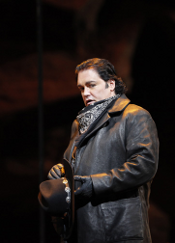
_MG_4593.pngSalvatore Licitra as Dick Johnson

The star of this San Francisco edition of Palermo’s Fanciulla is, no surprise, conductor Nicola Luisotti whose full throated orchestra sang out with delirious abandon Minnie’s true love for the bandito Ramerrez. He pulls us through this evening with orchestral sweep and dramatic point — typical Luisotti.

Mo. Luisotti is indeed a force to be reckoned with. Minnie, soprano Deborah Voight, and Dick Johnson (aka Ramerrez), tenor Salvatore Licitra had no problem at all. Mme. Voight sings her first Minnie, combining a bona fide Americana persona with convincing Italianate singing, cutting loose with high notes as only a dramatic soprano can and here needs to do. Minnie is not the usual Puccini heroine who accepts her unhappy fate. Minnie’s fate is true love that she gains with true soprano coglioni, three aces and a pair, and high notes that simply wither anything that gets in the way!

Salvadore Licitra cuts a fine figure on the stage, the red flag on the back pocket of his Levi’s convincing, the six shooters on his hips menacing . He also sings. His musicianship is impeccable, his phrasing is elegant, and he soars to high notes with ease in his powerful, baritone colored tenor. He should shut up with his retro ideas about opera staging, voiced in an San Francisco Opera Guild preview.

The unhappy, love sick sheriff, Jack Rance, was perfectly rendered by Roberto Frontali who was appropriately emotionally withdrawn though expressive in his brief but revealing soliloquy, and his pleadings to Minnie were touching too. His fine baritone served him just as well when he got mean. Mr. Frontali’s voice, stance and profile would threaten bandits in any spagetti western.

Of the large supporting cast, Timothy Mix [sic] stood out as Sonora, a fine voice and sympathetic, commanding presence, as did young Adler Fellow Maya Lahyani as the Indian Wowkle, the only female voice in the opera other than Mme. Voight.
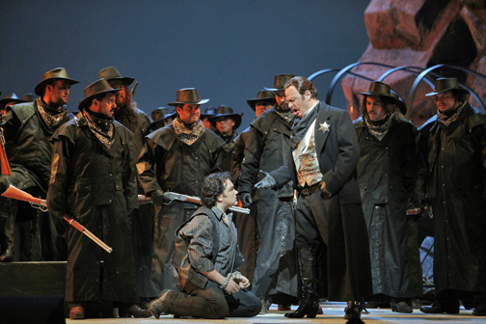
_MG_8325.pngSalvatore Licitra as Dick Johnson and Roberto Frontali as Jack Rance with Brian Jadge as Joe, Igor Viera as Happy, Timothy Mix as Sonora, Austin Kness as Handsome, David Lomelí as Harry and chorus members

Fanciulla is pure Italian kitsch. For Puccini California was a faraway colorful myth. Mix this with his beloved pentatonic scale (in his mind the perfect sound for California as well as Japan) and with a play that is like catchy short story (winning a guy in a card game). So no one expects a production of Fanciulla to be particularly California.

Nevertheless, evidently scene designer Maurizio Balò, like Puccini, has never been to California, because he would know that we do not have funny red brown rocks carved out of foam. Those rocks are in Utah and even there they are not carved out of foam. They turned weirdly blue when it was supposed to be snowing, though the snow was bubbles of some sort rather than flakes. Finally when Minnie and Dick were headed off into the sunset the foam wall turned gold, and split apart revealing a painted drop that was supposed to be, maybe, the Sierras as our plein air artists might imagine them. If this was the idea it failed miserably in execution.

Costumes are credited to American designer Gabriele Berry. The miners’ costumes seemed reasonable in the first act, but in the second act the many men of the posse had all donned identical, sinister, vaguely WWI looking raincoats. For her tryst with Dick Johnson in her cabin Mme. Voight was resplendent in a far too grand Victorian dress that she surely would have shed (but did not) to tease Dick a bit more before she rolled herself up (still in the dress) in a blanket to sleep on the floor (she had given Dick the bed).

Director Lorenzo Mariani moved actors on and off the stage as needed, and platforms holding a bar, a bed and a scaffold as well. When it was time for Minnie to rescue Dick he attempted a coup de théâtre with Minnie arriving on horseback — a bored, placid palomino was led slowly onto the stage by two keepers. Com’on, hasn’t he even seen Zefferelli’s white stallion gallop across the stage to rescue Leonora in Il Trovatore in Verona? That’s theater!

Provincial Italian opera surely has better to offer than this Fanciulla del West.

Michael Milenski

Send to a friend

Send a link to this article to a friend with an optional message.

Friend's Email Address: (required)

Your Email Address: (required)

Message (optional):