![Chiara Angella as Alkestis and Yves Saelens as Admetos [Photo by Andreas Birkigt courtesy of Oper Leipzig]](http://www.operatoday.com/OPER-LEIPZIG_3974_Alkestis-.gif)
23 Jun 2010
Leipzig Opera to stage Gluck Ring
Richard Wagner’s 200th birthday is just around the corner in 2013 — and the composer was, after all, born in Leipzig.
English Touring Opera are delighted to announce a season of lyric monodramas to tour nationally from October to December. The season features music for solo singer and piano by Argento, Britten, Tippett and Shostakovich with a bold and inventive approach to making opera during social distancing.
This tenth of ten Live from London concerts was in fact a recorded live performance from California. It was no less enjoyable for that, and it was also uplifting to learn that this wasn’t in fact the ‘last’ LfL event that we will be able to enjoy, courtesy of VOCES8 and their fellow vocal ensembles (more below …).
Ever since Wigmore Hall announced their superb series of autumn concerts, all streamed live and available free of charge, I’d been looking forward to this song recital by Ian Bostridge and Imogen Cooper.
Although Stile Antico’s programme article for their Live from London recital introduced their selection from the many treasures of the English Renaissance in the context of the theological debates and upheavals of the Tudor and Elizabethan years, their performance was more evocative of private chamber music than of public liturgy.
Evidently, face masks don’t stifle appreciative “Bravo!”s. And, reducing audience numbers doesn’t lower the volume of such acclamations. For, the audience at Wigmore Hall gave soprano Elizabeth Llewellyn and pianist Simon Lepper a greatly deserved warm reception and hearty response following this lunchtime recital of late-Romantic song.
For this week’s Live from London vocal recital we moved from the home of VOCES8, St Anne and St Agnes in the City of London, to Kings Place, where The Sixteen - who have been associate artists at the venue for some time - presented a programme of music and words bound together by the theme of ‘reflection’.
'Such is your divine Disposation that both you excellently understand, and royally entertaine the Exercise of Musicke.’
‘And there was war in heaven: Michael and his angels fought against the dragon; and the dragon fought and his angels, And prevailed not; neither was their place found any more in heaven … that old serpent … Satan, which deceiveth the whole world: he was cast out into the earth, and his angels were cast out with him.’
There was never any doubt that the fifth of the twelve Met Stars Live in Concert broadcasts was going to be a palpably intense and vivid event, as well as a musically stunning and theatrically enervating experience.
‘Love’ was the theme for this Live from London performance by Apollo5. Given the complexity and diversity of that human emotion, and Apollo5’s reputation for versatility and diverse repertoire, ranging from Renaissance choral music to jazz, from contemporary classical works to popular song, it was no surprise that their programme spanned 500 years and several musical styles.
The Academy of St Martin in the Fields have titled their autumn series of eight concerts - which are taking place at 5pm and 7.30pm on two Saturdays each month at their home venue in Trafalgar Square, and being filmed for streaming the following Thursday - ‘re:connect’.
The London Symphony Orchestra opened their Autumn 2020 season with a homage to Oliver Knussen, who died at the age of 66 in July 2018. The programme traced a national musical lineage through the twentieth century, from Britten to Knussen, on to Mark-Anthony Turnage, and entwining the LSO and Rattle too.
With the Live from London digital vocal festival entering the second half of the series, the festival’s host, VOCES8, returned to their home at St Annes and St Agnes in the City of London to present a sequence of ‘Choral Dances’ - vocal music inspired by dance, embracing diverse genres from the Renaissance madrigal to swing jazz.
Just a few unison string wriggles from the opening of Mozart’s overture to Le nozze di Figaro are enough to make any opera-lover perch on the edge of their seat, in excited anticipation of the drama in music to come, so there could be no other curtain-raiser for this Gala Concert at the Royal Opera House, the latest instalment from ‘their House’ to ‘our houses’.
"Before the ending of the day, creator of all things, we pray that, with your accustomed mercy, you may watch over us."
The doors at The Metropolitan Opera will not open to live audiences until 2021 at the earliest, and the likelihood of normal operatic life resuming in cities around the world looks but a distant dream at present. But, while we may not be invited from our homes into the opera house for some time yet, with its free daily screenings of past productions and its pay-per-view Met Stars Live in Concert series, the Met continues to bring opera into our homes.
Music-making at this year’s Grange Festival Opera may have fallen silent in June and July, but the country house and extensive grounds of The Grange provided an ideal setting for a weekend of twelve specially conceived ‘promenade’ performances encompassing music and dance.
There’s a “slide of harmony” and “all the bones leave your body at that moment and you collapse to the floor, it’s so extraordinary.”
“Music for a while, shall all your cares beguile.”
The hum of bees rising from myriad scented blooms; gentle strains of birdsong; the cheerful chatter of picnickers beside a still lake; decorous thwacks of leather on willow; song and music floating through the warm evening air.
Richard Wagner’s 200th birthday is just around the corner in 2013 — and the composer was, after all, born in Leipzig.
It was thus hardly a surprise when Leipzig Opera approached its chief resident director Peter Konwitschny and suggested that he consider staging the Ring to celebrate the anniversary. Konwitschny, son of the late music director of Leipzig’s esteemed Gewandhaus Orchestra and among the most erudite and experienced of today’s German directors, pointed out that the Big Birthday will prompt a rush of Ring stagings throughout Germany and suggested that Leipzig consider rather new productions of four operas by Christoph Willibald Gluck, the man who late in the 18th century rescued opera from the excesses of the Baroque spectacle that it had become. Wisely, the Leipzig Opera knew a good idea when they heard one and told Konwitschny to go to work.
The director launched the project earlier this season with a new production of Alceste — or Alkestis, as it is known in Germany, which was seen at the last performance of the current season in Leipzig’s 50-year-old, 1260-seat opera house on June 18. Stagings of Gluck’s two Iphigenia operas — in Aulis and Tauris — and of Armida will follow. Konwitschny defines the common ground that will give coherence to the cycle as studies of four unusually strong women viewed from a perspective that reaches from the beginning of time to the present day. All four are dramas, he says, in which the conflict between love and power is of central importance. Konwitschny points out that the later masters of music theater — Mozart, Wagner and Richard Strauss — were all Gluck fans. Indeed, Wagner conducted Gluck and wrote about his work in his own essay Opera and Drama.
Konwitschny is a long established master of Regieoper, the practice widely spread in Germany — and now in other countries as well — of giving a director a totally free hand with a work, even if the original story is hardly recognizable in the resulting staging. What sets Konwitschny apart from other directors, however, is his regard for the composer and the story that he once told. He is there to respect — and serve — history. Yet nothing would have prepared a foreigner uninitiated in Regieoper for what Konwitschny has done with Alceste.
In his own new and original score for the opera he concludes the 1767 Vienna version with the satyr play that Gluck wrote for the Paris production of the opera nine years later. Konwitschny plays the first two acts “straight” — indeed in the majesty of their extended choruses there are markings of the sublime that one once dared expect from great art. Greek soprano Chiara Angella — a fitting choice for the heroine — sings her demonic address to the gods of the underworld with true dramatic pathos against the leaden skies projected on the rear wall of the simply-set stage. Then — with no hint of the change to come — the curtain opens Act Three in Her-Cool-TV, a television studio, in which a curly blond-wigged body builder Hercules is the host.
The chorus discards its togas in favor of jeans, colored shirts and baseball caps and sits in bleachers on either side of the stage. The studio crew feeds them their lines on posters and tells them when to laugh. The mayhem that ensues stresses the degree to which TV has corrupted modern life — and been corrupted by it. Alceste and Admetos — Belgian countertenor Yves Saelens — progressively lose ground as they argue about which of them has the greater right to die first. Finally, Apollo — dressed in the business suit of a successful politician — brings things to a happy end from the elevated loge where East-German leaders once sat at the Leipzig Opera. As the curtain falls, the reunited couple is wrapped in Saran Wrap.
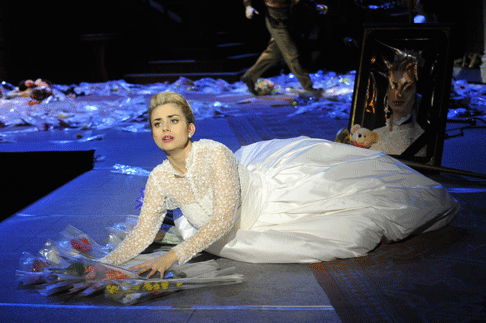 Soula Parassidis as Alceste [Photo by Andreas Birkigt courtesy of Oper Leipzig]
But, one must ask, where does this leave the audience, which has had an experience of riotous entertainment that few would think available in an opera house? Does one think of the dreadful turmoil Alceste has been through, when even the husband for whom she wishes to sacrifice herself questions her motives? Has Konwitschny given his audience too much of a good thing?
Despite the popularity that Baroque opera has come to enjoy, one would hardly expect a company anywhere to perform two tellings of the Alceste story on successive June evenings. That, however, is what Leipzig Opera did in offering Handel’s Admeto on June 17. (In 1745 Gluck and Handel actually met in London, where they staged a concert together. When director Tobias Kratzer took his first look at Admeto he was overwhelmed by its proximity in spirit to soap opera, which became his model for this staging.
Set in a palace that is already a museum while still serving as a royal residence, Kratzer makes the work a spoof on Europe’s surviving blue-bloods. As Alceste, for example, mezzo Soula Parassidis could be either Grace Kelly or Princess Di. Sleuthing Orindo, superbly played by Kathrin Göring, is an obvious take-off on Miss Marple. The progress that opera made in the years between Admeto and Alceste roughly equals the distance between the Model T Ford and space flights. Katzer understood, however, how to make the Handel superb entertainment. He diverted attention from the static quality of Handel’s da capo arias. He added a stately five-man ensemble that roamed the lobby before curtain time and then participated in on-stage action as players of the melodica, the blow organ introduced by Hohner in the 1960s. In one case, the quintet even accompanied an aria.
Yet it was the quality of the cast and the exemplary playing of the pit ensemble that made this Admeto memorable. (The Gewandhaus Orchestra plays for Leipzig Opera.) Alceste, the most complex character in the drama, was sung by mezzo Soula Parassidis, a coloratura of impressive agility, who touchingly followed the figure through changing modes of loss, sorrow, fury and the desire for revenge. Hagen Matzeit — Admeto — is a male alto who sings with incredible ease, as does male countertenor Norman Reinhardt, who was engaging as the king’s brother Trasimede. And petite Elena Tokar made Antigona sympathetic — despite her confusion of feelings. The cast sang the German translation by Bettina Bartz and Werner Hintze as easily as if it had been the original Italian libretto. Both operas added special flavor to the Leipzig Bach Festival that dominated the one-time home of Bach when these performances were on stage. Major curiosity of the BachFest season was the performance of Johann David Heinchen’s Die Lybische Talestris, possibly the first opera performed in Leipzig over 300 years ago. Sigrid T’Hooft, who reconstructed the score from material in Berlin’s Singakademie directed students of Leipzig’s Hochschule für Musik und Theater in the production staged in the tiny Bad Lauchstädt theater, once directed by Goethe. Alas, the five-hour — and somewhat slipshod — performance on the bare-board seats of the tiny Bad Lauchstädt proved more Baroque than most had bargained for. The theater was largely empty when — long after midnight — the curtain fell. (Allegedly, Heinrich — 1683-1729 — was well acquainted with Bach.) One rarely hears of anyone who has gone to Leipzig for opera. It is clearly time that one does! Wes Blomster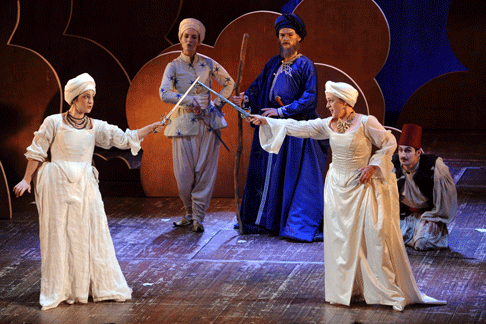 Scene from Die Lybische Talestris [Photo by Gert Mothes courtesy of Oper Leipzig