![Hanan Alattar as Leïla [Photo by Catherine Ashmore courtesy of English National Opera]](http://www.operatoday.com/Alattar.png)
09 Jun 2010
Pearl Fishers, ENO
The opening tableau of Penny Woolcock’s new production depicts deep waters with rays of sun hitting the surface; in the murky blue depths, three harnessed acrobats glide down to the sea bed and back up again.
English Touring Opera are delighted to announce a season of lyric monodramas to tour nationally from October to December. The season features music for solo singer and piano by Argento, Britten, Tippett and Shostakovich with a bold and inventive approach to making opera during social distancing.
This tenth of ten Live from London concerts was in fact a recorded live performance from California. It was no less enjoyable for that, and it was also uplifting to learn that this wasn’t in fact the ‘last’ LfL event that we will be able to enjoy, courtesy of VOCES8 and their fellow vocal ensembles (more below …).
Ever since Wigmore Hall announced their superb series of autumn concerts, all streamed live and available free of charge, I’d been looking forward to this song recital by Ian Bostridge and Imogen Cooper.
Although Stile Antico’s programme article for their Live from London recital introduced their selection from the many treasures of the English Renaissance in the context of the theological debates and upheavals of the Tudor and Elizabethan years, their performance was more evocative of private chamber music than of public liturgy.
Evidently, face masks don’t stifle appreciative “Bravo!”s. And, reducing audience numbers doesn’t lower the volume of such acclamations. For, the audience at Wigmore Hall gave soprano Elizabeth Llewellyn and pianist Simon Lepper a greatly deserved warm reception and hearty response following this lunchtime recital of late-Romantic song.
For this week’s Live from London vocal recital we moved from the home of VOCES8, St Anne and St Agnes in the City of London, to Kings Place, where The Sixteen - who have been associate artists at the venue for some time - presented a programme of music and words bound together by the theme of ‘reflection’.
'Such is your divine Disposation that both you excellently understand, and royally entertaine the Exercise of Musicke.’
‘And there was war in heaven: Michael and his angels fought against the dragon; and the dragon fought and his angels, And prevailed not; neither was their place found any more in heaven … that old serpent … Satan, which deceiveth the whole world: he was cast out into the earth, and his angels were cast out with him.’
There was never any doubt that the fifth of the twelve Met Stars Live in Concert broadcasts was going to be a palpably intense and vivid event, as well as a musically stunning and theatrically enervating experience.
‘Love’ was the theme for this Live from London performance by Apollo5. Given the complexity and diversity of that human emotion, and Apollo5’s reputation for versatility and diverse repertoire, ranging from Renaissance choral music to jazz, from contemporary classical works to popular song, it was no surprise that their programme spanned 500 years and several musical styles.
The Academy of St Martin in the Fields have titled their autumn series of eight concerts - which are taking place at 5pm and 7.30pm on two Saturdays each month at their home venue in Trafalgar Square, and being filmed for streaming the following Thursday - ‘re:connect’.
The London Symphony Orchestra opened their Autumn 2020 season with a homage to Oliver Knussen, who died at the age of 66 in July 2018. The programme traced a national musical lineage through the twentieth century, from Britten to Knussen, on to Mark-Anthony Turnage, and entwining the LSO and Rattle too.
With the Live from London digital vocal festival entering the second half of the series, the festival’s host, VOCES8, returned to their home at St Annes and St Agnes in the City of London to present a sequence of ‘Choral Dances’ - vocal music inspired by dance, embracing diverse genres from the Renaissance madrigal to swing jazz.
Just a few unison string wriggles from the opening of Mozart’s overture to Le nozze di Figaro are enough to make any opera-lover perch on the edge of their seat, in excited anticipation of the drama in music to come, so there could be no other curtain-raiser for this Gala Concert at the Royal Opera House, the latest instalment from ‘their House’ to ‘our houses’.
"Before the ending of the day, creator of all things, we pray that, with your accustomed mercy, you may watch over us."
The doors at The Metropolitan Opera will not open to live audiences until 2021 at the earliest, and the likelihood of normal operatic life resuming in cities around the world looks but a distant dream at present. But, while we may not be invited from our homes into the opera house for some time yet, with its free daily screenings of past productions and its pay-per-view Met Stars Live in Concert series, the Met continues to bring opera into our homes.
Music-making at this year’s Grange Festival Opera may have fallen silent in June and July, but the country house and extensive grounds of The Grange provided an ideal setting for a weekend of twelve specially conceived ‘promenade’ performances encompassing music and dance.
There’s a “slide of harmony” and “all the bones leave your body at that moment and you collapse to the floor, it’s so extraordinary.”
“Music for a while, shall all your cares beguile.”
The hum of bees rising from myriad scented blooms; gentle strains of birdsong; the cheerful chatter of picnickers beside a still lake; decorous thwacks of leather on willow; song and music floating through the warm evening air.
The opening tableau of Penny Woolcock’s new production depicts deep waters with rays of sun hitting the surface; in the murky blue depths, three harnessed acrobats glide down to the sea bed and back up again.
A couple of weeks ago I reviewed a new Tosca which looked suspiciously like Tristan und Isolde — now, we have a new Pearl Fishers which, if I hadn’t been able to hear the music as the curtain went up, I would have taken to be the opening of Das Rheingold. The series of major triads towards the end of Bizet’s prelude has never before struck me as sounding like Wagner, and I dare say it never will again — but its presence, coupled with the stage picture, makes for a disorientating few seconds of opera.
It is a stunning piece of visual theatre, making effective use of the vast dimensions of the Coliseum’s proscenium arch to emphasise the insignificance of humankind in comparison with the might of the sea. The precariousness of the pearl-fishing community’s existence is further underlined by designer Dick Bird’s Act 1 set — a shanty town on stilts, with little rickety wooden huts piled on top of one another up the hillside (small wonder that the announcement of a rapidly spreading fire causes such instant panic) — and by the fiercely billowing ocean waves which surround Leïla’s Act 2 sanctuary.
Woolcock’s production attempts to strip away most of the kitsch traditionally seen in 19th-century operas by European composers about the exotic East. Instead she gives us a hyper-realistic contemporary setting, in which shacks have rudimentary TV aerials rigged up on the roof, the locals wear an eclectic mix of Western and traditional Ceylonese clothing, and Western tourists with cameras are occasionally seen weaving through the dense crowd of locals. She doesn’t go quite so far as to replicate the litter-strewn shallows depicted in one of the photographs in the programme, but one suspects it is probably a good job this staging does not contain an olfactory element (it would surely be far less fragrant than Philip Prowse’s old production, last revived in 2000, with its heady scent of incense)!
The Act 1 set does, at least, look breathtakingly pretty when night falls and lights twinkle from the hillside huts, but the designs do create a few dramatic problems — the huts in the foreground are arrayed stage left and right, separated by a water-channel centre stage, so when Nadir and Zurga sing their duet from opposite sides of the divide, they are barely close enough to one another to be credible in greeting each other as old friends (what was that I said earlier about resemblance to Wagner?). And in Act 2, if Nadir has supposedly braved hell and high water to reach Leïla in her refuge, it’s amazing how Nourabad manages to get the whole chorus up there from another direction in five seconds flat.
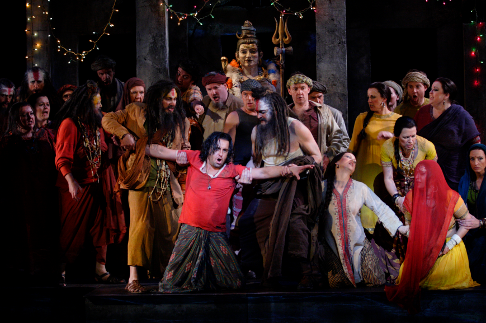 Alfie Boe as Nadir and Hanan Alattar as Leïla
The visual inspiration vanishes after Act 2, unfortunately, with Zurga’s aria and scene with Leïla set in front of what looks very much like a Bedouin tent, and the flames of the final inferno are a mere glow in the early morning sky, or at least they were from where I was sitting.
Though the staging grew steadily weaker throughout the opera, the musical quality went the other way. I was disappointed during Act 1 that tenor Alfie Boe, a popular star destined to ensure buoyant ticket sales, didn’t have the facility for a soft, floated ‘Je crois entendre encore’ in the mould of Vanzo or Kraus or even some of his own quite recent predecessors at the Coliseum. Bizet is the king of the high, piano tenor trick (think of the end of the Flower Song in Carmen) and when sung as written it is simply magical. This wasn’t. Similarly, the Leila, Hanan Alattar, started off the evening with a bright but frustratingly unyielding tone which bulldozed any notion that this young priestess might have been employed for her ability to seduce the gods into granting safety and protection to the pearl fishers.
One cast member was consistent — the Zurga, Hawaiian baritone Quinn Kelsey. He has a pleasant, even tone with complete security throughout the role’s considerable vocal range, coupled with a mature and centred stage persona. He is not one of nature’s great movers, but I barely minded as he was so expressive in his Act 3 aria. Perhaps even more importantly, he seemed to bring the best out in Alattar, whose previously monochromatic soprano finally began to show variation in colour and tone, and whose top turned out to be really very beautiful.
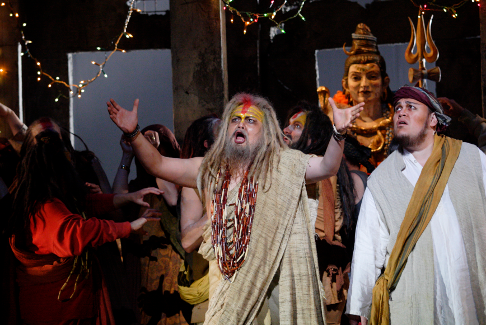 Quinn Kelsey as Zurga and Freddie Tong as Nourabad
The chorus sang powerfully and with impressive diction (though I sometimes wished I hadn’t been able to hear quite so much of Martin Fitzpatrick’s translation) and Rory Macdonald’s handling of the score was thrusting and powerfully driven during the big chorus scenes, if a little short on delicacy for intimate moments such as Leïla’s aria.
If not a complete triumph, owing to musical frustrations in the opera’s early scenes and scenic frustrations in its later ones, this new production is more than worth seeing for the high points alone.
Ruth Elleson, June 2010