Though
none of these ladies lived long enough to record her art, Andrew Porter, in a
pre-performance talk at Caramoor, quoted several critics of the era to show
that each Norma was controversial—what delighted one writer was
insufficient for another.
Lilli Lehmann, the Met’s first Norma (singing it in German), made the
famous comment that Norma took more out of her than all three of Wagner’s
Brünnhildes—a quote misconstrued by many an impresario to imply that any
natural Brünnhilde was also a Norma. (The Met tried to persuade Kirsten
Flagstad to take it over from Ponselle, but she had more sense than they did.)
More to the point, perhaps, is that the first Norma, Pasta, was also
Bellini’s first Sonnambula, a far gentler, more sentimental sort of
role—Norma must rage, but she also feels the pangs of rejected love, of
deep maternal love and of women’s friendship. Wagner admired Bellini
extravagantly and loved Norma—he had coached Lehmann’s
mother in the role for a benefit performance he conducted. From Bellini, in
part, Wagner learned the way a melody could be extended to express lingering
emotional truths, one emotion drifting into others. Too, there is more than a
touch of Greek tragedy to Norma, with its fierceness of feeling
beneath simplicity of action, and Wagner took much of his method of dramatic
construction from Greek sources.
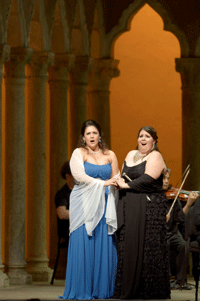 Angela Meade (Norma) and Keri Alkema (Adalgisa)
What Lehmann probably meant by her bon mot is that the vocal line in
Wagner’s Ring is part of many concurrent lines of sound, that
the voice fades out of and into the overall texture, and the orchestra will
carry the score if the voice fades. In Bellini, the singer has no place to
hide—the orchestration is delicate (a lot of pizzicato) and subservient
to the singer, who must create the statements, tensions and confrontations of
the role. If you run out of breath in Bellini, everyone in the house will know
it. For this among other reasons, perfect Normas are rare to unheard-of. In a
saner age, singers used to respect its complexities and seldom attempted it
without justification. In the entire twentieth century, by general consensus,
there were only two nearly perfect Normas, at least outside Italy: Rosa
Ponselle and Maria Callas. After Callas’s era, Joan Sutherland and
Montserrat Caballé both sang vocally sumptuous Normas that left something to be
desired in characterization. Unfortunately, they made the opera sound so easy
to sing, in their very different personal styles, that many ambitious sopranos
after them decided to tackle it, only to crash and burn. I haven’t heard
a competent Norma since Sutherland and Caballé laid down their verbena
wreaths—or I hadn’t until last Friday.
Norma is a seeress who has betrayed her gods and her country out of love for
an enemy seducer. Sworn to virginity, she has borne her lover two children and
repressed calls for a national uprising. When she learns he loves another
priestess, her jealous rage almost inspires her to murder her children à la
Medea or to command a nationwide massacre. Failing that, she could have her
rival burned in front of her lover’s eyes—she considers
this—or she can face the truth and her own corruption. Who is the
traitor? “Son io,” she sings—unaccompanied, a moment of stark
drama—“’Tis I”—adding, “Prepare the
fire.” Surely Wagner was inspired by the gorgeous finale, the melody
rising, falling, evolving, sweeping us along, the lovers marching through an
angry throng to fiery doom, and that it was not in the back of his mind as he
completed Götterdämmerung.
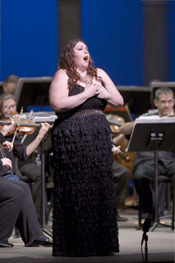
Angela Meade is 32. Her voice is large, beautiful and carefully trained. Her
theatrical temperament is on the cautious side but her instincts are good and
she has applied herself to the dramatic side of things. She made her stage
debut at the Met two years ago in Verdi’s Ernani, replacing an
ailing Sondra Radvanovsky, and though a bit uncertain on stage and
understandably wary in early scenes, she had the goods for a thrilling final
act. Last year, at Caramoor, Will Crutchfield persuaded her to undertake the
title role in Rossini’s Semiramide, one of the mightier
benchmarks for a dramatic coloratura. Again she made a slow start and her
acting was stiff, but the entire second act (an endurance contest for all four
leads) was edge-of-the-seat stuff. This year, therefore, Maestro Crutchfield
resolved to showcase her in two performances of Norma. Those, we
sighed, whom the Gods would destroy, they first tempt to appear as Norma.
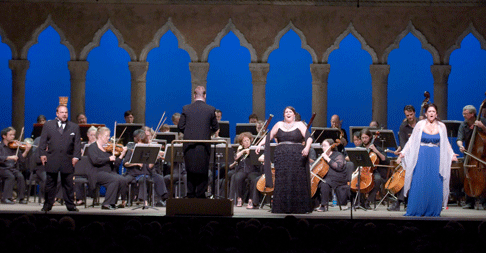 Angela Meade (Norma), Keri Alkema (Adalgisa) and Emmanuel di Villarosa (Pollione) with Will Crutchfield (conducting)
From the first performance came joyous reports; I attended the second and
happily confirm them: Meade is a far more than respectable Norma. For a first
attempt, this was exceptional bel canto singing and operatic acting.
Meade’s voice possesses some of Sutherland’s metallic power in
her upper range, including a clarion high D she brought forth to end the great
Act I trio, and she shares Sutherland’s cleanness of attack if not her
unwavering breath control. Some of her highest notes and ornaments, however,
are not quite so easy or even, especially in soft singing, where she sometimes
resorted to head voice. She ornaments with taste and the head-voice notes are
pretty, but this altered register implies she is ducking away from full-force
singing. Her chest voice, in contrast, is superbly produced and of great beauty
and evenness, reminding me of Tebaldi, who also sang dramatic coloratura roles
early in her career. This argues that bel canto roles will not be Meade’s
meat forever, but that when the highest notes fade, she could have an important
career in the lirico-spinto repertory of Verdi and Puccini that currently lacks
an ideal interpreter. Perhaps best of all, Meade knows how to present her
dramatic ideas forcefully, jabbing with a sudden attack (as Norma, so often
angry, must do) or turning reflective with a creamy legato.
In looks, though on the plump side, Meade moves well and holds herself with
dignity. She evinces a dramatic as well as a musical intelligence, and these
combined with the sheer loveliness of her singing to bring the house to its
feet at Caramoor. We were all eager to hear her again in any number of roles.
To achieve such an impression with Norma, the most unconquerable of heroines,
is itself a major achievement.
Her Adalgisa, Keri Alkema, sang with a dark, sensuous contrast to
Meade’s brighter sound. During their duets, the two ladies mingled their
voices to sublime effect, blending colors and ornaments deliciously.
The evening’s Pollione, Emmanuel di Villarosa, announced he was
performing with a cold and at first sounded that way, intonation faulty, high
phrases brought down an octave to avoid cracking. He nonetheless made a sturdy,
ardent figure and had warmed up by the great trio to carry his full dramatic
weight. His change of heart in the final scene (a weakness of the libretto)
seemed perfectly credible. Daniel Mobbs sang Norma’s father, Oroveso,
impressively, and the Orchestra of St. Luke’s muddled through punishing
humidity that hampered taut string playing.
For many of us, it was as genuine a Norma as we could have hoped
for after so many mediocre imitations. I almost envied the younger generation
who were hearing this superb score for the first time and hearing it done so
well.
Sadly, traffic jams getting out of New York on a Friday evening kept me from
attending the pre-opera concert of some of Wagner’s bel canto works,
excerpts from Das Liebesverbot (his “Bellini” opera) and
other items, sung by younger members of the Crutchfield program, but I got back
to Caramoor on Sunday afternoon for a concert of Chopin and Schumann chamber
music (this year marks the bicentennial of both gentlemen) with, set among the
cellos like a jewel of great price, Sasha Cooke performing Schumann’s
Frauenliebe und Leben.
As a rule, I am reluctant to hear yet another soprano take on this
too-familiar song cycle, Schumann’s idealization of the adoration of his
new bride, Clara—a loving but far more sophisticated and complex woman
than is the narrator of these poems. (In this the era of gay marriage, which
male singer will be the first to tackle it? Actually, Matthias Goerne has
already done so.) But Sasha Cooke is more than capable of making clichés new.
Her voice is an ample, generous mezzo of great size and appeal, clear and
precise at “chamber” level, then effortlessly soaring to fill
Caramoor’s enormous tent at the more delirious moments of the score. Her
diction is exceptional, her dramatic gifts considerable—she tells the
story and seems to inhabit the naïve narrator. In the music of
Frauenliebe, a very simple woman expresses with her voice an emotional
commitment deeper than words, and Cooke seemed to be living each layer of
meaning, the notes swelling as her heart sought words.
John Yohalem