![Plácido Domingo as Simon Boccanegra [Photo by Catherine Ashmore courtesy of The Royal Opera]](http://www.operatoday.com/Domingo_Boccanegra_ROH_2010.gif)
02 Jul 2010
Picture Perfect — Plácido Domingo as Simon Boccanegra, Royal Opera
Plácido Domingo isn’t a tenor, a baritone or even a singer. He’s a phenomenon. Dozens stood by the stage door at the Royal Opera House to greet him with bouquets.
English Touring Opera are delighted to announce a season of lyric monodramas to tour nationally from October to December. The season features music for solo singer and piano by Argento, Britten, Tippett and Shostakovich with a bold and inventive approach to making opera during social distancing.
This tenth of ten Live from London concerts was in fact a recorded live performance from California. It was no less enjoyable for that, and it was also uplifting to learn that this wasn’t in fact the ‘last’ LfL event that we will be able to enjoy, courtesy of VOCES8 and their fellow vocal ensembles (more below …).
Ever since Wigmore Hall announced their superb series of autumn concerts, all streamed live and available free of charge, I’d been looking forward to this song recital by Ian Bostridge and Imogen Cooper.
Although Stile Antico’s programme article for their Live from London recital introduced their selection from the many treasures of the English Renaissance in the context of the theological debates and upheavals of the Tudor and Elizabethan years, their performance was more evocative of private chamber music than of public liturgy.
Evidently, face masks don’t stifle appreciative “Bravo!”s. And, reducing audience numbers doesn’t lower the volume of such acclamations. For, the audience at Wigmore Hall gave soprano Elizabeth Llewellyn and pianist Simon Lepper a greatly deserved warm reception and hearty response following this lunchtime recital of late-Romantic song.
For this week’s Live from London vocal recital we moved from the home of VOCES8, St Anne and St Agnes in the City of London, to Kings Place, where The Sixteen - who have been associate artists at the venue for some time - presented a programme of music and words bound together by the theme of ‘reflection’.
'Such is your divine Disposation that both you excellently understand, and royally entertaine the Exercise of Musicke.’
‘And there was war in heaven: Michael and his angels fought against the dragon; and the dragon fought and his angels, And prevailed not; neither was their place found any more in heaven … that old serpent … Satan, which deceiveth the whole world: he was cast out into the earth, and his angels were cast out with him.’
There was never any doubt that the fifth of the twelve Met Stars Live in Concert broadcasts was going to be a palpably intense and vivid event, as well as a musically stunning and theatrically enervating experience.
‘Love’ was the theme for this Live from London performance by Apollo5. Given the complexity and diversity of that human emotion, and Apollo5’s reputation for versatility and diverse repertoire, ranging from Renaissance choral music to jazz, from contemporary classical works to popular song, it was no surprise that their programme spanned 500 years and several musical styles.
The Academy of St Martin in the Fields have titled their autumn series of eight concerts - which are taking place at 5pm and 7.30pm on two Saturdays each month at their home venue in Trafalgar Square, and being filmed for streaming the following Thursday - ‘re:connect’.
The London Symphony Orchestra opened their Autumn 2020 season with a homage to Oliver Knussen, who died at the age of 66 in July 2018. The programme traced a national musical lineage through the twentieth century, from Britten to Knussen, on to Mark-Anthony Turnage, and entwining the LSO and Rattle too.
With the Live from London digital vocal festival entering the second half of the series, the festival’s host, VOCES8, returned to their home at St Annes and St Agnes in the City of London to present a sequence of ‘Choral Dances’ - vocal music inspired by dance, embracing diverse genres from the Renaissance madrigal to swing jazz.
Just a few unison string wriggles from the opening of Mozart’s overture to Le nozze di Figaro are enough to make any opera-lover perch on the edge of their seat, in excited anticipation of the drama in music to come, so there could be no other curtain-raiser for this Gala Concert at the Royal Opera House, the latest instalment from ‘their House’ to ‘our houses’.
"Before the ending of the day, creator of all things, we pray that, with your accustomed mercy, you may watch over us."
The doors at The Metropolitan Opera will not open to live audiences until 2021 at the earliest, and the likelihood of normal operatic life resuming in cities around the world looks but a distant dream at present. But, while we may not be invited from our homes into the opera house for some time yet, with its free daily screenings of past productions and its pay-per-view Met Stars Live in Concert series, the Met continues to bring opera into our homes.
Music-making at this year’s Grange Festival Opera may have fallen silent in June and July, but the country house and extensive grounds of The Grange provided an ideal setting for a weekend of twelve specially conceived ‘promenade’ performances encompassing music and dance.
There’s a “slide of harmony” and “all the bones leave your body at that moment and you collapse to the floor, it’s so extraordinary.”
“Music for a while, shall all your cares beguile.”
The hum of bees rising from myriad scented blooms; gentle strains of birdsong; the cheerful chatter of picnickers beside a still lake; decorous thwacks of leather on willow; song and music floating through the warm evening air.
Plácido Domingo isn’t a tenor, a baritone or even a singer. He’s a phenomenon. Dozens stood by the stage door at the Royal Opera House to greet him with bouquets.
The fans know he doesn’t need flowers. The flowers are symbols to thank Domingo for being who he is. He’s an institution, or as they say in Japan, a Living National Treasure.
Given Domingo’s hectic schedule and age, it’s a miracle that he sings at all. Yet the moment he appears, the atmosphere seems to ignite, though he shares the stage with luminaries like Ferruccio Furlanetto, Joseph Calleja and Marina Poplavskaya.
Domingo’s authority is all the more impressive because there aren’t any florid, crowd pleasing arias in the part. It’s not Boccanegra’s style. He’s a shrewd politician who lives on constant alert, surrounded by danger. Hence the austere vocal colour, cold steel and granite. Boccanegra reveals himself in declamation, not decoration, and in ensemble where he’s not exposed. Indeed the tension in Domingo’s voice at some points enhances his characterization of Boccanegra as a man ravaged by fruitless struggle.
Domingo was convincingly tender in the reconciliation scene with Amelia, but reached true heights later. His monologue “Ah! ch’io respiri l’aura beata del libero cielo!”was exceptional. Acting skills grow with experience, so even if a voice ages, a true artist like Domingo can bring out aspects in the character deeper than words alone. “Oh refrigerio!... la marina brezza!...”, he sings, as the strings oscillate eerily. Domingo at once portrays the old Doge, whose power brought no peace, and the heroic corsair he once was.
Antonio Pappano understands that this “breeze” is sinister, and that Boccanegra will soon be chilled by death. Pappano’s feel for the hidden depths in this opera manifested itself in the way he brought out the strange, wavering textures in the orchestration. Tragedy hangs on this opera like a shroud : there’s an implication that headstrong Adorno might one day end up as broken as Boccanegra. Yet Verdi writes with cool-headed stoicism. Sparse textures, solo melodies, intense restraint. In Act 3, the juxtaposition of wedding chorus and execution march is so destabilizing Verdi doesn’t need to overstate the horror.
The central relationship in Simon Boccanegra is between Boccanegra and Jacopo Fiesco. Patrician and plebian, old authority pitted against a new order. Ferruccio Furlanetto’s Fiesco is a strong counterbalance to Domingo’s Boccanegra. Furlanetto has stage presence enough not to be intimidated by Domingo’s aura. His vocal control, too, was so vigorous that he could only be faulted for sounding like a much younger man, not Amelia’s grandfather. But the plot is a means of expressing the titanic power struggle in 14th century Genoa. Much better that Furlanetto sounds forceful and potent.
When Domingo and Furlanetto sang the reconciliation, it was profound because what has gone before has been so intense, a battle between two formidable forces.
Amelia is the pivot on which the plot turns, though the love story is secondary to the hate story that pervades the background. Marina Poplavskaya sings Amelia so assertively that her Amelia is much more than a plot device. Poplavskaya captures Amelia’s charm but the firmness in the centre of her voice indicates strong personality. A girl with such genes would hardly be a cipher.
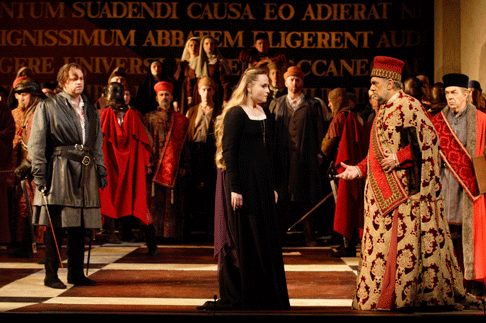 From Left To Right: Joseph Calleja as Gabriele Adorno, Marina Poplavskaya as Amelia Grimaldi, Plácido Domingo as Simon Boccanegra and Jonathan Summers as Paolo Albiani
Joseph Calleja’s Gabriele Adorno is energetic so much the young hothead that it’s hard to imagine what he’d be when he becomes Doge. Calleja has personality in his voice, which makes it attractive.
Lukas Jakobski’s Pietro was impressive, too, since he’s still a Jette Parker Young Artist. He stands out, vocally as well as physically (he’s very tall). Jonathan Summers’s Paolo Albiani was good too.
Since this production has been revived over 100 times, it’s almost superfluous to comment, but theatre is as much part of an opera as singing. Otherwise we’d stick to concert performances.
The sets in this Simon Boccanegra, designed by Michael Yeargan are extremely beautiful, and musically intelligent, too. Chessboard marble floor — a hard foundation that adapts to changes in time and scene, like Genoa itself. It’s black and white, typically Italianate, but also evokes the black and white power struggle in the narrative. On the uprights appear words, sometimes in gold, and in Latin, like frescoes, sometimes roughly scrawled graffiti in Italian. Plebians and Patricians again. Literally, “The writing is on the wall”.
This is a very painterly production, inspired by Renaissance painting and architecture. Yet beauty alone isn’t enough on its own, as Verdi himself was to say of this opera. Fundamentally this isn’t a decorative opera, but an opera about extreme emotions, however repressed. The physical action in this production seems oddly lethargic and stilted. as if the parts are stepping out from a painting. It works, if you think of the production as a scene in a frame on a wall in a marble hall. Fortunately, the cast is so experienced that they can create their roles almost by instinct.
Domingo is a very important artist, and Simon Boccanegra is hugely significant for him. This Royal Opera House production of Simon Boccanegra will be broadcast internationally, online by BBC 2 television on Saturday 10th July at 7.30 pm London time. There will also be a BP Big Screen Live Relay on Tuesday 13th July at 7.30 pm London time at Trafalgar Square, Canary Wharf, Bradford, Bristol, Ipswich, Leicester, Manchester, Plymouth and Portsmouth. There will also be a concert performance at the BBC Proms, broadcast live, internationally, online and on demand. from 18th July.
Anne Ozorio
For more information, please see: www.roh.org.uk