![Angela Denoke as Salome [Photo by The Royal Opera/ Clive Barda]](http://www.operatoday.com/SALOME-100701_0446-DENOKE-A.gif)
08 Jul 2010
Salome, London
David McVicar’s production of Salome received its first revival at Covent Garden, though McVicar left its revival in the capable hands of Justin Way.
English Touring Opera are delighted to announce a season of lyric monodramas to tour nationally from October to December. The season features music for solo singer and piano by Argento, Britten, Tippett and Shostakovich with a bold and inventive approach to making opera during social distancing.
This tenth of ten Live from London concerts was in fact a recorded live performance from California. It was no less enjoyable for that, and it was also uplifting to learn that this wasn’t in fact the ‘last’ LfL event that we will be able to enjoy, courtesy of VOCES8 and their fellow vocal ensembles (more below …).
Ever since Wigmore Hall announced their superb series of autumn concerts, all streamed live and available free of charge, I’d been looking forward to this song recital by Ian Bostridge and Imogen Cooper.
Although Stile Antico’s programme article for their Live from London recital introduced their selection from the many treasures of the English Renaissance in the context of the theological debates and upheavals of the Tudor and Elizabethan years, their performance was more evocative of private chamber music than of public liturgy.
Evidently, face masks don’t stifle appreciative “Bravo!”s. And, reducing audience numbers doesn’t lower the volume of such acclamations. For, the audience at Wigmore Hall gave soprano Elizabeth Llewellyn and pianist Simon Lepper a greatly deserved warm reception and hearty response following this lunchtime recital of late-Romantic song.
For this week’s Live from London vocal recital we moved from the home of VOCES8, St Anne and St Agnes in the City of London, to Kings Place, where The Sixteen - who have been associate artists at the venue for some time - presented a programme of music and words bound together by the theme of ‘reflection’.
'Such is your divine Disposation that both you excellently understand, and royally entertaine the Exercise of Musicke.’
‘And there was war in heaven: Michael and his angels fought against the dragon; and the dragon fought and his angels, And prevailed not; neither was their place found any more in heaven … that old serpent … Satan, which deceiveth the whole world: he was cast out into the earth, and his angels were cast out with him.’
There was never any doubt that the fifth of the twelve Met Stars Live in Concert broadcasts was going to be a palpably intense and vivid event, as well as a musically stunning and theatrically enervating experience.
‘Love’ was the theme for this Live from London performance by Apollo5. Given the complexity and diversity of that human emotion, and Apollo5’s reputation for versatility and diverse repertoire, ranging from Renaissance choral music to jazz, from contemporary classical works to popular song, it was no surprise that their programme spanned 500 years and several musical styles.
The Academy of St Martin in the Fields have titled their autumn series of eight concerts - which are taking place at 5pm and 7.30pm on two Saturdays each month at their home venue in Trafalgar Square, and being filmed for streaming the following Thursday - ‘re:connect’.
The London Symphony Orchestra opened their Autumn 2020 season with a homage to Oliver Knussen, who died at the age of 66 in July 2018. The programme traced a national musical lineage through the twentieth century, from Britten to Knussen, on to Mark-Anthony Turnage, and entwining the LSO and Rattle too.
With the Live from London digital vocal festival entering the second half of the series, the festival’s host, VOCES8, returned to their home at St Annes and St Agnes in the City of London to present a sequence of ‘Choral Dances’ - vocal music inspired by dance, embracing diverse genres from the Renaissance madrigal to swing jazz.
Just a few unison string wriggles from the opening of Mozart’s overture to Le nozze di Figaro are enough to make any opera-lover perch on the edge of their seat, in excited anticipation of the drama in music to come, so there could be no other curtain-raiser for this Gala Concert at the Royal Opera House, the latest instalment from ‘their House’ to ‘our houses’.
"Before the ending of the day, creator of all things, we pray that, with your accustomed mercy, you may watch over us."
The doors at The Metropolitan Opera will not open to live audiences until 2021 at the earliest, and the likelihood of normal operatic life resuming in cities around the world looks but a distant dream at present. But, while we may not be invited from our homes into the opera house for some time yet, with its free daily screenings of past productions and its pay-per-view Met Stars Live in Concert series, the Met continues to bring opera into our homes.
Music-making at this year’s Grange Festival Opera may have fallen silent in June and July, but the country house and extensive grounds of The Grange provided an ideal setting for a weekend of twelve specially conceived ‘promenade’ performances encompassing music and dance.
There’s a “slide of harmony” and “all the bones leave your body at that moment and you collapse to the floor, it’s so extraordinary.”
“Music for a while, shall all your cares beguile.”
The hum of bees rising from myriad scented blooms; gentle strains of birdsong; the cheerful chatter of picnickers beside a still lake; decorous thwacks of leather on willow; song and music floating through the warm evening air.
David McVicar’s production of Salome received its first revival at Covent Garden, though McVicar left its revival in the capable hands of Justin Way.
The House of Horrors element that irritated considerably last time seemed softened, replaced by a lighter, more humorous form of camp. Perhaps this were so, or maybe it was just a case of knowing what was coming; at any rate, in this of all operas, a somewhat lower level of sensationalism was gratefully received.
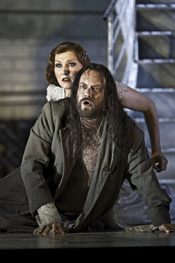 Johan Reuter as Jokanaan and Angela Denoke as Salome
There is something to be said, I suppose, for the transformation of Herod and Herodias into comic characters, though there was perhaps a little too much of the world of the sitcom to their behaviour. More fundamentally, I remain unsure why the work was updated to the inter-war years 1920s: not that I have any specific objection to it, but little was made of it, beyond perhaps the sense of a violent society — but what society is not? — and the still-problematical caricaturing of the Jews. Wilde, Hedwig Lachmann, and Strauss really do not need any help in that regard. McVicar’s Dance of the Seven Veils witnessed second time around was no surprise, but it remains perverse. Salome gains clothes rather than lose them, as she appears to relive her childhood with the suggestion of Herod as her abuser. Es Devlin’s set retains its striking appeal, the split-level ‘upstairs-downstairs’ arrangement providing glimpses of the Tetrarch’s dinner party proceeding above, until the guests repair below — somewhat oddly, given the distinctly unglamorous nature of the basement. The costumes are generally equally striking, not least in the case of the typical McVicar array of extras: the guests and various household functionaries, including an array of pretty waiters in tight uniforms. And then there is Naaman, the executioner, whom McVicar has transformed into a principal — though necessarily dumb — character, played once again by the muscular street entertainer from Covent Garden market, Duncan Meadows. I have yet to be enlightened as to why he would have stripped off whilst down in the cistern, but his bloodstained reappearance doubtless titillated some. There was quite a bit of casual nudity elsewhere but the only truly erotic moment was that of Salome’s fatal kiss, which certainly retained its horror, and rightly so.
Hartmut Haenchen’s account of the score took a while to get going; I seem to recall a similar trajectory when I heard him conduct Salome a few years ago in Paris. However, after the first half an hour or so, he captured a fine balance between demands of the dance and colouristic fantasy. The orchestra was on fine form after a slight initial thinness of tone, strings gleaming as if instantiating the jewels with which the Tetrarch vainly tries to pay off Herodias’s daughter.
Angela Denoke put up a valiant attempt in that role. She paid commendable attention to the words, give or take a few peculiar consonants, but lacked the sheer physicality of Nadja Michael in 2008. Denoke appears a little too much the elegant woman of a certain age. Moreover, the more extreme demands placed upon her by Strauss found this Salome almost as severely parted as her predecessor, albeit closer to the prescribed pitches. McVicar’s conception of Jokanaan — a ‘Beckettian tramp soaked in sewage’ — does not assist a singer’s assumption of the role, but Johan Reuter proved a worthy successor to Michael Volle, providing an aptly lumbering physical presence, expressed through his voice as much as his acts. Gerhard Siegel and Irina Mishura impressed in their way as the Herods, amusing if not necessarily regal. Andrew Staples presented a credibly sympathetic portrayal of Narraboth, who is after all the only sympathetic character in the drama, though memories of Joseph Kaiser last time around were undimmed. Smaller parts were generally well taken, the chattering Jews especially — whatever resultant discomfort one might feel.
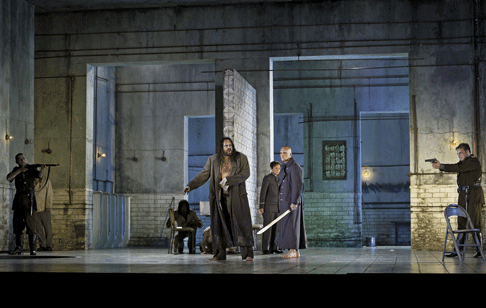 From Left to Right: Nicolas Courjal as First Soldier, Johan Reuter as Jokanaan, Sarah Castle as Page Of Herodias, Duncan Meadows as Naaman and Andrew Staples as Narraboth
If there was something of an end-of-term feeling to this revival, which comprises but five performances, everything was commendably professional. Ultimately, however, I do not feel that the production gets to the heart — if heart Salome has — of the work. I remain hopeful that Harry Kupfer’s stunning production for the Staatsoper Unter den Linden will see the light of day on DVD. In the meantime, there is amusement to be had here.
Mark Berry