Were I to be able to fiddle with the nominees to the New Seven Wonders of the World, Bryn Terfel’s overwhelming performance as Hans Sachs would easily crowd out such also-ran’s as Iguassu Falls or the Great Barrier Reef, though every bit as much a force of nature. Simply put, I cannot imagine anyone in the opera’s history has ever sung this tour-de-force part better. I know Bryn has quite wrecked me for anyone else in this role. Ever. It is not hard to say why.
He is possessed of one of the greatest bass-baritone voices on the operatic roster today, characterized by the familiar easy production, amazing resonance, incredible beauty, richness of tone, subtlety of delivery, immaculate diction, reserves of power, and awesome stamina. Even at five and a half hours into the evening, he arrived at the final pontificating proclamation sounding so fresh it seemed like he could do it all over again. Mr. Terfel is also an unaffected, winning actor, one moment prankish and charming, the next effectively communicating the cobbler’s deeply internalized human concerns and disappointments. The great “Wahn” monologue was heart-breaking in its intensity, immaculate in its vocalization. Uniquely gifted and undaunted by the challenges, Terfel relished every moment in one of the lyric theatre’s most demanding assignments.
As towering as his achievement was, I can happily report that WNO miraculously peopled this Meistersinger with a cast of equals. Christopher Purves was an ideal Beckmesser, imbuing the character with good doses of pomposity to be sure, but balancing that with a truly diversified emotional palette that went well beyond the boorish posturing oft-seen in lesser hands. Mr. Purves is also possessed of a gleaming, responsive baritone capable of pinging declarations as well as smoothly phrased lyrical passages. And he is an accomplished comic actor, never-overplaying but willing to do anything. Having been beat up the night before, and wearing shoes that pinch, his Act III entrance into Sachs shop was a marvel of sustained physical humor. I will not soon forget him stepping up into the room oh-so-carefully and then somehow getting caught in a goofy spin and a sudden pratfall as he closed the door. (A bit that was repeated later to equal guffaws when he mounted the grandstand to sing his contest entry). And. . .and. . .alone in the cobbler studio, he checked out the bruise he sustained on his hip, at the same time he “unawares” fully bared his butt to the audience. Laugh out loud funny. Purves is the best Beckmesser of my experience, surpassing even the beloved Hermann Prey.
Lovely Amanda Roocroft achieved the difficult feat of looking and acting like a very believable young girl, while capably singing with enough of an experienced jugend-dramatisch thrust to her well-schooled soprano to make for a highly enjoyable and plausible Eva. She was utterly ingratiating and sympathetic, not only in her growing feeling for Walther but in her obvious love for Hans Sachs. Anna Burford sported a dark-hued mezzo that delivered wonderful results as Magdalene, complementing while contrasting Ms. Roocroft’s brighter production. Andrew Tortise gave us a perky, boyish, pleasingly annoying David, and I especially liked the moments when his sweet-toned tenor settled down for some shining mezzo forte singing. Mr. Tortise nailed the part to be sure, but I thought the tone took on a harder edge than necessary when pushed at the top. Perhaps a bit less histrionic abandon would keep the bloom in the upper register. Raymond Very also presented a very good case for Walther von Stolzing. He cuts a fine figure on stage as the impassioned youth, and displays a commendable understanding of the young man’s dramatic journey. While his instrument may lack the dark warmth of Kauffmann or the lyric spin of Heppner, Very nonetheless scored all the major moments and commanded his somewhat steely resources very credibly.
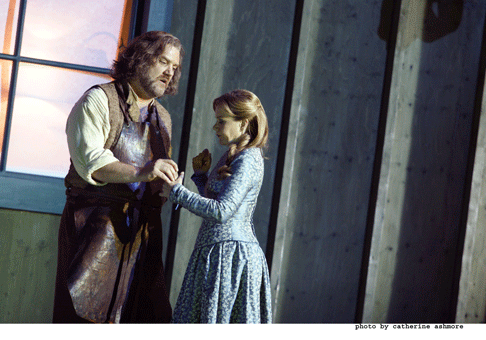 Bryn Terfel as Hans Sachs and Amanda Roocroft as Eva
All of the Masters were securely presented, with accomplished singing and assured acting from a diverse roster of performers so fine they deserve to be knows more widely (see cast list below). Brindley Sherratt must be singled out for his tremendous achievement as Veit Pogner. Mr. Sherratt has a bass-baritone of enjoyable timbre and considerable power, which he deploys with great security as well as sensitivity. His prowess in the role suggests that he, too, may have a fine Sachs within him. I was also mightily impressed by the gorgeously intoned phrases from David Soar’s Nightwatchman.
Conductor Lothar Koenigs worked musical wonders with the mass of accomplished musicians in the pit, leading with sweep and abandon. Ocassionally, a wee too much ‘abandon:’ Ms. Roocroft was somewhat challenged on “O Sachs! Mein Freund”. But such moments were momentary compared to the glories of the orchestral detail that Koenigs revealed, especially the fleet footed comic touches of the dancing winds. Maestro Koenigs managed a real partnership with the voices and struck a good balance while still reveling in Wagner’s scoring. As one might expect in Wales, the choral singing under Stephen Harris was of the highest rank, surpassing even the much-lauded Bayreuth standard.
With this spot-on, straight-to-the-heart-of-the-matter realization of Die Meistersinger, Richard Jones has helmed an absolute theatrical triumph. Past experiences with Jones left me thinking he we was a gifted if challenging director, often in your face, sometimes maddeningly provocative as he diddles around the edges of a piece trying (often successfully) to illuminate the dramatic truth. I usually admired the ‘parts’ if not the ‘sum.’ Here he is in total focused control of not only the best Meistersinger I have ever seen, but one of the best opera productions I have ever seen.
There is a quiet quirkiness going on to be sure with the evocative and highly functional set designs by Paul Steinberg. The tone is perfectly set by the vibrant show curtain, featuring a collage of likenesses (mostly head shots) that fill the proscenium with of a vast array of brilliant German (or German-speaking) artists from the country’s history: Bach, Goethe, von Karajan, Marlene, Mozart, Ruth Berghaus, Brecht, Schwarzkopf. . .and on and on. This opens to a clean, lean church with a hunter green, paneled back wall, the congregation facing off right seated on stylized green benches perpendicular to the audience. This space proved amazingly adaptable to the various clever ideas the production team devised.
Apprentices soon hung the back wall with portraits of the Masters by inserting them in ridges in the back paneling. A red clothes Schrank was rolled on for each Master, painted outside with graphics/figures that illustrated the ‘song criteria’ what David was enumerating. These same delightful cartoonish graphics were reproduced in rows on the scoring ‘Tafel.’ As they were positioned in a welcoming semi-circle, they revealed the contents of the mini-closets: lavish period Masters robes designed by the supremely talented costumer Buki Shiff whose well-judged creations went from strength to strength.
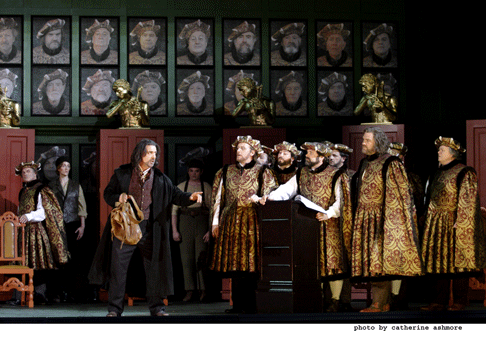 Raymond Very as Walther, Brindley Sherratt as Pogner, Bryn Terfel as Hans Sachs and WNO Cast
Within this milieu, Jones created some masterful blocking of both scenery and actors, witness the initial exchange between Walther and Eva, delightfully broken up with Magdalene’s perfectly timed interruptions as she deftly made her way around the stage looking for the ‘lost’ broach/scarf/book like a well-tuned mine-sweeper. The invention of one of the Masters as a doddering old man, always just a few beats behind the action was, well, Master-fully repeated just enough to be increasingly funny over the evening. Just when you had forgotten about him, he would be revealed, once more having been left in the dust and having to catch up like Arte Johnson’s geezer on Laugh-In.
The plain look of the exterior of Sach’s humble cobbler shop which filled stage center was well contrasted by Pogner’s well-to-do half-timbered house sitting down right flanked by an impressive tree. A cheeky contemporary touch was added with the colorful stylized projections that created flowered roofs, and the matching flower backdrop -- a retro nod to the 60’s. Thanks to Mimi Jordan Sherin for so many effective lighting effects, always shifting to reflect the correct mood, or to focus our attention right where it should be.
I think that Richard Jones succeeded so magnificently where others fail in that he never lost sight of the fact that this is a comedy. When Walther sings of being intimidated by the Masters, lo and behold three extras cross in full Masters drag, their heads covered with cubes bearing the cartoon ‘criteria’ and wagging a stick of chalk. A moment of inspired madness worthy of Bill Irwin. In a spontaneous moment, Sachs suddenly breaks into a daffy Schuhplatten dance, and why not? He’s having a good time. The nightwear for the big choral finish and street fight was all funky white fun, and the mob not only assaults Beckmesser, they strip him to his shorts leaving him to cover his genitalia with his lute (placed rather suggestively).
The stage-filling interior of Sachs shop/house is meticulously dressed as well as any set I have ever seen. No piece of furnishing, no prop, no element of this environment was left to chance. This was loving attention to detail. The curtain rose in silence on Act III with the streaming sunlight awakening Sachs from the sofa/bed where we get the impression he has fallen asleep and just never moved to the bedroom. Later a revelatory piece of business has him picking up three emptied beer bottles from the floor by the sofa and puts them on a side shelf. And, we get it. What volumes that spoke.
In that simple gesture is revealed another insight into our hero than we ever had before. Thank you, Mr. Jones. Thank you, Mr. Terfel.
When Sachs, at his desk, takes ‘dictation’ of the Prize Song, he rises and clothespins five separate sheets on a clothesline stretching above the sofa.
He collects them back, of course and allows Beckmesser to take them, but later when he christens the tune “Morning Dream Song”, that too gets posted on the line and as the five soloists sat variously and regarded the paper, and Ms. Sherin’s lighting picked out the singers and the song, and they launched into arguably the most glorious pages of the score, well, time was indeed suspended. A luminous quintet in every way.
The festive last act was perhaps the most predictable, although no less enjoyable. There was clever business with a self-important local noble woman serving as a sort of county fair judge, who apportioned blue ribbons for shoes, embroidered panels, and pretzels as the appropriate guilds sang and made their presence known. The large green grandstand upstage was colorfully festooned with flowers and the like, and it provided a straight forward playing space. But the team had one more trick up its sleeve.
Just as Sachs began his last (to some, controversial) monologue, one by one the chorus stood and held up a placard with one of the likenesses from the show curtain. Here Brahms. There Ludwig II. Now Handel. And another. And another. Until finally, the cast had recreated the show curtain, a sea of placards held chest level, with each singer pointing to their placard on the final chord as if to say: ‘German culture, how cool is that?’
Overwhelming. Brilliant. Towering. I think Wagner himself would have loved it. And if he didn’t. . .to hell with him!
James Sohre
Click here to download trailer (iPod).
![Bryn Terfel as Hans Sachs [Photo by Catherine Ashmore courtesy of Welsh National Opera]](http://www.operatoday.com/Terfel_Meistersinger_WNO_20.gif)