Subscribe to
Opera Today

Receive articles and news via RSS feeds or email subscription.


twitter_logo[1].gif


UCP_9780226043425.gif

Recently in Performances

Wozzeck at ENO

“Man is an abyss. It makes one dizzy to look into it.” So utters Georg Büchner’s Woyzeck, repeating what was also a recurring motif in the playwright’s own letters.

Mulhouse: Rare Britten Well Done

National Opera Company of the Rhine has marked this year’s Benjamin Britten celebration with a remarkably compelling, often gripping new production of the seldom-seen Owen Wingrave.

Frankfurt's Intriguing Idomeneo

Once upon a time, Frankfurt Opera had the baddest ass reputation in Germany as “the” cutting edge producer of must-see opera.

Rigoletto at Lyric Opera of Chicago

Productions of Giuseppe Verdi’s Rigoletto can serve as a vehicle for individual singers to make a strong impression and become afterward associated with specific roles in the opera.

Britten Sinfonia with Ian Bostridge

Just in case we were not aware that the evening’s programme was ‘themed’, the Britten Sinfonia designed a visual accompaniment to their musical exploration of night, sleep and dreams.

Aida, Manitoba Opera

Poor Aida! She never seems to have anything go her way.

Superlative singing: Don Carlo, Royal Opera House

Is it possible to upstage Jonas Kaufmann? Kaufmann was brilliant in this Verdi Don Carlo at the Royal Opera House, London, but the rest of the cast was so good that he was but first among equals. Don Carlo is a vehicle for stars, but this time the stars were everyone on stage and in the pit. Even the solo arias, glorious as they are, grow organically out of perfect ensemble. This was a performance that brought out the true beauty of Verdi's music.

Sarah Connolly: French Song at Wigmore Hall

The big names were absent: Duparc, D’Indy, Debussy, Ravel … and while Fauré, Chausson, Roussel and several members of Les Six put in an appearance, in less than familiar guises, this survey of French song of the early 20th century and interwar years deliberately took us on a journey through infrequently travelled terrain.

Rare restoration: Handel’s Esther 1720

Composed between 1718 and 1720, Handel’s Esther is sometimes described as the ‘first English Oratorio’, but is in fact a hybrid form, mixing elements of oratorio, masque, pastoral and opera.

The Damnation of Faust, London

Hector Berlioz's légende dramatique, La Damnation de Faust, exists somewhere between cantata and opera. Berlioz's flexible attitude to dramatic form made the piece unworkable on the stages of early 19th century Paris and his music is so vivid that you wonder whether the piece needs staging at all.

Elizabeth Connell Memorial Concert, St John's Smith Square

St. John’s Smith Square was the site of Elizabeth Connell’s final London concert, intended as a farewell to London on her moving to Australia. It was rendered ultimately final by her unexpected death.

Aida with all the Trimmings, Even a Blue Silk Elephant!

With the building of the Suez Canal, Egypt became more interesting to Western Europeans. Khedive Ismail Pasha wanted a hymn by Verdi for the opening of a new opera house in Cairo, but the composer said he did not write occasional pieces.

Die Zauberflöte, Royal Opera

Back for its fourth revival, David McVicar’s 2003 production of Mozart’s Die Zauberflöte has much charm, beauty and artistry.

The Marriage of Figaro Ends Season at Arizona Opera

Wolfgang Amadeus Mozart's opera The Marriage of Figaro has a libretto by Lorenzo daPonte based on the French play La folle journée, ou le Mariage de Figaro (The Crazy Day or the Marriage of Figaro) by Pierre Caron de Beaumarchais (1732-1799).

Baden’s Flute Goes Barefoot in the Park

For its world class Easter Festival, Baden-Baden mounted a Die Zauberflöte that owed more to the grey penitential doldrums of Lent than to the unbridled jubilance of re-birth.

Bonjour M. Gauguin in Berkeley

Once Berkeley Opera, renamed West Edge Opera, this enterprising company offers the Bay Area’s only serious alternative to corporate opera, to wit Bonjour M. Gauguin.

Mahler Lieder, Wigmore Hall

In the first of pianist Julius Drake’s three-part series, ‘Perspectives’, our gaze was directed at Gustav Mahler’s eclectic musical responses to human experiences: from the trauma and distress of anguished love to the sweet contentment of true friendship, from the agonised introspection of the artist to the diverse dramas of human interaction.

Cinderella Goes to the Opera

The Los Angeles opera company marketed its spring production of Rossini's La Cenerentola as Cinderella though there is no opera by that name. The libretto of La Cenerentola is not the Cinderella story we know.

Die Walküre, Paris

The Paris Opéra has not staged a full Ring Cycle since 1957, but its current season will conclude with a correction of this grand operatic gap.

Manon Lescaut, Washington National Opera

Washington National’s 2012-2013 season continues this spring with a production of Giacomo Puccini’s first successful opera.

OPERA TODAY ARCHIVES »

Performances

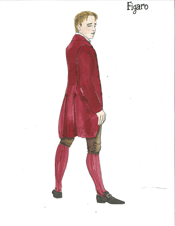
Sketch of Figaro by Marina Reti courtesy of the Aspen Opera Theater Center
24 Aug 2010

Aspen makes Corigliano’s Ghosts classic

When it debuted at the Met in 1991 John Corigliano’s overwrought and somewhat all-too comic Ghosts of Versailles was praised largely as a vehicle for the long-celebrated artistry of Teresa Stratas and Marilyn Horne.

John Corigliano: Ghosts of Versailles

Aspen Music Festival 2010

Photos by Alex Irvin courtesy of Aspen Opera Theater Center


The Met production journeyed to the Chicago Lyric — and then the work disappeared. Happily, Ghosts returned to life a year ago when John David Earnest’ s revised and trimmed-down version was premiered by the St. Louis Opera Theater and then exported to Ireland for the festive opening of a new house in Wexford.

Still scored, however, for 60 singers and a full-sized orchestra, the demands made by Ghosts places the work beyond the reach of many professional companies, while making it a field day for student opera enterprises. Northwestern University staged the work last season, and a third totally new production by the Aspen Opera Theatre Center brought down the certain on the 63rd season of one of the nation’s major summer festivals late in August. Edward Berkeley, Juilliard mentor who has directed the Aspen Center for three decades, built the 2011 season around the figure of Figaro. Ghosts was preceded by both Rossini’s Barber of Seville and Mozart’s Marriage of Figaro, the first two parts of Pierre Beaumarchais’ 18th-century account of the Almavivas. (Northwestern staged the same “trilogy” during its past season.)

Ghosts fits a festival well,” said Berkeley, who directed the production, seen on August 19 in Aspen’s historic Wheeler Opera House. “And in this context it gave students a look at how different composers treat the same group of characters.” “It also gave our audience a chance to compare how they have used the same material.”

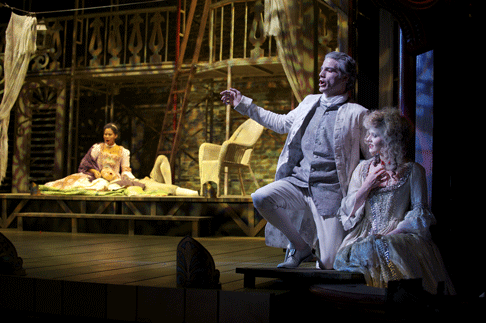
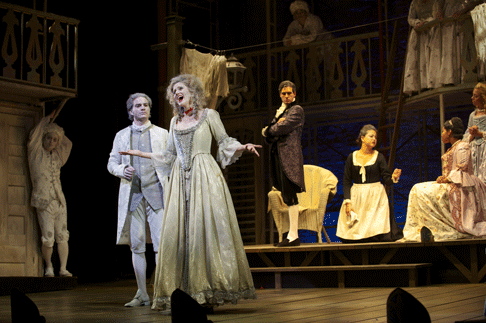
Although the reduced version — with a single intermission it runs slightly less than three hours — contains enough plot and calls for singers sufficient for three operas, the Aspen staging made clear that Ghosts is a success now worthy of entering the standard repertory. The central figure of the story is Marie Antoinette, who 200 years after she was beheaded in the French Revolution, wants to return to life. In an opera-within-an opera the story moves back to 1793 and offers a complex picture of the Almaviva family, familiar from Rossini and Mozart.
_AIP2614.gif

For the libretto William M. Hoffman relied heavily on The Guilty Mother, the third part of Beaumarchais’s Figaro trilogy. But instead of merely re-writing the story Beaumarchais, author the original, becomes the central figure of Ghosts — author, director and major figure of the inner opera, in which he and the late Empress fall in love. Although it is still more opera than can be absorbed in a single performance, Ghosts is now effective and often moving theater. (Small wonder that one heard voices in the Aspen audience express the wish to see the work again.)

Top vocal honors in Aspen went to South-African soprano Golda Schultz, now a student at Juilliard, who sang Rosina. Her tender duet with Korean mezzo Chorong Kim, now — as Beaumarchais tells it — the loving father of Léon, was the highlight of the Aspen staging. As Beaumarchais, the man who makes everything move in Ghosts, tall and lean bass-baritone Andreas Aroditis, a further Juilliard student, was amazingly adept and versatile. Christin Wismann, cover for the role in St. Louis and a member of the supporting cast in Wexford, was a delicately tragic Marie Antoinette, an ideal object for Beaumarchais’ affection. As ill-intentioned Begéarss Julius Ahn, a regular with Boston Lyric Opera, was delightfully malicious in his Aspen debut. David Williams, a recent studio artist with Berlin’s Komische Oper, left one with a strong desire to hear him as the “real” Figaro, the role that he sang with such professional aplomb in the Aspen Ghosts. And Aspen provided him with a vivacious Susanna in Kim Sogioka, a mezzo with impressive credentials in the oratorio world. Tenor Michael Kelly, highly regarded as a song recitalist, sang an aristocratic — if dissolute — Count Almaviva, while Lauren Snouffer was thoroughly engaging as his illegitimate daughter Florestine.

Major credit for the success of Aspen’s Ghosts goes, however, to Michael Christie, who conducted both the St. Louis and Wexford performances of the revised score. Still in his mid-’30s Christie, now music director of the Phoenix Symphony, began his career as assistant to Franz Welser-Möst at the Zurich Opera. Earlier in the summer he identified himself as a future Wagnerian of promise in a concert with Jane Eaglen at the Colorado Music Festival in Boulder.
_AIP2705.gif

Conducting an orchestra that overflowed into the Wheeler Green Room, Christie’s total command of the score was impressive; he further showed that rare balance of concern for both singers and ensemble under his command. Handsome — and ghost-like — sets were by John Kasarda; lavish period costumes were the work of Marina Reti.

Finally, Ghosts could profit from further reduction. If excised, the entire scene built around Samira, the hoochie-cochie dancer at the Turkish embassy bash, would not be missed — even if this was the role on which Marilyn Horne squandered her talent at the Met.

Wes Blomster
Send to a friend

Send a link to this article to a friend with an optional message.

Friend's Email Address: (required)

Your Email Address: (required)

Message (optional):