Recently in Performances
English Touring Opera are delighted to announce a season of lyric monodramas to tour nationally from October to December. The season features music for solo singer and piano by Argento, Britten, Tippett and Shostakovich with a bold and inventive approach to making opera during social distancing.
This tenth of ten Live from London concerts was in fact a recorded live performance from California. It was no less enjoyable for that, and it was also uplifting to learn that this wasn’t in fact the ‘last’ LfL event that we will be able to enjoy, courtesy of VOCES8 and their fellow vocal ensembles (more below …).
Ever since Wigmore Hall announced their superb series of autumn concerts, all streamed live and available free of charge, I’d been looking forward to this song recital by Ian Bostridge and Imogen Cooper.
Although Stile Antico’s programme article for their Live from London recital introduced their selection from the many treasures of the English Renaissance in the context of the theological debates and upheavals of the Tudor and Elizabethan years, their performance was more evocative of private chamber music than of public liturgy.
Evidently, face masks don’t stifle appreciative “Bravo!”s. And, reducing audience numbers doesn’t lower the volume of such acclamations. For, the audience at Wigmore Hall gave soprano Elizabeth Llewellyn and pianist Simon Lepper a greatly deserved warm reception and hearty response following this lunchtime recital of late-Romantic song.
For this week’s Live from London vocal recital we moved from the home of VOCES8, St Anne and St Agnes in the City of London, to Kings Place, where The Sixteen - who have been associate artists at the venue for some time - presented a programme of music and words bound together by the theme of ‘reflection’.
'Such is your divine Disposation that both you excellently understand, and royally entertaine the Exercise of Musicke.’
‘And there was war in heaven: Michael and his angels fought against the dragon; and the dragon fought and his angels, And prevailed not; neither was their place found any more in heaven … that old serpent … Satan, which deceiveth the whole world: he was cast out into the earth, and his angels were cast out with him.’
There was never any doubt that the fifth of the twelve Met Stars Live in Concert broadcasts was going to be a palpably intense and vivid event, as well as a musically stunning and theatrically enervating experience.
‘Love’ was the theme for this Live from London performance by Apollo5. Given the complexity and diversity of that human emotion, and Apollo5’s reputation for versatility and diverse repertoire, ranging from Renaissance choral music to jazz, from contemporary classical works to popular song, it was no surprise that their programme spanned 500 years and several musical styles.
The Academy of St Martin in the Fields have titled their autumn series of eight concerts - which are taking place at 5pm and 7.30pm on two Saturdays each month at their home venue in Trafalgar Square, and being filmed for streaming the following Thursday - ‘re:connect’.
The London Symphony Orchestra opened their Autumn 2020 season with a homage to Oliver Knussen, who died at the age of 66 in July 2018. The programme traced a national musical lineage through the twentieth century, from Britten to Knussen, on to Mark-Anthony Turnage, and entwining the LSO and Rattle too.
With the Live from London digital vocal festival entering the second half of the series, the festival’s host, VOCES8, returned to their home at St Annes and St Agnes in the City of London to present a sequence of ‘Choral Dances’ - vocal music inspired by dance, embracing diverse genres from the Renaissance madrigal to swing jazz.
Just a few unison string wriggles from the opening of Mozart’s overture to Le nozze di Figaro are enough to make any opera-lover perch on the edge of their seat, in excited anticipation of the drama in music to come, so there could be no other curtain-raiser for this Gala Concert at the Royal Opera House, the latest instalment from ‘their House’ to ‘our houses’.
"Before the ending of the day, creator of all things, we pray that, with your accustomed mercy, you may watch over us."
The doors at The Metropolitan Opera will not open to live audiences until 2021 at the earliest, and the likelihood of normal operatic life resuming in cities around the world looks but a distant dream at present. But, while we may not be invited from our homes into the opera house for some time yet, with its free daily screenings of past productions and its pay-per-view Met Stars Live in Concert series, the Met continues to bring opera into our homes.
Music-making at this year’s Grange Festival Opera may have fallen silent in June and July, but the country house and extensive grounds of The Grange provided an ideal setting for a weekend of twelve specially conceived ‘promenade’ performances encompassing music and dance.
There’s a “slide of harmony” and “all the bones leave your body at that moment and you collapse to the floor, it’s so extraordinary.”
“Music for a while, shall all your cares beguile.”
The hum of bees rising from myriad scented blooms; gentle strains of birdsong; the cheerful chatter of picnickers beside a still lake; decorous thwacks of leather on willow; song and music floating through the warm evening air.
Performances
![Andrea Concetti as Moses [Photo by Liz Lauren courtesy of Chicago Opera Theater]](http://www.operatoday.com/Moses_COT_Photo-3.gif)
11 Aug 2010
Rossini’s Mosè in Egitto at Chicago Opera Theater
Although productions of Gioachino Rossini’s Mosè in Egitto
are infrequent, the lively debate on successive versions of the work has
generally led to questions of priority and to informative discussions on
performance history.
For the first opera during its Spring 2010 season Chicago
Opera Theater staged a production based on the new critical edition of
Mosè by Charles S. and Patricia B. Brauner. As Philip M. Gossett
indicates in his notes accompanying the program for this production, the
Italian Mosè, originally performed in Naples, “is a work of
great value” which “contains some of Rossini’s finest
music.” The present production, with strong vocal contributions from a
convincing cast, gave ample support to these statements.
Under the direction of Leonardo Vordoni the brief orchestral prelude set a
tone both stately and somber, in which the distraught court of the Pharaoh and
the plight of Moses and his people are alternately depicted. Darkness has
fallen over the land, and Faraone determines to free the camp of Moses in order
to release Egypt from such a plague. When he sends for Moses and makes known
his intention, the captive leader calls out to God and, with the gesture of his
staff, causes light to return to the land. The two opposing leaders were sung
by bass-baritone Tom Corbell as Faraone and bass Andrea Concetti as Mosè. Mr.
Corbell showed admirable facility in his delivery of rapid notes whereas Mr.
Concetti struck an imposing figure with declamatory weight in his delivery of
Mosè’s opening lines. In the ensemble showing varied reactions to this
change, brought about by Mosè, Faraone and his consort Amaltea are joined by
the Egyptian heir and Prince Osiride along with Aronne, the compatriot of Mosè.
Faraone declares that the Hebrews will, in return for this gesture, be set free
and Amaltea supports the decision. Corbell as Faraone was joined in his florid
statement with the equally challenging line composed for Amaltea, here sung
admirably by Kathryn Leemhuis, a member of the Ryan Opera Center at Lyric Opera
of Chicago. Leemhuis gave a strong individual impression in her careful
decoration yet blended with the others to yield a memorable and dramatic
ensemble. The final lead member featured in this group was the Osiride of
Taylor Stayton. Mr. Stayton shows great promise as a tenor able to project with
dramatic lyricism the challenging dramatic line featured in this and comparable
pieces by Rossini. Here Osiride expresses his disagreement concerning the
release of the Hebrews, since his secret beloved Elcia is one of the people of
Mosè, now scheduled to depart in freedom.
After the others leave, Osiride plots with the high priest Mambre and
suggests that the latter use his powers to sow discord once again between Mosè
and Faraone. Elcia now joins her lover Osiride in order to bid farewell as she
expects to leave Egypt with Mosè. In their moving duet Siân Davies sang the
part of Elcia with great urgency and proved to be an appropriate match for Mr.
Stayton’s compelling depiction of the Egyptian prince. Upon the exciting
conclusion to their duet, Amaltea appears and chides Mambre for his attempts to
dissuade Faraone from releasing the Hebrews. Her words go unheeded, for
Osiride’s plan has succeeded, Faraone declares his decision revoked, and
the Hebrews feel themselves betrayed. At the close of the act Mosè invites
further storms to fall upon the land of Egypt.
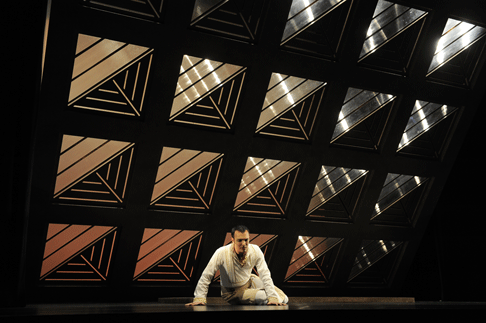 Taylor Stayton as Osiride
After an intermission, Acts II and III were performed without pause in this
production by Chicago Opera Theater. Attempts to resolve the imprisonment of
the Hebrews are fueled by Amaltea’s independent negotiations with Mosè.
At the same time Faraone resolves to marry off Osiride to an Armenian princess
and to proclaim him co-ruler of Egypt. The dismay of Osiride was expressed in
Stayton’s fervent delivery, in which he maintained hopes still to retain
Elcia’s love. When the latter enters among the imprisoned Hebrews, she
advised Osiride to seek an equivalent love in his official betrothed. Ms.
Davies’ moving expressiveness and exquisitely secure pitch in this aria
remained one of the highlights of the performance. Osiride then threatens
violence to Mosè but he is, instead, struck dead by a lightning bolt; as the
act concludes, both Faraone and Elcia mourn his loss.
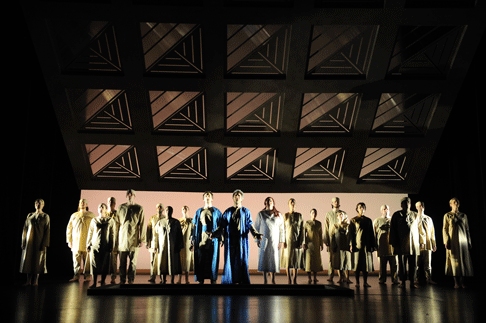 Jorge Prego as Aronne, Andrea Concetti as Moses and Siân Davies as Elcia with the Israelites
In the brief Act III on the banks of the Red Sea the famous prayer delivered
by Mosè calms his people, who fear that they will be sacrificed to the anger of
Faraone’s troops. Elcia is encouraged to continue her journey with the
other Hebrews. In this Mr. Concetti as Mosè delivered a fervent declamation in
the concluding piece of the opera. The Red Sea parts and his people cross, just
as Faraone and the high priest are swallowed up as they attempt to pursue. The
dramatic moment received an appropriately conclusive orchestral flourish.
Salvatore Calomino