![Stéphane Degout as Guglielmo and Jurgita Adamonytė as Dorabella [Photo by Mike Hoban]](http://www.operatoday.com/COSI-9990_1778-DEGOUT-ASGUG.gif)
13 Sep 2010
Così fan tutte, Royal Opera House
Everyone loves Mozart. The Royal Opera House's 2010-2011 season began with Così fan tutte, and simultaneous live international broadcast.
English Touring Opera are delighted to announce a season of lyric monodramas to tour nationally from October to December. The season features music for solo singer and piano by Argento, Britten, Tippett and Shostakovich with a bold and inventive approach to making opera during social distancing.
This tenth of ten Live from London concerts was in fact a recorded live performance from California. It was no less enjoyable for that, and it was also uplifting to learn that this wasn’t in fact the ‘last’ LfL event that we will be able to enjoy, courtesy of VOCES8 and their fellow vocal ensembles (more below …).
Ever since Wigmore Hall announced their superb series of autumn concerts, all streamed live and available free of charge, I’d been looking forward to this song recital by Ian Bostridge and Imogen Cooper.
The Sixteen continues its exploration of Henry Purcell’s Welcome Songs for Charles II. As with Robert King’s pioneering Purcell series begun over thirty years ago for Hyperion, Harry Christophers is recording two Welcome Songs per disc.
Although Stile Antico’s programme article for their Live from London recital introduced their selection from the many treasures of the English Renaissance in the context of the theological debates and upheavals of the Tudor and Elizabethan years, their performance was more evocative of private chamber music than of public liturgy.
In February this year, Albanian soprano Ermonela Jaho made a highly lauded debut recital at Wigmore Hall - a concert which both celebrated Opera Rara’s 50th anniversary and honoured the career of the Italian soprano Rosina Storchio (1872-1945), the star of verismo who created the title roles in Leoncavallo’s La bohème and Zazà, Mascagni’s Lodoletta and Puccini’s Madama Butterfly.
Evidently, face masks don’t stifle appreciative “Bravo!”s. And, reducing audience numbers doesn’t lower the volume of such acclamations. For, the audience at Wigmore Hall gave soprano Elizabeth Llewellyn and pianist Simon Lepper a greatly deserved warm reception and hearty response following this lunchtime recital of late-Romantic song.
Collapsology. Or, perhaps we should use the French word ‘Collapsologie’ because this is a transdisciplinary idea pretty much advocated by a series of French theorists - and apparently, mostly French theorists. It in essence focuses on the imminent collapse of modern society and all its layers - a series of escalating crises on a global scale: environmental, economic, geopolitical, governmental; the list is extensive.
For this week’s Live from London vocal recital we moved from the home of VOCES8, St Anne and St Agnes in the City of London, to Kings Place, where The Sixteen - who have been associate artists at the venue for some time - presented a programme of music and words bound together by the theme of ‘reflection’.
'Such is your divine Disposation that both you excellently understand, and royally entertaine the Exercise of Musicke.’
Amongst an avalanche of new Mahler recordings appearing at the moment (Das Lied von der Erde seems to be the most favoured, with three) this 1991 Mahler Second from the 2nd Kassel MahlerFest is one of the more interesting releases.
‘And there was war in heaven: Michael and his angels fought against the dragon; and the dragon fought and his angels, And prevailed not; neither was their place found any more in heaven … that old serpent … Satan, which deceiveth the whole world: he was cast out into the earth, and his angels were cast out with him.’
If there is one myth, it seems believed by some people today, that probably needs shattering it is that post-war recordings or performances of Wagner operas were always of exceptional quality. This 1949 Hamburg Tristan und Isolde is one of those recordings - though quite who is to blame for its many problems takes quite some unearthing.
There was never any doubt that the fifth of the twelve Met Stars Live in Concert broadcasts was going to be a palpably intense and vivid event, as well as a musically stunning and theatrically enervating experience.
‘Love’ was the theme for this Live from London performance by Apollo5. Given the complexity and diversity of that human emotion, and Apollo5’s reputation for versatility and diverse repertoire, ranging from Renaissance choral music to jazz, from contemporary classical works to popular song, it was no surprise that their programme spanned 500 years and several musical styles.
The Academy of St Martin in the Fields have titled their autumn series of eight concerts - which are taking place at 5pm and 7.30pm on two Saturdays each month at their home venue in Trafalgar Square, and being filmed for streaming the following Thursday - ‘re:connect’.
The London Symphony Orchestra opened their Autumn 2020 season with a homage to Oliver Knussen, who died at the age of 66 in July 2018. The programme traced a national musical lineage through the twentieth century, from Britten to Knussen, on to Mark-Anthony Turnage, and entwining the LSO and Rattle too.
With the Live from London digital vocal festival entering the second half of the series, the festival’s host, VOCES8, returned to their home at St Annes and St Agnes in the City of London to present a sequence of ‘Choral Dances’ - vocal music inspired by dance, embracing diverse genres from the Renaissance madrigal to swing jazz.
Just a few unison string wriggles from the opening of Mozart’s overture to Le nozze di Figaro are enough to make any opera-lover perch on the edge of their seat, in excited anticipation of the drama in music to come, so there could be no other curtain-raiser for this Gala Concert at the Royal Opera House, the latest instalment from ‘their House’ to ‘our houses’.
"Before the ending of the day, creator of all things, we pray that, with your accustomed mercy, you may watch over us."
Everyone loves Mozart. The Royal Opera House's 2010-2011 season began with Così fan tutte, and simultaneous live international broadcast.
Worldwide screenings are geared towards mass audiences, many of whom are new to opera. This production of Così fan tutte first heard in 1995 now in its seventh revival, was a safe choice.
Sir Thomas Allen’s presence guaranteed success. Like Don Alfonso, he’s a grandee, elevated above the common run. The lovers strut and fret their hour upon the stage, but Don Alfonso’s seen it all before. Allen has created Don Alfonso so many times that he has it down pat. Before the performance began, he sauntered on the Royal Opera House stage for some cheerful repartee. he’s a consummate charmer.
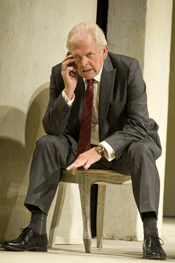 Thomas Allen as Don Alfonso
As Allen said, “I spend a lot of time sitting about”, since Don Alfonso’s a suave observer, who hardly needs to pulls strings to make puppets dance. The part makes no heroic vocal demands and suits Allen’s range well. He’s mellowed so well into the persona that his acting is effortless. At one point he calmly makes golf swings in the air, without a club.
Rebecca Evans as Despina made a perfect foil. She, too, has extensive experience in the role and in this production. If anything, she’s now in her prime. Wonderfully agile singing, full of verve. Her tiny frame pulsates energy. She zips about with much more vigour than her youthful mistresses. Diction and phrasing are sharp, her singing so vivid you could listen eyes closed and enjoy. When she comes in disguised in operating theatre greens, she has a mask over her face. Even before she starts to sing, her body language is so expressive it conveys personality.
Despina is a wonderful part but it isn’t the whole opera, and Evans can’t make up for the other performances which were adequate, rather than scintillating.
Maria Bengtsson and Jurgita Adamonytė resemble each other physically, and while their voices differ, neither is vocally as distinctive as might be. Adamonytė was impressive as Blanche in Prokofiev’s The Gambler at Covent Garden earlier this year, but her Dorabella, while sweetly formed, could use more individuality. Bengstsson’s Fiordiligi was more forcefully projected, dramatically sound, if lacking in nuance.
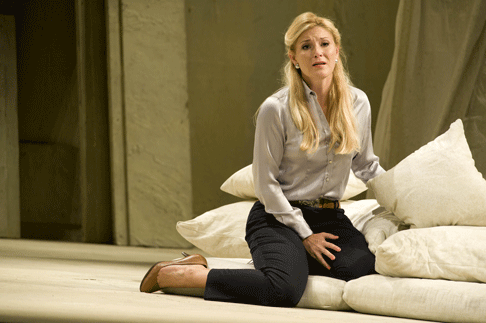 Maria Bengtsson as Fiordiligi
Neither Pavol Breslik’s Ferrando nor Stéphane Degout’s Guglielmo were specially engaging to listen to, so they were upstaged by their costumes. This is the production where the Albanians are dressed as Rockstars with bandanas and skull motif T shirts. At the premiere, this was shocking. Now it’s just corny, but in the absence of colour to listen to, it afforded some colour to look at.
Jonathan Miller’s production plays up the visual gags. Cell phones with camera applications, golf imagery, ultra-trendy costumes. This bland set looks like a caricature of “Regie” staging. It was probably more effective on film because the long flat horizontals on stage would have been foreshortened. Similarly, film would have allowed more detail than could be seen in the auditorium, enlivening the general lack of pace. Much of the action takes place off the stage. Perhaps Miller is trying to create the impression of “theatre-within-theatre” but it doesn’t work well live.
This is the sort of production gives minimalism a bad name, but unlike many where simplicity directs attention to the soul of the opera, this didn’t attempt to offer any insights. Its superficiality wouldn’t matter if the singing were uniformly impressive, but this wasn’t the case here.
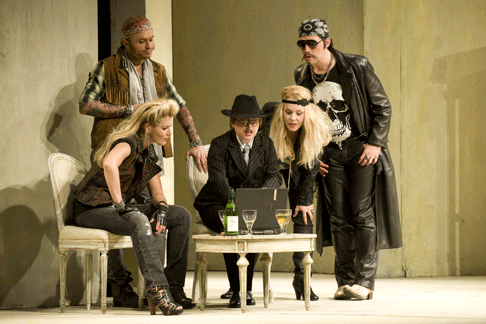 From Left to Right: Maria Bengtsson as Fiordiligi, Pavol Breslik as Ferrando, Rebecca Evans as Despina, Jurgita Adamonytė as Dorabella and Stéphane Degout as Guglielmo
Yet when Miller took his bows, he was wildly applauded. Perhaps this was because there was little tension in the ensemble, and the sharper edges of Mozart’s wit were blunted But Così fan tutte without challenge undersells Mozart. This is comedy, but not shallow. Nonetheless, jokes are entertaining. Here mobile phone tunes sang the message.
The real news this evening was Thomas Hengelbrock, the conductor. He cofounded the Freiburger Barockorchester.and later the Balthasar-Neumann Ensemble and Choir. Lively period instrument ensembles prove that historically-informed practice can be vigorous and modern in spirit.They can be very adventurous, experimenting with 19th and 20th century repertoire as well as baroque.
The Royal Opera House Orchestra isn’t a period orchestra, but Hengelbrock brings the vivacity for which he is famed. It’s ideal for Così fan tutte where timing and clarity are important. Excellent balance — the harpsichord continuo specially vivid. Hengelbrock will soon be conducting Agostino Steffani’s Niobe, Regina di Tebe at the Royal Opera House.
For more information, please visit the Royal Opera House website.
Anne Ozorio