![Íride Martinez as Norina and Barry Banks as Ernesto [Photo by Catherine Ashmore courtesy of the Royal Opera]](http://www.operatoday.com/DP_ROH_01_2010.png)
15 Sep 2010
Don Pasquale at the Royal Opera House
This show, a revival of Jonathan Miller’s 2004 production (first seen at the Maggio Musicale in Florence) is certainly a feast for the eyes.
English Touring Opera are delighted to announce a season of lyric monodramas to tour nationally from October to December. The season features music for solo singer and piano by Argento, Britten, Tippett and Shostakovich with a bold and inventive approach to making opera during social distancing.
This tenth of ten Live from London concerts was in fact a recorded live performance from California. It was no less enjoyable for that, and it was also uplifting to learn that this wasn’t in fact the ‘last’ LfL event that we will be able to enjoy, courtesy of VOCES8 and their fellow vocal ensembles (more below …).
Ever since Wigmore Hall announced their superb series of autumn concerts, all streamed live and available free of charge, I’d been looking forward to this song recital by Ian Bostridge and Imogen Cooper.
The Sixteen continues its exploration of Henry Purcell’s Welcome Songs for Charles II. As with Robert King’s pioneering Purcell series begun over thirty years ago for Hyperion, Harry Christophers is recording two Welcome Songs per disc.
Although Stile Antico’s programme article for their Live from London recital introduced their selection from the many treasures of the English Renaissance in the context of the theological debates and upheavals of the Tudor and Elizabethan years, their performance was more evocative of private chamber music than of public liturgy.
In February this year, Albanian soprano Ermonela Jaho made a highly lauded debut recital at Wigmore Hall - a concert which both celebrated Opera Rara’s 50th anniversary and honoured the career of the Italian soprano Rosina Storchio (1872-1945), the star of verismo who created the title roles in Leoncavallo’s La bohème and Zazà, Mascagni’s Lodoletta and Puccini’s Madama Butterfly.
Evidently, face masks don’t stifle appreciative “Bravo!”s. And, reducing audience numbers doesn’t lower the volume of such acclamations. For, the audience at Wigmore Hall gave soprano Elizabeth Llewellyn and pianist Simon Lepper a greatly deserved warm reception and hearty response following this lunchtime recital of late-Romantic song.
Collapsology. Or, perhaps we should use the French word ‘Collapsologie’ because this is a transdisciplinary idea pretty much advocated by a series of French theorists - and apparently, mostly French theorists. It in essence focuses on the imminent collapse of modern society and all its layers - a series of escalating crises on a global scale: environmental, economic, geopolitical, governmental; the list is extensive.
For this week’s Live from London vocal recital we moved from the home of VOCES8, St Anne and St Agnes in the City of London, to Kings Place, where The Sixteen - who have been associate artists at the venue for some time - presented a programme of music and words bound together by the theme of ‘reflection’.
'Such is your divine Disposation that both you excellently understand, and royally entertaine the Exercise of Musicke.’
Amongst an avalanche of new Mahler recordings appearing at the moment (Das Lied von der Erde seems to be the most favoured, with three) this 1991 Mahler Second from the 2nd Kassel MahlerFest is one of the more interesting releases.
‘And there was war in heaven: Michael and his angels fought against the dragon; and the dragon fought and his angels, And prevailed not; neither was their place found any more in heaven … that old serpent … Satan, which deceiveth the whole world: he was cast out into the earth, and his angels were cast out with him.’
If there is one myth, it seems believed by some people today, that probably needs shattering it is that post-war recordings or performances of Wagner operas were always of exceptional quality. This 1949 Hamburg Tristan und Isolde is one of those recordings - though quite who is to blame for its many problems takes quite some unearthing.
There was never any doubt that the fifth of the twelve Met Stars Live in Concert broadcasts was going to be a palpably intense and vivid event, as well as a musically stunning and theatrically enervating experience.
‘Love’ was the theme for this Live from London performance by Apollo5. Given the complexity and diversity of that human emotion, and Apollo5’s reputation for versatility and diverse repertoire, ranging from Renaissance choral music to jazz, from contemporary classical works to popular song, it was no surprise that their programme spanned 500 years and several musical styles.
The Academy of St Martin in the Fields have titled their autumn series of eight concerts - which are taking place at 5pm and 7.30pm on two Saturdays each month at their home venue in Trafalgar Square, and being filmed for streaming the following Thursday - ‘re:connect’.
The London Symphony Orchestra opened their Autumn 2020 season with a homage to Oliver Knussen, who died at the age of 66 in July 2018. The programme traced a national musical lineage through the twentieth century, from Britten to Knussen, on to Mark-Anthony Turnage, and entwining the LSO and Rattle too.
With the Live from London digital vocal festival entering the second half of the series, the festival’s host, VOCES8, returned to their home at St Annes and St Agnes in the City of London to present a sequence of ‘Choral Dances’ - vocal music inspired by dance, embracing diverse genres from the Renaissance madrigal to swing jazz.
Just a few unison string wriggles from the opening of Mozart’s overture to Le nozze di Figaro are enough to make any opera-lover perch on the edge of their seat, in excited anticipation of the drama in music to come, so there could be no other curtain-raiser for this Gala Concert at the Royal Opera House, the latest instalment from ‘their House’ to ‘our houses’.
"Before the ending of the day, creator of all things, we pray that, with your accustomed mercy, you may watch over us."
This show, a revival of Jonathan Miller’s 2004 production (first seen at the Maggio Musicale in Florence) is certainly a feast for the eyes.
Isabella Bywater beautifully realises Miller’s clever visual concept, presenting us with an exquisite reproduction of an eighteenth-century doll’s house, the façade of which is drawn back to reveal a realistic and immensely detailed interior — the connecting corridors, doors and stairwells are perfect for upstairs-downstairs intrigues and affairs. Bywater is alert to every minor detail, the only anachronism being the arrival of boxes from Versace, Prada, Escada and La Perla after Norina’s extravagant post-marriage spending spree. Costumes are similarly precise and elaborate, the characters dressed as elaborate mannequins, with whitened faces, and gowns and cloaks of gharish reds, purples and pinks.
Beyond its visual appeal, this set has one clear advantage: it can be seen clearly from all corners and heights of the auditorium — not something that could be boasted off all recent ROH productions. However, enclosing the action in a succession of tiny chambers, three-storeys high, does produce a rather ‘distanced’ result, and at times the singers, trapped in their cubicles, struggled to project over the orchestral fabric and to communicate directly with the audience. It is thus quite a relief when, in the closing moments, the protagonists venture into the garden; as the door of the doll’s house is closed, a reassuring air of reality is intimately; these are real characters after all, not puppets, although the artificial world is still visible through a narrow chink, and the genuinely tragic and comic sentiments of this human drama are never fully evoked.
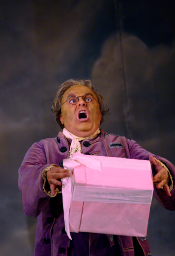 Paolo Gavanelli as Don Pasquale
As the eponymous old ogler, duped by his avaricious nephew, Paolo Gavanelli
huffed and puffed, stamped and pounded, frustrated and exasperated almost to
the point of self-combustion. While he hammed up the gags, Gavanelli’s
baritone is a little heavy and his portrayal would have benefitted from some
light buffo esprit — and from crisper diction. His patter-duet
with Dr Malatesta, sung by Jacques Imbrailo, is the high point of the comedy,
but it did not produce quite the excitement that it should, and was the wrong
sort of ‘breathless’.
Imbrailo was a confident, wry Malatesta — a Dulcimara with style. Among the two-dimensional stereotypes, he conveyed a naturalism and credibility, sang with clear diction, and balanced lyricism with dramatic singing. A recent graduate of the Jette Parker Young Artist scheme, he’s one to watch.
Barry Banks, as Ernesto, was reportedly afflicted with an allergic reaction; his high, ringing tenor was a little unyielding at times, but, while he did not attain a truly Italianate bel canto lyricism, his voice has a freshness and focus which added vigour to a foppish role.
Making her house debut, Íride Martínez initially appeared somewhat nervous. This Norina was rather shrill and uncomfortable, but Martínez relaxed as the evening progressed and had no difficulty spanning the vocal compass of the role, or dispatching the coloratura demands of the final act. She revealed a sure sense of comic timing and gradually began to enjoy herself, metamorphosing from sweet young bride to scathing harridan.
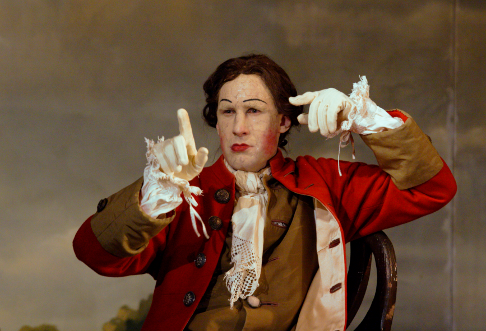 Jacques Imbrailo as Doctor Malatesta
The chorus have little to do musically until Act 3, but they kept themselves busy, dusting, cooking, gossiping…at times all this activity was a little distracting. When they did get the opportunity to sing, however, they produced an exciting, invigorated ensemble sound.
Perhaps sensing that the cast were rather constricted by the staging, Evelino Pidò injected some movement and fizz in the pit; tempi were pacy, textures were clear — there was some exquisite woodwind playing — and the accompanying patterns were energetic and light-footed.
Overall, the performances were solid but for this listener the parts did not add up to a totally convincing whole. Most unsettling of all, in this production the values articulated by this fairly straightforward farce were not absolutely clear - who are the ‘baddies’? We may pity our ‘hero’, Ernesto, as a lover deprived of his heart’s desire; but his campness is less appealing and his covetousness less admirable. Norina is an amusing minx but the slap she delivers to her long-suffering husband, sits uncomfortably among the frivolities and artifice, and dilutes our sympathy. Don Pasquale is a pitiful dupe, but also a dissipated old lecher. Even the calculating Malatesta is an ambiguous ‘villain’: his intentions are, after all, beneficent, and his manipulative scheming does have a happy outcome.
One can’t help feeling that things should either be more frothy or more revelatory. As it is, it’s hard to care about these marionettes in their artificial bubble.
Claire Seymour