![Lydia Teuscher as Gretel [Photo by Bill Cooper courtesy of Glyndebourne Festival 2010]](http://www.operatoday.com/H%26G_Glyndebourne_003.gif)
01 Sep 2010
Englebert Humperdinck: Hansel und Gretel — BBC Prom 61
The annual visit of Glyndebourne Opera to the BBC Proms has become an eagerly awaited event.
English Touring Opera are delighted to announce a season of lyric monodramas to tour nationally from October to December. The season features music for solo singer and piano by Argento, Britten, Tippett and Shostakovich with a bold and inventive approach to making opera during social distancing.
This tenth of ten Live from London concerts was in fact a recorded live performance from California. It was no less enjoyable for that, and it was also uplifting to learn that this wasn’t in fact the ‘last’ LfL event that we will be able to enjoy, courtesy of VOCES8 and their fellow vocal ensembles (more below …).
Ever since Wigmore Hall announced their superb series of autumn concerts, all streamed live and available free of charge, I’d been looking forward to this song recital by Ian Bostridge and Imogen Cooper.
Although Stile Antico’s programme article for their Live from London recital introduced their selection from the many treasures of the English Renaissance in the context of the theological debates and upheavals of the Tudor and Elizabethan years, their performance was more evocative of private chamber music than of public liturgy.
Evidently, face masks don’t stifle appreciative “Bravo!”s. And, reducing audience numbers doesn’t lower the volume of such acclamations. For, the audience at Wigmore Hall gave soprano Elizabeth Llewellyn and pianist Simon Lepper a greatly deserved warm reception and hearty response following this lunchtime recital of late-Romantic song.
For this week’s Live from London vocal recital we moved from the home of VOCES8, St Anne and St Agnes in the City of London, to Kings Place, where The Sixteen - who have been associate artists at the venue for some time - presented a programme of music and words bound together by the theme of ‘reflection’.
'Such is your divine Disposation that both you excellently understand, and royally entertaine the Exercise of Musicke.’
‘And there was war in heaven: Michael and his angels fought against the dragon; and the dragon fought and his angels, And prevailed not; neither was their place found any more in heaven … that old serpent … Satan, which deceiveth the whole world: he was cast out into the earth, and his angels were cast out with him.’
There was never any doubt that the fifth of the twelve Met Stars Live in Concert broadcasts was going to be a palpably intense and vivid event, as well as a musically stunning and theatrically enervating experience.
‘Love’ was the theme for this Live from London performance by Apollo5. Given the complexity and diversity of that human emotion, and Apollo5’s reputation for versatility and diverse repertoire, ranging from Renaissance choral music to jazz, from contemporary classical works to popular song, it was no surprise that their programme spanned 500 years and several musical styles.
The Academy of St Martin in the Fields have titled their autumn series of eight concerts - which are taking place at 5pm and 7.30pm on two Saturdays each month at their home venue in Trafalgar Square, and being filmed for streaming the following Thursday - ‘re:connect’.
The London Symphony Orchestra opened their Autumn 2020 season with a homage to Oliver Knussen, who died at the age of 66 in July 2018. The programme traced a national musical lineage through the twentieth century, from Britten to Knussen, on to Mark-Anthony Turnage, and entwining the LSO and Rattle too.
With the Live from London digital vocal festival entering the second half of the series, the festival’s host, VOCES8, returned to their home at St Annes and St Agnes in the City of London to present a sequence of ‘Choral Dances’ - vocal music inspired by dance, embracing diverse genres from the Renaissance madrigal to swing jazz.
Just a few unison string wriggles from the opening of Mozart’s overture to Le nozze di Figaro are enough to make any opera-lover perch on the edge of their seat, in excited anticipation of the drama in music to come, so there could be no other curtain-raiser for this Gala Concert at the Royal Opera House, the latest instalment from ‘their House’ to ‘our houses’.
"Before the ending of the day, creator of all things, we pray that, with your accustomed mercy, you may watch over us."
The doors at The Metropolitan Opera will not open to live audiences until 2021 at the earliest, and the likelihood of normal operatic life resuming in cities around the world looks but a distant dream at present. But, while we may not be invited from our homes into the opera house for some time yet, with its free daily screenings of past productions and its pay-per-view Met Stars Live in Concert series, the Met continues to bring opera into our homes.
Music-making at this year’s Grange Festival Opera may have fallen silent in June and July, but the country house and extensive grounds of The Grange provided an ideal setting for a weekend of twelve specially conceived ‘promenade’ performances encompassing music and dance.
There’s a “slide of harmony” and “all the bones leave your body at that moment and you collapse to the floor, it’s so extraordinary.”
“Music for a while, shall all your cares beguile.”
The hum of bees rising from myriad scented blooms; gentle strains of birdsong; the cheerful chatter of picnickers beside a still lake; decorous thwacks of leather on willow; song and music floating through the warm evening air.
The annual visit of Glyndebourne Opera to the BBC Proms has become an eagerly awaited event.
This year, Laurent Pelly’s 2008 staging of Humperdinck’s fairy-tale favourite, Hansel and Gretel, with its economical, ‘recession-savvy’ sets — brown cardboard boxes à la homeless-city, floor-mop trees, litter-strewn landscape and flimsy paper ovens — proved a timely and fitting choice for the restricted stage space and theatrical basics available at the Royal Albert Hall. The absence of luxurious stage designs and copious props was certainly not a hindrance to Stéphane Marlot’s clever adaptation for the Royal Albert Hall, which hinted at fantasy and enchantment but left it to the audience’s imagination to fill in the ambiguous gaps — which is just as it should be in fairyland.
After a long Glyndebourne run, which began in July, the cast were confident and at ease; interestingly, performances that might have lacked freshness were given a boost of spontaneity by the unfamiliar locale, none more so that the arrival William Dazely’s Father, surreptitiously signalled by a speculative glance to the back of the Arena by conductor, Robin Ticciati. A boisterous Dazely, clutching two bursting supermarket-bags, raucously negotiated his way through a crowded, surprised Proms Arena, lurching and launching himself over successive barriers to climb up to the stage — the cymbal player serving as a useful bag carrier as the final hoist was accomplished.
As his wife, Imgard Vilsmaier was rather less rough and ready. Vilsmaier has a big Wagnerian voice — booming the Mother’s frustration and despair to the rafters of the Gallery — but it is a pleasant-toned instrument, one which she modulated skilfully in her Act 1 aria to convey her maternal distress and despair.
But it is eponymous siblings who dominate the opera, and this production presented a superlative pairing. Alice Coote, enacted an astonishing metamorphosis to petulant, prepubescent mischief-maker — a touch of attention deficit disorder, perhaps? Coote was exhaustingly hyperactive, even managing to make disappearing into a cardboard box appear interesting and amusing. Her glorious tone was consistently projected with clarity and warmth - one cannot imagine a better Hansel, or a mezzo-soprano who enjoys the role more. Lydia Teuscher, as Gretel, held her own admirably with such a seasoned partner. Possessing a crisp, clear soprano, she twisted and twirled engagingly with her impish brother, their voices entwining with breathtaking beauty in the Evening Prayer.
Attired in a fluorescent pink two-piece suit and bouffant wig, Wolfgang Ablinger-Sperrhacke was an eye-watering picture of consumerist and gastronomic greed as the Witch. His ‘Shirley-Bassey’ strutting, brazenly clutching an upturned mop — microphone or broomstick? — raised uncomfortable hackles, and anticipated the exposure of his chilling intent when he whipped off the wig and revealed the sinisterly bare-headed, pot-bellied, knife-wielding monster beneath the deceptively frivolous drag-queen apparel.
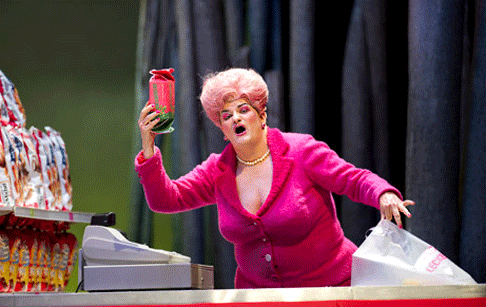 Wolfgang Ablinger-Sperrhacke as the Witch
In the absence of the full trappings of the opera house, it was essentially left to the lighting scheme to successfully evoke location and ambience. The panels encircling the raised platform variously shone ice-blue, for the loveless, foodless family home; blared gothic red for the slaughter-house kitchen; twinkled luminous silver for the moonlit forest; and gleamed verdant green for the final familial reunion. Despite these resourceful effects, it remained somewhat difficult for the minor roles to establish their character effectively, in such a large arena, although the performances of both Tara Erraught, as the Sandman, and Ida Falk Winland’s Dew-Fairy captured the ambiguous bitter-sweet mood of this production.
The children’s chorus, no doubt well-drilled for Glyndebourne, sang sweetly but looked a little unsure and slightly stilted as they moved around the confines of the stage platform. The Dream Pantomime is a clever concept though: Pelly presents a pristine parade of white-frocked, well-fed children, gorging on Big Macs while a hungry Hansel and Gretel can only dream of gluttonous gastronomy — an ‘angelic host’ which leaves the children nothing but discarded wrappers and empty bellies. As one critic has put it, this is a sharp metaphor for the ‘haves and have-nots’, a pertinent message which Pelly presumably hoped would not be lost on the affluent Glyndebourne clientele.
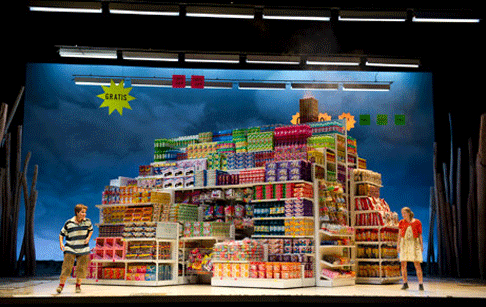 Lydia Teuscher as Gretel and Alice Coote as Hänsel
Conductor Robin Ticciati, danced light-footedly on the podium before an engaging and committed London Philharmonic Orchestra. Ticciati proved himself a master of rhythmic flexibility, skilfully controlling pace to expose the juxtapositions of sweet joy and melancholy deprivation, energetic optimism and despondent resignation, which characterise the score. The orchestra provided the tints and shades of the rich colour palette which was missing visually; their energetic playing never tipped into Wagnerian weightiness, as Ticciati conjured both the effervescence of the children’s escapade and the satisfyingly soporific moments of rest.
There were no sub- or sur-titles for this performance; thus the audience were prompted out of an habitual ‘laziness’, forced to listen closely to the sung text, or attentively follow the libretto provided in the programme, or to rely on their familiarity with this well-known tale. There were no complaints, and no difficulties, as far as I could tell; we simply rediscovered our ability to be responsive to what was presented to our eyes and ears, an effort which audiences should be pushed to make more frequently perhaps?
As the fairy-story reached its equivocal ‘happy ever after’, Ticciati’s baton drew ravishing warmth from his players. Pelly’s reading of this Grimm tale may be ironic and more than a little shadowy, but the darkness on this occasion was buried beneath the orchestral light and hope.
Claire Seymour