![Vèronique Gens as Niobe [Photo by Bill Cooper courtesy of the Royal Opera]](http://www.operatoday.com/Gens_Niobe_ROH.gif)
26 Sep 2010
Niobe, Regina di Tebe, Royal Opera
The Royal Opera is hardly renowned for its commitment to baroque opera, and even the great Handel still gets short shrift in his adopted city’s major house.
English Touring Opera are delighted to announce a season of lyric monodramas to tour nationally from October to December. The season features music for solo singer and piano by Argento, Britten, Tippett and Shostakovich with a bold and inventive approach to making opera during social distancing.
This tenth of ten Live from London concerts was in fact a recorded live performance from California. It was no less enjoyable for that, and it was also uplifting to learn that this wasn’t in fact the ‘last’ LfL event that we will be able to enjoy, courtesy of VOCES8 and their fellow vocal ensembles (more below …).
Ever since Wigmore Hall announced their superb series of autumn concerts, all streamed live and available free of charge, I’d been looking forward to this song recital by Ian Bostridge and Imogen Cooper.
Although Stile Antico’s programme article for their Live from London recital introduced their selection from the many treasures of the English Renaissance in the context of the theological debates and upheavals of the Tudor and Elizabethan years, their performance was more evocative of private chamber music than of public liturgy.
Evidently, face masks don’t stifle appreciative “Bravo!”s. And, reducing audience numbers doesn’t lower the volume of such acclamations. For, the audience at Wigmore Hall gave soprano Elizabeth Llewellyn and pianist Simon Lepper a greatly deserved warm reception and hearty response following this lunchtime recital of late-Romantic song.
For this week’s Live from London vocal recital we moved from the home of VOCES8, St Anne and St Agnes in the City of London, to Kings Place, where The Sixteen - who have been associate artists at the venue for some time - presented a programme of music and words bound together by the theme of ‘reflection’.
'Such is your divine Disposation that both you excellently understand, and royally entertaine the Exercise of Musicke.’
‘And there was war in heaven: Michael and his angels fought against the dragon; and the dragon fought and his angels, And prevailed not; neither was their place found any more in heaven … that old serpent … Satan, which deceiveth the whole world: he was cast out into the earth, and his angels were cast out with him.’
There was never any doubt that the fifth of the twelve Met Stars Live in Concert broadcasts was going to be a palpably intense and vivid event, as well as a musically stunning and theatrically enervating experience.
‘Love’ was the theme for this Live from London performance by Apollo5. Given the complexity and diversity of that human emotion, and Apollo5’s reputation for versatility and diverse repertoire, ranging from Renaissance choral music to jazz, from contemporary classical works to popular song, it was no surprise that their programme spanned 500 years and several musical styles.
The Academy of St Martin in the Fields have titled their autumn series of eight concerts - which are taking place at 5pm and 7.30pm on two Saturdays each month at their home venue in Trafalgar Square, and being filmed for streaming the following Thursday - ‘re:connect’.
The London Symphony Orchestra opened their Autumn 2020 season with a homage to Oliver Knussen, who died at the age of 66 in July 2018. The programme traced a national musical lineage through the twentieth century, from Britten to Knussen, on to Mark-Anthony Turnage, and entwining the LSO and Rattle too.
With the Live from London digital vocal festival entering the second half of the series, the festival’s host, VOCES8, returned to their home at St Annes and St Agnes in the City of London to present a sequence of ‘Choral Dances’ - vocal music inspired by dance, embracing diverse genres from the Renaissance madrigal to swing jazz.
Just a few unison string wriggles from the opening of Mozart’s overture to Le nozze di Figaro are enough to make any opera-lover perch on the edge of their seat, in excited anticipation of the drama in music to come, so there could be no other curtain-raiser for this Gala Concert at the Royal Opera House, the latest instalment from ‘their House’ to ‘our houses’.
"Before the ending of the day, creator of all things, we pray that, with your accustomed mercy, you may watch over us."
The doors at The Metropolitan Opera will not open to live audiences until 2021 at the earliest, and the likelihood of normal operatic life resuming in cities around the world looks but a distant dream at present. But, while we may not be invited from our homes into the opera house for some time yet, with its free daily screenings of past productions and its pay-per-view Met Stars Live in Concert series, the Met continues to bring opera into our homes.
Music-making at this year’s Grange Festival Opera may have fallen silent in June and July, but the country house and extensive grounds of The Grange provided an ideal setting for a weekend of twelve specially conceived ‘promenade’ performances encompassing music and dance.
There’s a “slide of harmony” and “all the bones leave your body at that moment and you collapse to the floor, it’s so extraordinary.”
“Music for a while, shall all your cares beguile.”
The hum of bees rising from myriad scented blooms; gentle strains of birdsong; the cheerful chatter of picnickers beside a still lake; decorous thwacks of leather on willow; song and music floating through the warm evening air.
The Royal Opera is hardly renowned for its commitment to baroque opera, and even the great Handel still gets short shrift in his adopted city’s major house.
So it was with some surprise that Niobe, Regina di Tebe by Agostino Steffani (first performed 1688) hit the computer screen some months ago as Covent Garden’s 2010/11 baroque offering. Many could be forgiven for muttering “what…by whom?”
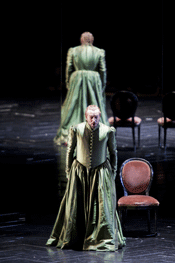 Jacek Laszczkowski as Anfione
Reading the ROH notes, it becomes clear that it was a combination of
financial expediency (a useful co-production with a recent successful track
record) and genuine appreciation of the music revealed in the 2008 revival at
the Schwetzingen Festival that encouraged the Royal Opera to add its
considerable clout to the 2010 revival performances around Europe. Leaving
aside the question of why Steffani — an admirable polymath of his time,
but hardly the baroque’s greatest opera composer — we must at least
be thankful that the ROH has been prepared to put some time and effort into
converting what was an essentially small scale festival production into
something that fits the bigger stage.
Even more important than this stage adaptation is the quality of the music and story-telling: and for this we must thank the energetic and committed Thomas Hengelbrock who as director of the period-instrument Balthazar-Neumann Ensemble has been the driving force behind the production from 2008 with his own critical edition. The same production team that enjoyed such success at Schwetzingen are responsible for the “hard gloss & soft fabric” look of the piece that on occasion seems to hark back to some of Pierre Audi’s early works with the Monteverdi operas. Exaggerated richly-hued baroque flounces and golden breast plates contrast with mirror surfaces and monumental palatial interiors. There are some very effective visual ideas that complement the richness of the scoring and the mythological elements of the libretto — be prepared for costumed fanfares, huge helium balloons and some very realistic fire effects — Steffani, with his taste for stage machinery and loud bangs, would have approved.
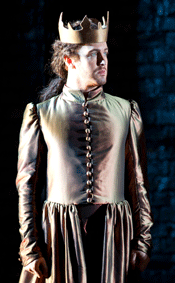 Tim Mead as Clearte
The story itself is a re-telling of the events leading up to the destruction
of the proud queen Niobe of Thebes as told by Ovid — a tale of love,
desire, pride and hubris that ends in tragedy - yet in true baroque fashion it
also confirms the ascendancy of love and honour. Niobe, soprano Veronique Gens,
is left to rule Thebes as her husband Anfione, male soprano Jacek Laszczkowski,
goes off on a sort of regal “retreat” — a bad move on his
part as Niobe has a would-be lover in the form of courtier Clearte,
countertenor Tim Mead, and another in the form of foreign prince Creonte,
countertenor Iestyn Davies. There is the almost-ubiquitous malevolent magician
of these times, Poliferno, bass Alastair Miles, plotting in the background. Add
to this the amorous sub-plot of two lesser characters, priestess Manto, soprano
Amanda Forsythe, the daughter of High Priest Tiresia, baritone Bruno Taddia,
and prince Tiberino, tenor Lothar Odinius, and season with a comic nurse
character Nerea, contralto Delphine Galou, and you have a baroque
compôte to rival any of Handel’s or Vivaldi’s. Where it
differs is that here there is no lieto fine and the final scenes are a
chilling reminder of how the gods punish the proud and foolish. Dead children
are never an easy call for opera, and the emotional punches are not pulled. The
very final scene, sung by the newly-enthroned Creonte, is both sternly
optimistic but also ambiguous.
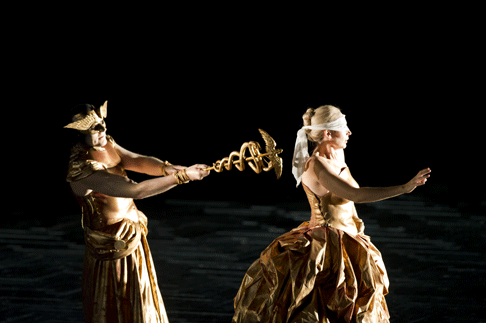 Alastair Miles as Poliferno and Véronique Gens as Niobe
The quality of the vocal writing matches the inventiveness of the music which seems to hover, musicologically, somewhere between Cavalli and early Handel. The recitatives are lyrical, the arias and duets constantly change form and texture with no one vocal style predominating. There is no aria longer than five minutes and the da capo form in its full Handelian sense is missing: this helps to drive the action forward and several set-piece arias are interrupted by another character. The orchestration is equally complex and thoroughly fascinating in its detail and richness; often a character will be assigned his or her “own” obbligato instrument - such as the nurse Nerea who sings several slightly cynical or world-weary arias with some virtuosic recorder playing echoing her complaints. Anfione is often accompanied by the smaller strings and viola da gamba. Under the confident and stylish direction of Hengelbrock, his expanded orchestra gives an object lesson in how to transfer what was an intimate festival performance in 2008 into a major house display in 2010.
The singers themselves — also mainly from the Schwetzinger production — sound and look comfortable in their music. Niobe is a perfect role for the statuesque figure and warmly lyrical soprano of Gens; she convinced totally as her voice moved from purring eroticism to agonised despair. Her husband Anfione, the reluctant king, was equally believable in the hands and voice of Laszczkowski whose male soprano worked best when he stopped the action with heartfelt prayers for harmony, love and a bit of peace and quiet. Occasional tenorial lapses were a slight problem at the bottom of his soprano range, but there is no denying the ethereal effect of his top. Of the countertenors, Iestyn Davies had the least to do vocally, but did it best. He continues to mature vocally and dramatically and his voice is an effective mix of clarity, volume and pleasing tone. Tim Mead perhaps gave more on the acting front and was a convincing besotted lover. Alastair Miles, who makes something of a habit of playing evil magicians, was nicely devious with his reliable bass as agile as ever. Is there a better baroque Mr Nasty? Delphine Galou (Nerea), Amanda Forsythe (Manto), Bruno Taddia (Tiresia) and Lothar Odinius (Tiberino) all pleased without quite approaching the levels of the principals; Forsythe has a pretty, light, soprano that struggled in the large space whilst Galou’s lightish contralto carried more easily to the back of the house.
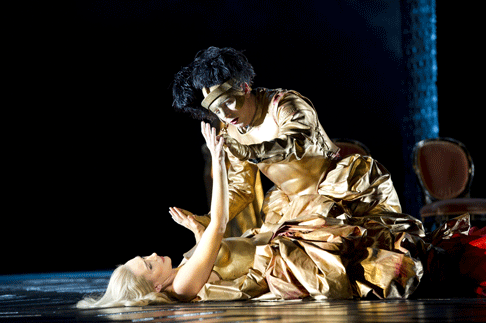 Véronique Gens as Niobe and Iestyn Davies as Creonte
Although there was not, unsurprisingly, a full house on first night, there was a noticeable lack of empty seats after the one interval, which is always a good sign with a “new” opera. Most of the audience seemed caught up with the excellence of the music and visual spectacle and were generous in their applause at curtain call. If Gens and Davies just about won the applause-stakes for the singers, then they were both beaten by a short head by the superb players of the Balthasar Neumann Ensemble in the pit. Thomas Hengelbrock looked both relieved and delighted, and so he should. The production runs to the 3rd October before transferring to Luxembourg. Recommended.
Sue Loder © 2010