08 Sep 2010
Unique Rigoletto live from Mantua
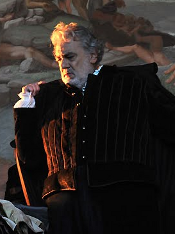
Realism never comes more authentic than this RAI Rigoletto filmed live on location in Mantua, Italy and broadcast simultaneously in 148 countries..
English Touring Opera are delighted to announce a season of lyric monodramas to tour nationally from October to December. The season features music for solo singer and piano by Argento, Britten, Tippett and Shostakovich with a bold and inventive approach to making opera during social distancing.
This tenth of ten Live from London concerts was in fact a recorded live performance from California. It was no less enjoyable for that, and it was also uplifting to learn that this wasn’t in fact the ‘last’ LfL event that we will be able to enjoy, courtesy of VOCES8 and their fellow vocal ensembles (more below …).
Ever since Wigmore Hall announced their superb series of autumn concerts, all streamed live and available free of charge, I’d been looking forward to this song recital by Ian Bostridge and Imogen Cooper.
The Sixteen continues its exploration of Henry Purcell’s Welcome Songs for Charles II. As with Robert King’s pioneering Purcell series begun over thirty years ago for Hyperion, Harry Christophers is recording two Welcome Songs per disc.
Although Stile Antico’s programme article for their Live from London recital introduced their selection from the many treasures of the English Renaissance in the context of the theological debates and upheavals of the Tudor and Elizabethan years, their performance was more evocative of private chamber music than of public liturgy.
In February this year, Albanian soprano Ermonela Jaho made a highly lauded debut recital at Wigmore Hall - a concert which both celebrated Opera Rara’s 50th anniversary and honoured the career of the Italian soprano Rosina Storchio (1872-1945), the star of verismo who created the title roles in Leoncavallo’s La bohème and Zazà, Mascagni’s Lodoletta and Puccini’s Madama Butterfly.
Evidently, face masks don’t stifle appreciative “Bravo!”s. And, reducing audience numbers doesn’t lower the volume of such acclamations. For, the audience at Wigmore Hall gave soprano Elizabeth Llewellyn and pianist Simon Lepper a greatly deserved warm reception and hearty response following this lunchtime recital of late-Romantic song.
Collapsology. Or, perhaps we should use the French word ‘Collapsologie’ because this is a transdisciplinary idea pretty much advocated by a series of French theorists - and apparently, mostly French theorists. It in essence focuses on the imminent collapse of modern society and all its layers - a series of escalating crises on a global scale: environmental, economic, geopolitical, governmental; the list is extensive.
For this week’s Live from London vocal recital we moved from the home of VOCES8, St Anne and St Agnes in the City of London, to Kings Place, where The Sixteen - who have been associate artists at the venue for some time - presented a programme of music and words bound together by the theme of ‘reflection’.
'Such is your divine Disposation that both you excellently understand, and royally entertaine the Exercise of Musicke.’
Amongst an avalanche of new Mahler recordings appearing at the moment (Das Lied von der Erde seems to be the most favoured, with three) this 1991 Mahler Second from the 2nd Kassel MahlerFest is one of the more interesting releases.
‘And there was war in heaven: Michael and his angels fought against the dragon; and the dragon fought and his angels, And prevailed not; neither was their place found any more in heaven … that old serpent … Satan, which deceiveth the whole world: he was cast out into the earth, and his angels were cast out with him.’
If there is one myth, it seems believed by some people today, that probably needs shattering it is that post-war recordings or performances of Wagner operas were always of exceptional quality. This 1949 Hamburg Tristan und Isolde is one of those recordings - though quite who is to blame for its many problems takes quite some unearthing.
There was never any doubt that the fifth of the twelve Met Stars Live in Concert broadcasts was going to be a palpably intense and vivid event, as well as a musically stunning and theatrically enervating experience.
‘Love’ was the theme for this Live from London performance by Apollo5. Given the complexity and diversity of that human emotion, and Apollo5’s reputation for versatility and diverse repertoire, ranging from Renaissance choral music to jazz, from contemporary classical works to popular song, it was no surprise that their programme spanned 500 years and several musical styles.
The Academy of St Martin in the Fields have titled their autumn series of eight concerts - which are taking place at 5pm and 7.30pm on two Saturdays each month at their home venue in Trafalgar Square, and being filmed for streaming the following Thursday - ‘re:connect’.
The London Symphony Orchestra opened their Autumn 2020 season with a homage to Oliver Knussen, who died at the age of 66 in July 2018. The programme traced a national musical lineage through the twentieth century, from Britten to Knussen, on to Mark-Anthony Turnage, and entwining the LSO and Rattle too.
With the Live from London digital vocal festival entering the second half of the series, the festival’s host, VOCES8, returned to their home at St Annes and St Agnes in the City of London to present a sequence of ‘Choral Dances’ - vocal music inspired by dance, embracing diverse genres from the Renaissance madrigal to swing jazz.
Just a few unison string wriggles from the opening of Mozart’s overture to Le nozze di Figaro are enough to make any opera-lover perch on the edge of their seat, in excited anticipation of the drama in music to come, so there could be no other curtain-raiser for this Gala Concert at the Royal Opera House, the latest instalment from ‘their House’ to ‘our houses’.
"Before the ending of the day, creator of all things, we pray that, with your accustomed mercy, you may watch over us."
Realism never comes more authentic than this RAI Rigoletto filmed live on location in Mantua, Italy and broadcast simultaneously in 148 countries..
Verdi’s stage directions are so faithfully followed that the performance took place over two days. Just as Verdi indicated, each Act unfolds at the correct time of day, in the places indicated in the libretto. Ultimate veracity to script.
No ordinary theatre has the capacity to create a production as loyal to the composer’s instructions as this. This is the real Palazzo Ducale di Mantova. No two dimensional theatre set could hope to replicate the possibilities filming in real space can offer. The Palace is a maze of different buildings connected by alleyways and courtyards. A metaphor for the complex relationships within the Court, where nothing is quite as simple as might seem.
Real Renaissance staircases and hallways, real marble parquets. Frescoes painted by 15th and 16th century masters. Real antique tapestries and furniture. No opera house workshop would even dream of competing with Mantegna or Corregio. Design doesn’t get more perfect than this.
Yet the production resists the temptation to linger on these riches. The focus is resolutely on the opera itself, which is as it should be. Film offers possibilities which expand the impact of any opera. At the ball in Act One, for example, the camera shoots the dancers from above, so we can appreciate the intricate choreography. It’s not just for show, since intrigue at Court is like a dance, with death for those out of step. Rigoletto mocks Count Monterone but soon it will be his own turn to be trounced.
Film enables commentary without interrupting action. Plácido Domingo runs from the courtiers into the room with the famous Mantegna ceiling, painted to look as it if opens onto the sky. It’s trompe l’oeil, deliberate illusion, reversing the natural order. The Dukes of Mantua looked on it as a joke. Rigoletto has no illusions. For him, life is a bad joke. He has to play the fool to survive. Domingo’s face twists in anguish, but for a moment his head is framed against Mantegna’s golden circle, like a halo.
Similarly, the film adds to the portrayal of Gilda. The character’s a mystery. She’s her father’s daughter because she’s inherited his extreme personality. Ten years ago, Christine Schäfer created a Gilda who exploded with passionate heroism. Julia Novikova is much too young and inexperienced to attempt such intensity. Instead Director Marco Bellochio makes her innocence a positive feature. She’s filmed in a room of Lucca della Robbia medallions, depicting the Madonna and Infant Jesus. Gilda’s grown up in isolation. Her only references to life come from religion. Other girls might be wary of blind faith, love, sacrifice and death, but Gilda never questions. The very purity Rigoletto hoped would protect her becomes his defeat.
Plácido Domingo chooses to sing Rigoletto perhaps because the tessitura in the first Act lies close enough to his range that it’s not much of a challenge. Later, when the part darkens, he relies more on the integrity of his acting. Rigoletto is growing old, ravaged by a lifetime of pretending to be what he isn’t. Domingo’s growing old, too, at last able to release his “Inner baritone” not so much through vocal perfection but through the authenticity of his acting.
His performance is artistically valid because he’s creating the character intuitively. Film helps moderate the experience, focusing close-up on his mobile facial muscles, so expressive that even if his vocal chords aren’t what they were, you’re drawn through other means to a true portrayal of Rigoletto’s personality.
Vittorio Grigolo, hot new favourite, comes over very well indeed as the Duke of Mantua. He’s a film natural, good looking and sexy, moving as if he inhabits this set like he was born to it. Interesting warm voice, with potential.
Faithful as this production is to script, following directions too literally leads to problems in Act Three. Verdi wanted a night-time atmosphere but being too literal means the action is fatally obscured. Ruggerio Raimondi’s Sparafucile impresses because he’s indoors where there’s light, an interesting reversal of his first appearance in the dark alley.
The final scene, where Rigoletto finds his daughter again is too shrouded. On conventional stage, it would be completely lost. Here, it’s done via close-ups that can be easily lit. In a sense it’s psychologically true, since Rigoletto is now truly alone, but it doesn’t make for good theatre.
Producer Andrea Alderman and this team created the 1992 Tosca filmed on location in Rome, with Domingo as Cavaradossi and Ruggerio Raimondi as Scarpia. Twenty years on, technology and telecommunications are much more sophisticated. Still, the logistics are such that it’s amazing there weren’t more technical hitches, especially as this was live, with no room for correction.
Zubin Mehta didn’t conduct at the scene where the singing was being filmed. He and the orchestra were in the building nearby, so there was simultaneous transmission, apparently by state of the art techniques, between orchestra, singers and film crew. It’s certainly not unusual these days for performers to communicate via TV monitors, so the slight discord between Mehta’s pace and the singing stemmed more from his tempi than from the medium itself.
This film, in any case, isn’t supposed to replicate studio conditions. Nowadays, operas aren’t filmed in sterile conditions, but as they happen on stage (even if they’re carefully edited). There are compensations, like greater spontaneity, which are closer to real experience in an opera house, where things aren’t necessarily perfect every time. Films like these are an extension of the process.
Imagine the technical, legal and logistic nightmares that were involved making this. Insurance and government clearance must have been hard to negotiate. International simultaneous broadcast to organize. The wonder is that more didn’t go wrong.
We can see stage performances of Rigoletto any time, but we’ll never see another production quite like this. This ambitious venture is unique.
Anne Ozorio
Click here for a video clip.
Click here for a photo array of this production.