16 Oct 2010
Jephtha, New York
Jephtha was Handel’s last work — he went blind while composing it, noting this on the manuscript, and though he lived another seven years, did not deign to dictate new music.
English Touring Opera are delighted to announce a season of lyric monodramas to tour nationally from October to December. The season features music for solo singer and piano by Argento, Britten, Tippett and Shostakovich with a bold and inventive approach to making opera during social distancing.
This tenth of ten Live from London concerts was in fact a recorded live performance from California. It was no less enjoyable for that, and it was also uplifting to learn that this wasn’t in fact the ‘last’ LfL event that we will be able to enjoy, courtesy of VOCES8 and their fellow vocal ensembles (more below …).
Ever since Wigmore Hall announced their superb series of autumn concerts, all streamed live and available free of charge, I’d been looking forward to this song recital by Ian Bostridge and Imogen Cooper.
Although Stile Antico’s programme article for their Live from London recital introduced their selection from the many treasures of the English Renaissance in the context of the theological debates and upheavals of the Tudor and Elizabethan years, their performance was more evocative of private chamber music than of public liturgy.
Evidently, face masks don’t stifle appreciative “Bravo!”s. And, reducing audience numbers doesn’t lower the volume of such acclamations. For, the audience at Wigmore Hall gave soprano Elizabeth Llewellyn and pianist Simon Lepper a greatly deserved warm reception and hearty response following this lunchtime recital of late-Romantic song.
For this week’s Live from London vocal recital we moved from the home of VOCES8, St Anne and St Agnes in the City of London, to Kings Place, where The Sixteen - who have been associate artists at the venue for some time - presented a programme of music and words bound together by the theme of ‘reflection’.
'Such is your divine Disposation that both you excellently understand, and royally entertaine the Exercise of Musicke.’
‘And there was war in heaven: Michael and his angels fought against the dragon; and the dragon fought and his angels, And prevailed not; neither was their place found any more in heaven … that old serpent … Satan, which deceiveth the whole world: he was cast out into the earth, and his angels were cast out with him.’
There was never any doubt that the fifth of the twelve Met Stars Live in Concert broadcasts was going to be a palpably intense and vivid event, as well as a musically stunning and theatrically enervating experience.
‘Love’ was the theme for this Live from London performance by Apollo5. Given the complexity and diversity of that human emotion, and Apollo5’s reputation for versatility and diverse repertoire, ranging from Renaissance choral music to jazz, from contemporary classical works to popular song, it was no surprise that their programme spanned 500 years and several musical styles.
The Academy of St Martin in the Fields have titled their autumn series of eight concerts - which are taking place at 5pm and 7.30pm on two Saturdays each month at their home venue in Trafalgar Square, and being filmed for streaming the following Thursday - ‘re:connect’.
The London Symphony Orchestra opened their Autumn 2020 season with a homage to Oliver Knussen, who died at the age of 66 in July 2018. The programme traced a national musical lineage through the twentieth century, from Britten to Knussen, on to Mark-Anthony Turnage, and entwining the LSO and Rattle too.
With the Live from London digital vocal festival entering the second half of the series, the festival’s host, VOCES8, returned to their home at St Annes and St Agnes in the City of London to present a sequence of ‘Choral Dances’ - vocal music inspired by dance, embracing diverse genres from the Renaissance madrigal to swing jazz.
Just a few unison string wriggles from the opening of Mozart’s overture to Le nozze di Figaro are enough to make any opera-lover perch on the edge of their seat, in excited anticipation of the drama in music to come, so there could be no other curtain-raiser for this Gala Concert at the Royal Opera House, the latest instalment from ‘their House’ to ‘our houses’.
"Before the ending of the day, creator of all things, we pray that, with your accustomed mercy, you may watch over us."
The doors at The Metropolitan Opera will not open to live audiences until 2021 at the earliest, and the likelihood of normal operatic life resuming in cities around the world looks but a distant dream at present. But, while we may not be invited from our homes into the opera house for some time yet, with its free daily screenings of past productions and its pay-per-view Met Stars Live in Concert series, the Met continues to bring opera into our homes.
Music-making at this year’s Grange Festival Opera may have fallen silent in June and July, but the country house and extensive grounds of The Grange provided an ideal setting for a weekend of twelve specially conceived ‘promenade’ performances encompassing music and dance.
There’s a “slide of harmony” and “all the bones leave your body at that moment and you collapse to the floor, it’s so extraordinary.”
“Music for a while, shall all your cares beguile.”
The hum of bees rising from myriad scented blooms; gentle strains of birdsong; the cheerful chatter of picnickers beside a still lake; decorous thwacks of leather on willow; song and music floating through the warm evening air.
Jephtha was Handel’s last work — he went blind while composing it, noting this on the manuscript, and though he lived another seven years, did not deign to dictate new music.
That’s a pity, because Jephtha’s musical and dramatic structures indicate that a closer intertwining of staged drama and static oratorio was coming into being: Chorales are fewer and less involved in the action than in the earlier oratorios, and the action includes a remarkable quartet of conflicting points of view at a moment of high tension, almost unprecedented in Handelian drama and pointing the way to Mozart and Rossini. Characters state their feelings in da capo arias, as one expects, but alternate such static reveries with soliloquies in recitative accompanied by full orchestra or the occasional duet. The characteristic emotions and tunes we know from Handel are here, but new expressive tools are brought to their aid. After forty years in the business, the great man hadn’t run out of, or even low on, new ideas.
The story, though Biblical, resembles the Idomeneo legend familiar to us from Mozart’s opera (Bible stories could not be staged in England before the twentieth century): Israel’s General Jephtha has vowed, if successful in battle, to sacrifice the first creature he encounters on his return. To his embarrassment, the creature who emerges to welcome him is his daughter. He squirms, he bargains, he considers alternatives — but a vow’s a vow. However, like Neptune (in Idomeneo’s case), Jehovah lets him off the hook: An angel suggests that Iphis, the general’s daughter, be offered to perpetual virginity as a Jewish nun, in effect, and that an animal be sacrificed instead. In the Bible, actually, relentless Jephtha sacrifices his daughter, but Handel’s version recalls the tale of Abraham’s “sacrifice” of Isaac. In any case, the unhappy ending would have had unpleasant political ramifications in Handel’s day, when the rationalists were dwelling on such tales to discredit religion generally. Handel, devout believer and lifelong optimist, pulls it off convincingly, and few among his usual audience today are likely to spot the change. Only Iphis’s boyfriend remains unhappy.
St. Ignatius Loyola, Manhattan’s Jesuit church, is an edifice in the style of a great Roman basilica, with porphyry columns, faux marble panels, frescos of the saint’s life, death and apotheosis and a rather muddy acoustic: A small chorus and orchestra (always preferable for Handel) booms down the long nave to Park Avenue, but individual voices and instruments are not as clear as one might like and soloists seemed to lose their clarity at one end or another of their range. Conductor Kent Tritle’s rhythms were happily vivid, and the three lengthy acts passed swiftly to the exciting conclusion.
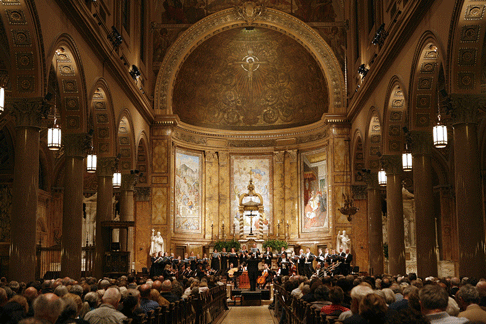 St. Ignatius Loyola
The singers made rather an able than a striking set. Thomas Cooley, in the emotionally awkward title role, sounded too light for the martial persona in the first act but gained strength and bite as the catastrophe of his ineluctable choice came home to him. Charlotte Daw Paulsen has some splendid maternal contralto notes but her voice thinned to a strand above them. Ian Howell, singing Iphis’s boyfriend, a role Handel wrote for a mezzo soprano, is an adept countertenor without the mezzo power or sensuousness one might desire. Kelly Markgraf has a pleasing and agile bass but had very little to do as Jephtha’s brother.
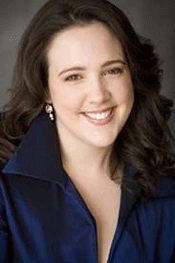
Vocally the occasion would have been professional but little more had not Susanna Phillips sung Iphis, the designated sacrifice, whose arias must present her as a spirited warriors’ cheerleader, a devoted daughter, a fearful suppliant, and a willing martyr by turns. Phillips, who has been garnering lots of attention lately, proved worthy of it: she has an even, flexible voice with a goodly heft to it, shining power in the upper range and no less force and beauty in lower tones. (Handel never wastes part of a voice — he expects his singers to use it all.) Phillips gave a radiant performance, and by the very fact of singing so well throughout her compass disproved any suspicions that St. Ignatius’s acoustics were kinder to certain ranges of sound than others. Her only failing is a certain imprecision in swift ornament — she has, for instance, no trill, and Handel often calls for one. The quality of her soprano is so thrilling and her musicianship so steady that I hope to encounter it often. She will sing Pamina at the Met this winter; she should be adorable in that adorable (and not too ornamental) part.
John Yohalem